
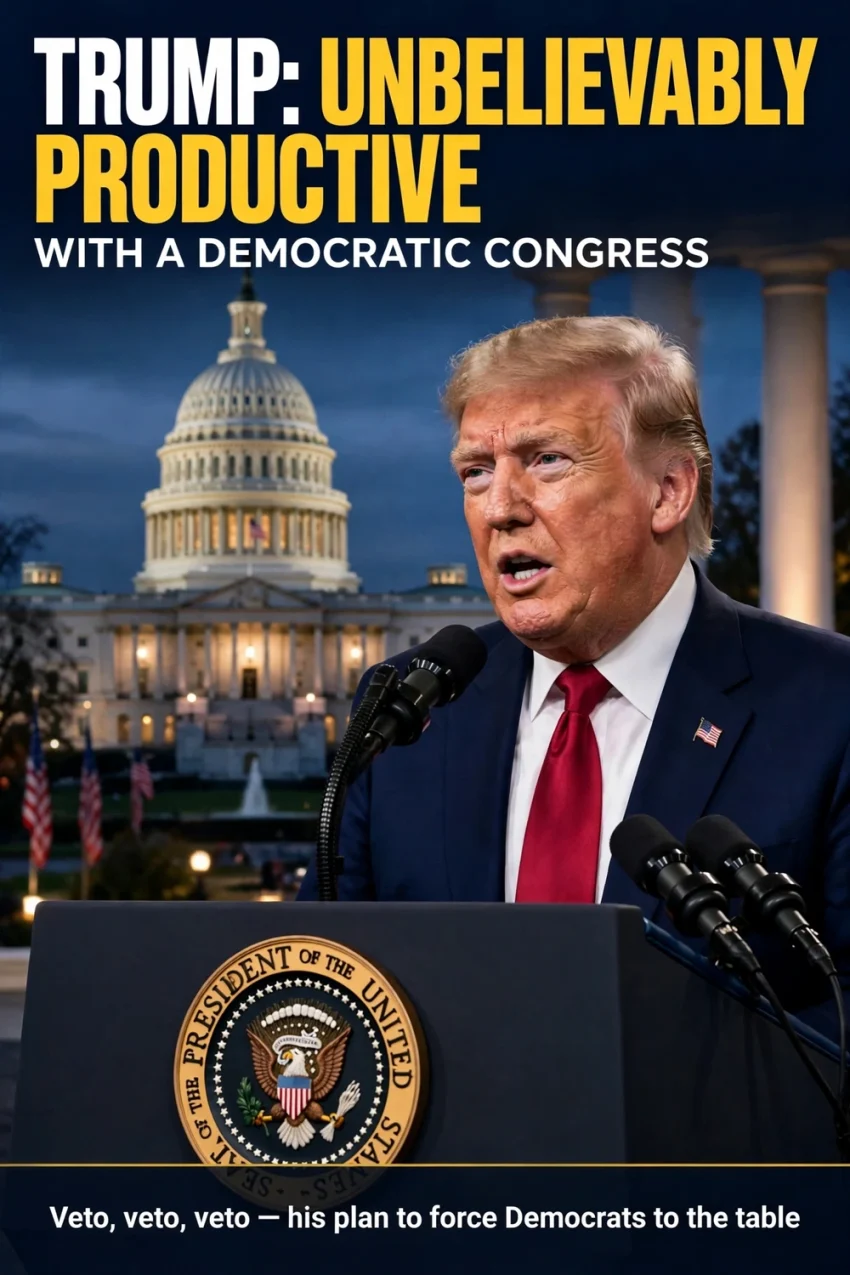
The Trump Democratic Congress prediction is the President’s own: Donald Trump says he expects to be more productive with the incoming Democratic Congress than he was with the Republican-led Congress of the first two years of his second term. His reason is blunt — the veto.
In a Fox News interview recorded in Shenzhen, China, during the APEC summit and aired on Wednesday night, Trump said Democrats are already calling him to make deals, because he holds the power to block anything they send him. “I have a feeling that this is going to be an unbelievably productive two years,” he said. “They’ll send me a bill on health care, and I’ll say, ‘No way,’ and I’ll veto it. And then they’ll call me and they’ll say — and we’ll sit down. And that’s what I do.”
It is a striking claim from a president whose party has just lost both chambers of Congress. Whether it is confidence, spin or a genuine strategy will be tested in January 2027, when the new Congress takes over — and when the same Democratic leaders Trump wants to deal with are also promising investigations of his administration.
What Trump actually said
The interview was conducted by Fox News senior White House correspondent Jacqui Heinrich and aired on “The Ingraham Angle” on Wednesday night. Most outlets reported it on Thursday 19 November. The Hill’s report of the interview quotes Trump directly:
“I have a feeling that this is going to be an unbelievably productive two years. They’ll send me a bill on health care, and I’ll say, ‘No way,’ and I’ll veto it. And then they’ll call me and they’ll say — and we’ll sit down. And that’s what I do.”
He added: “I think I can do, in many ways, better now.” And: “I respect them. They won. Politics is a nasty game, and they won.” Trump said he has been “called by many Democrats” — “at a level that is pretty amazing… the top of the line” — seeking deals. He did not name any of them, so no specific Democrat should be reported as having called him. The claim is his, and it is unattributed.
He named the veto and the pardon as “two very powerful powers of president” and said of Democratic legislation: “They do all the bills they want; I just go veto, veto, veto.” He said he will invite Democratic leaders to the White House to negotiate and plans to negotiate in good faith. Health care is his example of how the process would work: Democrats send a bill, he vetoes it, they call, and they sit down and deal.
How the veto works — and why it is leverage
The veto is the centre of Trump’s argument, and it is worth explaining in plain English, because it is also the reason his prediction is more than bravado.
When Congress passes a bill, the President can sign it or veto it. If he vetoes it, the bill only becomes law if both chambers override the veto with a two-thirds majority. Democrats won the House and Senate in the 3 November 2026 midterms, with a projected 56–44 Senate majority — a majority, but not a two-thirds majority. That is the maths that makes Trump’s position work: Democrats can pass what they like, but they cannot override his veto on their own.
That is why the veto is leverage rather than just a block. A vetoed bill is a dead bill unless the other side comes to the table. That is the whole logic of the Trump Democratic Congress pitch: the sequence — bill, veto, phone call, negotiation — will produce deals that the Republican Congress never produced.
Trump Democratic Congress: deals or investigations?
The tension at the heart of the Trump Democratic Congress story is that the incoming Democratic leaders are promising two things at once: deals and investigations. Trump is talking about the first. Democrats are loudly promising the second.
Incoming House leader Hakeem Jeffries is in line to become Speaker when the new Congress convenes in January 2027. Democratic leaders have promised wide-ranging investigations of the administration. Jeffries has warned Democrats are ready to investigate “everyone” in what he called the “MAGA extremist movement”, according to Political.org. Our report on the House Democrats’ Trump investigations sets out the four probes already under way, including the preservation letters sent to a dozen Trump allies.
That is the collision course. A president who wants to negotiate health care and other bills with Democratic leaders who are simultaneously preparing to investigate him, his family business and his administration. No deal has been agreed — this is a prediction about January 2027, not an event — and it would be wrong to claim Democrats will cooperate.
There is one concrete area of agreement already on the record. In the same interview, Trump named a federal tax incentive for film and television production, designed to stop shoots moving to the UK, Canada and Australia. Democratic Sen. Adam Schiff of California has publicly backed the idea. It is a small item, but it is the only specific policy both sides have already endorsed.
The interview also covered the week’s tech outages. Trump told Americans to “relax”, saying “these are individual events”, according to Brussels Signal’s report.
Why Trump needs a deal: the polling
There is a reason beyond strategy for Trump’s pitch — the numbers. National exit polls cited by Political.org found only 38% approved of Trump’s job performance, and 63% blamed the president for higher prices. A separate post-election poll put his approval at 31%. Those are different polls and should not be presented as a single settled number, but the direction is consistent.
That cost-of-living pressure is the same backdrop driving the rest of the week’s news. Our report on the Federal Reserve’s expected December rate hike sets out how borrowing costs are set to rise again — the economic reality behind the 63% figure.
What happens next
- 20 November 2026 — Trump returns to Washington from Asia; White House news conference at noon.
- 30 November 2026 — Congress returns from the Thanksgiving recess; government funding expires 11 December.
- January 2027 — New Congress convenes; Jeffries in line to become Speaker; investigations begin; the veto-first strategy gets its first test.
- Early 2027 — First Democratic bills reach the President’s desk — health care first, by Trump’s own account — and the veto-or-deal sequence begins.
Trump’s prediction will be judged quickly. The Trump Democratic Congress test begins in January: if the first Democratic bills are vetoed and then negotiated into law, he will say he was right. If they are vetoed and nothing follows — or if investigations swallow the relationship — the “unbelievably productive two years” will read very differently.
Will Trump work productively with the Democratic Congress?
- YES
- NO
- NOT SURE
This poll is not a scientific survey. Results show the views of readers who chose to vote on this page.
Sources
- The Hill (Tara Suter), “Donald Trump signals he can do better with Democrats leading Congress next year than GOP”, 19 November 2026.
- AP report via Zark News, “Trump Says Democrats Are Already Calling Him to Make Deals, and He Expects a Productive Two Years With Their Congress”, 19 November 2026.
- Brussels Signal, “Trump tells Americans to ‘relax’ as tech-outages fuel stockpiling fears”, 19 November 2026.
- The Washington Sun, “Trump Says He’ll Be More Productive With a Democratic Congress”, 19 November 2026.
3 thoughts on “Trump: ‘Unbelievably Productive’ With Democratic Congress”