
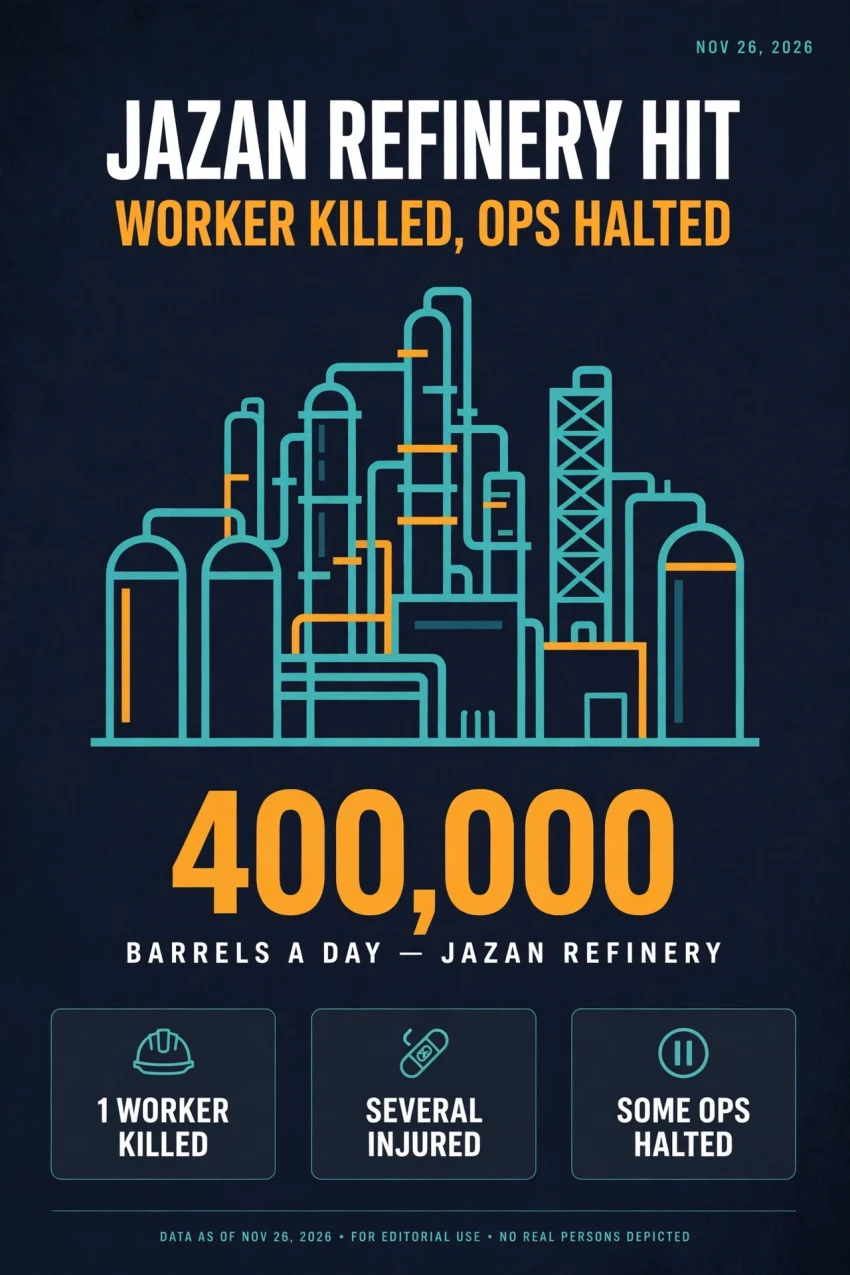
A projectile struck Saudi Aramco’s refinery in Jazan on Thursday, 26 November, killing a Nepalese worker, injuring several others and temporarily halting some operations at the 400,000-barrel-a-day plant on Saudi Arabia’s Red Sea coast. The Houthi Jazan refinery attack is the second Saudi refinery targeted in two days — and the first confirmed refinery hit of this round of fighting, after the Houthis’ claim of a strike on the kingdom’s largest refinery at Ras Tanura a day earlier remains unconfirmed. A fire broke out at the Jazan facility and has been brought under control, the Saudi Energy Ministry said, while emergency and technical teams assess the damage.
Table of Contents
Houthi Jazan refinery attack: what the Energy Ministry confirmed
The Energy Ministry said in a statement carried by the Saudi Press Agency that a hostile aerial projectile hit the refinery in the Jazan region on Thursday, causing a fire that has since been brought under control and leading to the temporary suspension of some of the refinery’s operational activities. According to preliminary information, the ministry said, the attack killed a Nepalese worker and left several others of various nationalities with injuries of varying severity. The injured are receiving medical care, and the ministry expressed condolences to the family of the worker who died and wished the injured a speedy recovery.
The ministry’s statement did not identify who fired the projectile. That restraint matters, because the one fact nobody disputes is the damage itself: a worker is dead, others are hurt, a fire burned at a major refinery, and part of the plant stopped working. Emergency teams and specialist technical crews responded immediately after the strike, the ministry said, and work is under way to assess the damage and verify the safety of the facilities in coordination with the relevant authorities. No timetable has been given for restoring full operations, and no estimate of the damage has been published.
The Jazan refinery sits in Saudi Arabia’s far southwest, close to the Yemeni border, and is designed to process up to 400,000 barrels of crude oil a day. Its position makes it one of the most exposed pieces of Saudi energy infrastructure in the current fighting — a large, fixed, coastal target within reach of projectiles fired from Houthi-held territory across the border. The plant is run by Aramco, the state oil company. CNN reported that it had approached Aramco for comment; no Aramco statement on the strike had been issued at the time of publication.
Who the coalition blames — and its answer in Hodeidah
The Saudi-led coalition fighting Yemen’s Houthis said earlier on Thursday that the Houthis had attacked the refinery, attributing the strike to the Iran-aligned group even though the Energy Ministry’s own statement named no attacker. Later on Thursday, the coalition said its forces had destroyed a ballistic-missile launch platform in Yemen’s Hodeidah governorate, which it said the Houthis had used to stage the attack on the refinery. That claim about the launch platform comes from the coalition alone and has not been independently verified.
The distinction between what the ministry confirmed and what the coalition claimed is worth keeping straight. The strike, the death, the injuries, the fire and the halted operations are confirmed by the Saudi government itself. The identity of the attacker rests on the coalition’s statement, and the destruction of the Hodeidah launch platform rests on the coalition’s word as well. Neither has been confirmed by an independent source. The Houthis have not been reported as issuing a claim of responsibility for the refinery strike itself, in contrast to their public claims about the port attacks a day earlier. Readers should treat the attribution as the coalition’s account, not as an established fact, until further evidence appears. Until then, the Houthi Jazan refinery attack should be reported as a confirmed strike with a claimed attribution, not as a proven Houthi operation.
The coalition also condemned the strike and threatened a counterattack. That language, combined with the reported Hodeidah platform strike, points to further retaliation — the same pattern seen all week, in which each attack has drawn a military answer within hours.
A second refinery in 24 hours — but only one confirmed hit
The Jazan strike came a day after the Houthis claimed to have hit Ras Tanura, home to Saudi Arabia’s largest refinery and a major crude export hub on the Gulf coast, and the Red Sea ports of Jeddah and Jazan. Of those claims, only the Jizan port hit has been confirmed: a projectile struck Jizan port on 25 November, causing minor damage and no civilian casualties, the coalition said. A drone over Jeddah port was intercepted and destroyed, and ballistic missiles aimed at Riyadh were intercepted. No hit at Jeddah has been confirmed, and no damage at Ras Tanura has been confirmed either — the coalition said it destroyed four drones over Ras Tanura on Wednesday morning, with fragments falling and no injuries in an initial assessment, while the Houthis claimed a direct strike and fires at the refinery. No Aramco statement has been issued on Ras Tanura, and no operational impact there has been verified.
That is why the Houthi Jazan refinery attack changes the picture. Until Thursday, the Houthis’ refinery claims were just that — claims, with interceptions and denials on the Saudi side. Now there is a confirmed refinery hit with a death, injuries, a fire and halted operations. The Houthi Jazan refinery attack proves that Saudi energy infrastructure on the Red Sea coast can be reached and damaged, not merely threatened. It also raises the stakes for every further claim: traders, shippers and governments will now treat the next Houthi claim about a refinery as a serious possibility rather than rhetoric, at least until Saudi defences show otherwise.
Four days of escalation: how the week built to Jazan
The Houthi Jazan refinery attack did not come out of nowhere. It is the latest step in a rapid escalation that began on Tuesday, 24 November, when a Houthi drone attack hit the PIF Tower in Riyadh, injuring 11 people. On Wednesday morning, the Saudi-led coalition answered with strikes on Hodeidah, the Yemeni Red Sea port city that feeds Houthi-held northern Yemen. Hours later the Houthis claimed strikes on the Saudi ports of Jizan and Jeddah and on Ras Tanura, and the coalition confirmed the Jizan port hit while reporting the Jeddah and Riyadh interceptions. On Thursday, the focus moved from ports to refineries — and from claims to a confirmed kill at a refinery.
The pattern is a tit-for-tat cycle with a widening target list. Ports on Wednesday, a refinery on Thursday. Each side answers the other’s strike within hours, and each answer reaches a little further into the other’s most valuable infrastructure. The Houthis are showing they can hit Saudi energy and port facilities on two coasts — the Gulf at Ras Tanura, claimed but unconfirmed, and the Red Sea at Jizan port and now the Jazan refinery, both confirmed. The coalition is showing it will strike back in Yemen, at Hodeidah and elsewhere, just as fast.
The regional picture widened further on Thursday, when a drone attack in Kuwait killed two Italian technicians at an air defence site — an attack Italy and Kuwait blame on Iran, which denies responsibility. That strike is a separate event from the Jazan refinery attack, but it belongs to the same week of escalation across the Gulf, and it underlines how quickly a Yemen-centred fight is pulling in other countries and other actors. The Houthis, Iran and the Gulf states are now entangled in a single, fast-moving confrontation, and the Jazan refinery is its latest flashpoint.
Oil markets: risk priced in, supply not yet cut
Brent crude rose 2.4 percent to 93.60 dollars a barrel on Wednesday after the Jizan port strike, and oil prices ticked up again on Thursday as the Houthis stepped up attacks on Saudi Arabia and Iran kept up its threats around the Strait of Hormuz. No confirmed interruption to oil deliveries has been reported from Jazan, and the refinery’s halted operations are described as a temporary suspension of some activities, not a shutdown of the plant. The market, in other words, is pricing risk rather than a realised supply cut — just as it did after the port strike.
The Houthi Jazan refinery attack has moved prices without cutting supply — but that could change quickly. If the damage assessment shows a longer outage, or if a second refinery is confirmed hit, traders will start pricing a real loss of refining capacity rather than a warning. The Jazan plant’s 400,000 barrels a day is a significant slice of Saudi refining, and a prolonged halt would matter well beyond the kingdom. For now, though, the honest reading is the same as after Jizan port: a serious incident, a real casualty, a real fire — but no verified cut to the oil flowing out of Saudi Arabia.
The attacks have already had practical effects beyond the oil market. Previous strikes in this round temporarily disrupted some Aramco operations and led to the cancellation of most international flights to Riyadh, according to Al Jazeera’s reporting. Shipping through the Red Sea is watching every claim and interception for signs that the corridor itself is becoming unsafe, and insurers and shipowners will be reading the damage assessment from Jazan closely.
What to watch next
Five things would change this story. First, the Aramco damage assessment: how much of the Jazan refinery is halted, and for how long. Second, an Aramco statement on Ras Tanura, which would settle whether Wednesday’s claim was real or empty. Third, the coalition’s next retaliation — the Hodeidah platform strike may not be the end of it. Fourth, any Houthi statement claiming the refinery attack or threatening the next target, which would clarify intent and attribution. And fifth, any new warning from maritime authorities for Red Sea shipping, or any sign that oil loadings at Saudi terminals have been affected.
Until one of those arrives, the verified record stands: a projectile hit the Jazan refinery on Thursday, a Nepalese worker was killed, several people were injured, a fire was brought under control, and some operations were temporarily halted. The coalition blames the Houthis and says it destroyed the launch platform used in the attack. The Houthi Jazan refinery attack is the first confirmed refinery hit of this escalation — and the clearest sign yet that the fight has moved from threats and claims to deadly damage at the heart of Saudi Arabia’s energy infrastructure.
(Poll results are reader opinion, not scientific.)