
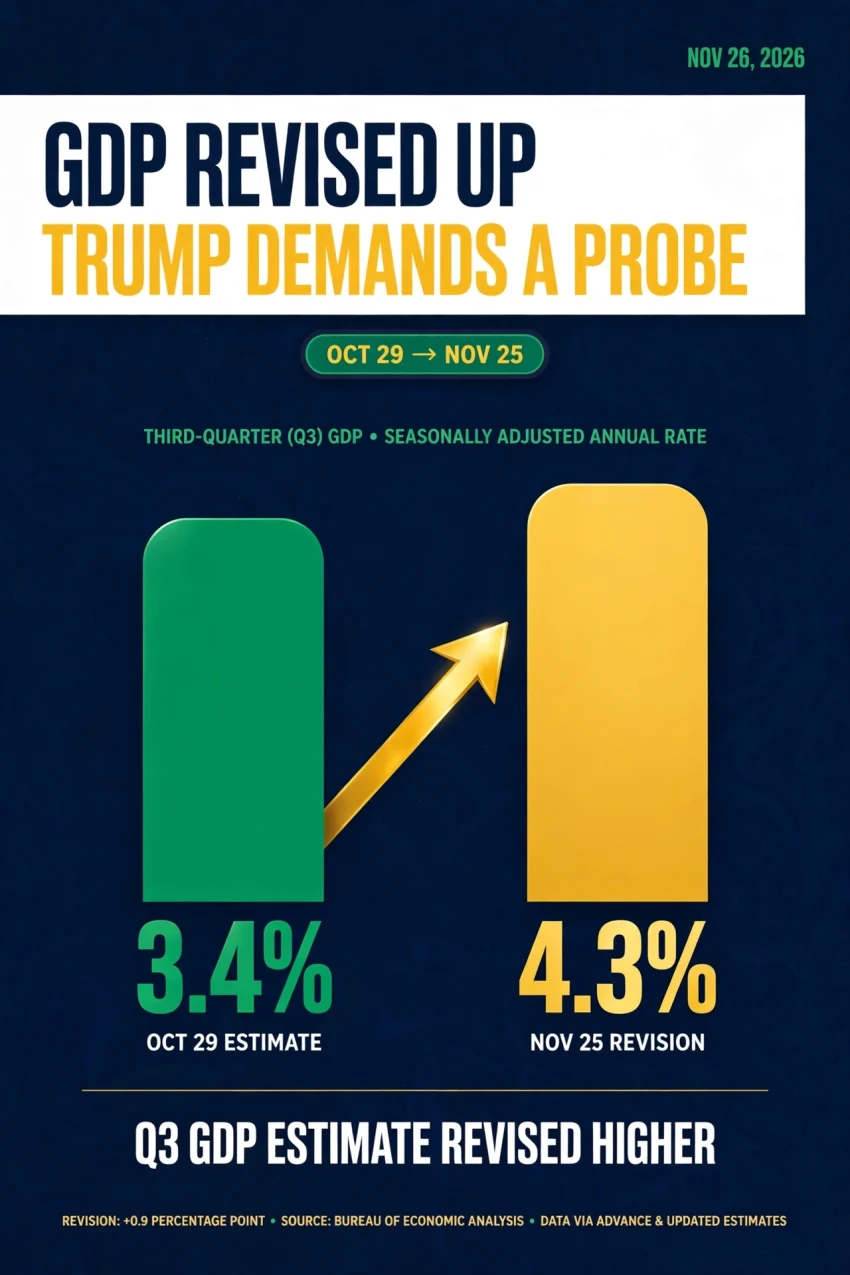
On Thanksgiving Day, President Donald Trump demanded an immediate investigation into his own Commerce Department, accusing it of publishing “fake” economic growth figures before the November 3 midterm elections. The demand came a day after the department’s Bureau of Economic Analysis (BEA) revised third-quarter growth up to 4.3% from an advance estimate of 3.4% — a correction Trump called “a massive, and purposeful, error” in a Truth Social post, without offering evidence. The Trump GDP probe demand is now the latest flashpoint in the president’s long-running confrontation with official economic data, and it raises a question the numbers alone cannot answer: was this a routine statistical revision, or something that needs investigating?
The answer matters beyond politics. Gross domestic product figures guide business investment, financial markets and the Federal Reserve’s decisions. If the public stops trusting the numbers, every decision built on them gets harder. That is why the details of what the BEA changed, when it changed it, and what Trump actually alleged deserve a careful look — separated, as always, from what has not been shown.
Table of Contents
Trump GDP probe: what the president demanded
Trump’s demand was posted on Truth Social on Thursday, November 26. “It was just revealed that the REAL Numbers on the Economy, published before the Election, were FAKE, and a correction was issued yesterday by the people in the Government Agency that does these numbers,” he wrote. “Why wasn’t the correct number issued before the Election? I am asking for an immediate investigation of this situation.”
He went further in the same post, calling the gap between the two estimates “a massive, and purposeful, error” and adding: “This is not a small error, this is a massive, and purposeful, error.” In a separate Thanksgiving post on the same platform, he wrote that the American economy under his administration “is doing FAR BETTER than the good numbers already released” and that “Third Quarter GDP Growth has now been corrected to be 4.3%, instead of 3.4%, a major difference!”
Trump did not say who should conduct the investigation or what form it should take, and he offered no evidence that officials deliberately understated growth. Reuters, reporting the demand on November 26, noted that he made the allegation “without providing evidence”. The Associated Press described him as “suggesting without evidence a conspiracy within the government” to report the revised figures after the midterms. The BEA did not immediately respond to a request for comment.
The 4.3% revision: what the BEA actually changed
The Trump GDP probe centres on a revision the BEA published on Wednesday, November 25, in its second estimate of third-quarter growth. The agency raised annualised growth to 4.3%, up 0.9 percentage points from the 3.4% advance estimate it had announced on October 29. The BEA said the revision “primarily reflecting upward revisions to investment and consumer spending”, as more complete source data became available.
The advance estimate had itself beaten expectations: the 3.4% reading came in above a 3.2% consensus forecast. The 0.9-point upward move is larger than the BEA’s average advance-to-second revision, but smaller than its 1.3-point average move from advance estimate to latest estimate, according to analysis of BEA data. In other words, revisions of this size are unusual but not unprecedented — they are a known feature of how the figures are built, not a sign of manipulation on their own.
The BEA routinely publishes three scheduled estimates for each quarter — an advance reading, a second estimate and a third estimate — with the final third-quarter reading due on December 23 at 8:30 a.m. ET. Each round incorporates more complete source data than the last, which is why the numbers move. The same release that lifted growth also reported that a key measure of inflation — the personal consumption expenditures price index — accelerated to an annual pace of 3.8% in October. Trump did not mention that figure in his posts.
Why the timing matters: the November 3 midterms
The timing is the core of the Trump GDP probe claim. The advance estimate of 3.4% was published on October 29, five days before the November 3 midterm elections. In those elections, Trump’s Republican Party suffered heavy losses, and Democrats won control of both houses of Congress. Trump linked the two events directly, arguing that voters went to the polls on the basis of understated growth figures and that the correct number only appeared after the election was over.
That sequence is real, and it is the strongest part of his complaint: the better number did arrive after polling day. But the sequence alone does not show intent. The BEA’s revision schedule is set in advance, and the second estimate was always due in late November — the agency publishes its calendar publicly, and the timing of this release was not moved. Nothing in the BEA’s release or in any public statement suggests officials held back data, and no official has been accused by name of altering a figure.
The broader economic picture also complicates the claim. October retail sales rose just 0.2% as shoppers pulled back on big purchases, and prices rose faster than spending — signs of an economy that was cooling in places even as overall growth was revised up. The Federal Reserve, meanwhile, is heading into the Federal Reserve’s December 8–9 meeting with almost all officials backing further rate rises, a backdrop in which strong growth figures cut both ways for the administration.
What the revision does — and does not — prove
The Trump GDP probe question turns on a distinction between two things that look similar from a distance: a large revision and a deliberate error. A large revision is what happens when early, incomplete data is replaced by fuller data. A deliberate error would require someone inside the BEA to have chosen to publish a number they knew was wrong — and then to have corrected it three weeks later, in public, on a pre-announced schedule. Trump has alleged the second; the public record so far shows only the first.
There are also practical questions his posts did not answer. An investigation would need a target and a mechanism: the Commerce Department’s inspector general, a congressional committee, or another body. Trump has not specified one, and he did not say what evidence an investigation would examine beyond the BEA’s published methodology and source data, both of which are public.
None of this settles whether the BEA’s processes deserve scrutiny. Statistical agencies should be able to explain large revisions clearly, and a 0.9-point move in a politically charged week was always going to invite questions. But scrutiny and a finding of wrongdoing are different things, and the gap between them is exactly where evidence is needed — evidence Trump has not yet provided.
A pattern: Trump and official economic data
The demand fits a pattern the Associated Press has documented: Trump has repeatedly sought to undermine trust in economic data that fails to match his claims of a historic boom, a pattern the agency says threatens the credibility of figures needed by businesses, financial markets and consumers when making investments. The Trump GDP probe demand is the most direct version of that pattern yet — not a criticism of a single release, but a demand for an investigation of the agency that produces the figures.
That pattern is worth naming because it frames what happens next. If the administration opens an investigation, the BEA’s independence as a statistical agency will be tested in public. If it does not, the allegation will stand as a social-media claim rather than a formal charge. Either way, the episode adds to a longer argument over who Americans should trust to describe the economy: the career statisticians, or the president’s own account of it.
The stakes are not abstract. The same week Trump demanded the probe, his administration was also pressing ahead with a data-centre tax proposal aimed at big tech, and the USTR proposed new Section 301 tariffs on 14 trading partners — policies that depend on the same official trade and growth data Trump is now questioning. An administration cannot easily build economic policy on numbers it calls fake.
What to watch next
Three things will decide where the Trump GDP probe demand goes next. First, whether any investigation is actually opened, and by whom — a formal step would turn a Truth Social post into a process with findings. Second, the BEA’s third estimate of third-quarter GDP, due on December 23, which will show whether the 4.3% figure holds, rises further, or is revised back down. Third, whether the administration produces any evidence for the claim that the pre-election figures were deliberately understated, rather than simply incomplete.
Until one of those things happens, the honest summary is the one in the headline: the president has demanded an investigation into figures he calls fake, the agency says the revision reflects better data, and the allegation of deliberate wrongdoing remains unproven.
(Poll results are reader opinion, not scientific.)