
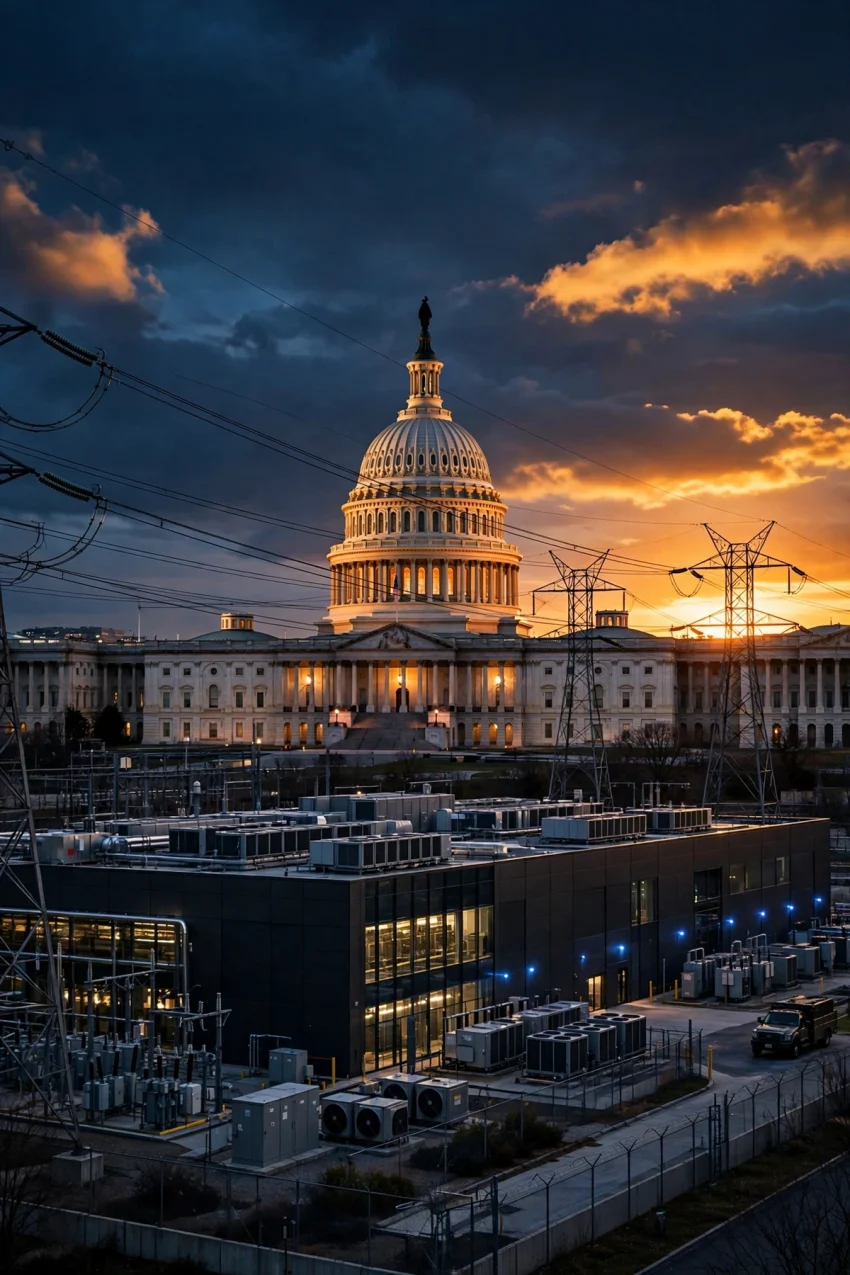
Senate Permitting Reform Bill Passes 62–33
The Senate permitting reform bill passed late on Thursday, November 19, 2026, by 62 votes to 33, clearing the biggest energy and infrastructure measure to reach the Senate floor in years. The Bipartisan American Affordability and Jobs Act — known as BAAJA — now heads to the House, where its fate will decide whether American households see lower electricity bills and whether the huge data centres powering artificial intelligence finally pay their own way.
The vote was the first major legislation to pass the Senate since the midterm elections, in which voters repudiated President Donald Trump and congressional Republicans. Democrats are due to take control of Congress in January 2027, which gives the bill’s supporters only a narrow window to get it through the House and onto the president’s desk.
What the Senate permitting reform bill changes
At its core, the bill rewrites how quickly the federal government must decide on energy and infrastructure projects. Today, major environmental reviews can drag on for more than four years on average, according to Reuters. Under the bill, agencies would have to keep to a one-year target for environmental assessments and a two-year target for full environmental impact statements. Once a final environmental impact statement is issued, agencies would get 45 days to issue a record of decision, followed by 90 to 120 days for outstanding authorisations.
The bill also rewrites parts of four bedrock environmental laws: the National Environmental Policy Act, the Clean Water Act, the Endangered Species Act and the National Historic Preservation Act. Legal challenges to environmental reviews and permits would face a 150-day statute of limitations, replacing deadlines that could previously run for months or years. And where a court finds a flaw in a review, it would in most cases have to send the matter back to the agency to fix it, rather than vacating the permit outright.
A further provision, described by supporters as “permit certainty”, would bar agencies from revoking, suspending or materially altering permits that were in effect on or after November 6, 2026, with only limited exceptions. Critics call this section “forever permits”, and it is one of the most contested parts of the bill.
The bill also expands transmission planning and siting, and includes provisions for geothermal energy, critical minerals and mining — all aimed at building the power grid and energy projects faster.
What it could mean for your electric bill
The most eye-catching claim attached to the bill is about household costs. The White House Council of Economic Advisers estimated that the bill could raise annual economic output by $82–164 billion and cut the average household electric bill by about $178–251 a year. That figure is an estimate from the White House Council of Economic Advisers, not a guaranteed saving, and it depends on projects actually being built faster and on power prices responding as the advisers project.
Demand for electricity is surging as artificial intelligence data centres multiply, and backers say slow permitting pushes up power costs for everyone. Resources for the Future, an independent research organisation, also found that the bill would significantly expand transmission capacity — the power lines that carry electricity from where it is generated to where it is used.
One provision speaks directly to that fairness question. Large data centres would have to bear the transmission and infrastructure costs created by their own electricity demand, under a Ratepayer Protection provision. In plain terms, the bill says the cost of powering a data centre should fall on the data centre, not be passed on to other households and businesses through higher bills.
Who backed it — and who voted no
The bill was written by four senators from both parties: Shelley Moore Capito of West Virginia and Mike Lee of Utah, both Republicans, and Sheldon Whitehouse of Rhode Island and Martin Heinrich of New Mexico, both Democrats. It was introduced on September 30, 2026. A substitute amendment was adopted 69–27 on November 18, and final passage followed on November 19.
| Vote | Number |
|---|---|
| In favour | 62 |
| Against | 33 |
| Republicans in favour | 47 |
| Democrats joining them | 15 |
(as reported by AP)
The final vote was 62–33, with 15 Democrats joining most Republicans, according to AP, including Senate Minority Leader Chuck Schumer. Only two Republicans voted against the bill: Senators Josh Hawley of Missouri and Mike Rounds of South Dakota.
Supporters say the bill will cut energy costs, speed up the grid and create jobs. President Trump has said he will sign it, posting that it will “lower Energy Costs for American Families.” Senate Majority Leader John Thune has urged the House to pass the bill unchanged.
Who objects — and why
The opposition is substantial, and it comes largely from environmental groups, tribal organisations and some Democrats who otherwise support faster clean-energy building. The Sierra Club, the National Wildlife Federation, Earthjustice, the Center for Western Priorities and the Association on American Indian Affairs are among the groups opposing the bill, along with dozens of tribes. They argue it weakens bedrock environmental laws, limits the courts’ power to check unlawful permits, locks in fossil-fuel development and puts tribal and public lands at risk.
One provision drawing particular fire is Section 1402, which critics describe as a “polluter payout”: developers could collect 50–100% of expected construction costs if an administration deliberately slowed or denied their permits. Critics say that would reward developers and punish future administrations for enforcing environmental law. Supporters reject that characterisation and say the provision deters political abuse of the permitting process.
Senator Catherine Cortez Masto, a Democrat from Nevada, voted against the bill despite supporting some of its provisions. Some Democrats argue that the next Congress, with Democratic majorities from January, should write a better bill rather than accept this one. Former Vice President Al Gore opposed the measure, while climate scientist Zeke Hausfather and some clean-energy groups support it — a split that shows how divided even the climate movement is over the trade-off between speed and safeguards.
What happens next
The bill now goes to the Republican-controlled House, which passed its own more limited permitting bill in December 2025. Roll Call reported that House action is expected after Thanksgiving. Senator Thune has urged the House to pass the Senate bill unchanged, because any change would send it back to the Senate for another vote.
Both chambers must agree on the same text before January 3, 2027, when the current Congress ends. If the House changes the bill, or if it runs out of time, the whole effort would have to start again in the new Congress — where Democrats will hold the majorities and have already signalled they want a different bill.
For households, the question is simple: will this actually lower electric bills? Supporters say the Senate permitting reform bill will cut costs by unblocking power lines and energy projects; critics say the savings are speculative and the environmental price too high. The House vote, expected after Thanksgiving, will show whether the estimated $178–251 a year off the average bill ever becomes reality.
This poll is not a scientific survey — it reflects the views of readers who choose to vote.
Sources
- AP via Manufacturing.net, “Senate Approves Bill to Speed Up Permitting Reviews, Force Data Centers to Pay for Energy Costs” (Nov 20, 2026): https://www.manufacturing.net/energy/news/22978766/senate-approves-bill-to-speed-up-permitting-reviews-force-data-centers-to-pay-for-energy-costs
- Reuters explainer, “Explainer: What to know about the energy permitting overhaul bill before US Congress” (Nov 18, 2026): https://wncy.com/2026/11/18/explainer-what-to-know-about-the-energy-permitting-overhaul-bill-before-us-congress/
- ENR, “Senate Passes Permitting Reform Bill to Speed Infrastructure Construction”: https://www.enr.com/articles/64380-senate-passes-permitting-reform-bill-to-speed-infrastructure-construction
- Senate EPW Committee statement: https://www.epw.senate.gov/press/rep/senate-passes-capitos-bipartisan-american-affordability-and-jobs-act/
3 thoughts on “Senate Permitting Reform Bill Passes 62–33”