
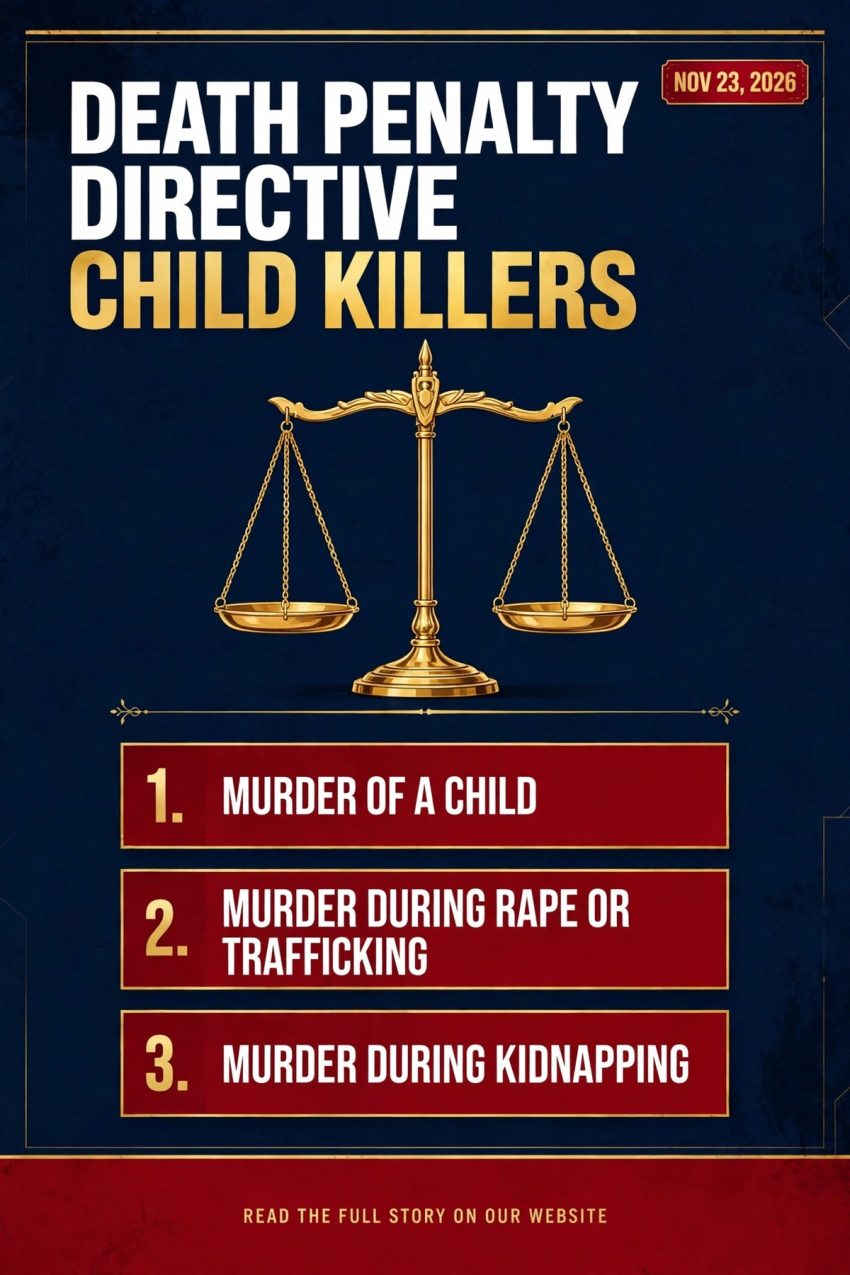
The Trump death penalty directive signed on Monday, November 23, 2026, orders federal prosecutors to seek the death penalty in a wider set of federal murder cases — and to carry out federal death sentences faster. President Donald Trump signed the presidential memorandum, titled “Expeditious Enforcement of Capital Sentences and the Pursuit of Justice for Victims of Heinous Crimes,” during remarks at the Justice Department under the banner “Protecting American Families,” alongside Attorney General Todd Blanche and FBI Director Kash Patel.
The directive is the administration’s second major move on capital punishment. It builds on Executive Order 14164, signed on January 20, 2025, which restored the federal death penalty and ended the previous administration’s moratorium on federal executions. The new memorandum adds three categories of killings to the list of cases in which prosecutors are told to pursue federal jurisdiction and seek a death sentence.
What the Trump Death Penalty Directive Orders
The memorandum directs the attorney general, “when appropriate and consistent with applicable law,” to pursue federal jurisdiction and seek the death penalty for particularly heinous federal capital crimes, including three newly listed categories:
- First-degree murder of a minor — the killing of a child.
- Murder committed in the course of rape, sexual abuse, sexual exploitation of a child, or sex trafficking.
- Murder committed in the course of kidnapping or human trafficking.
These join the categories already singled out in the January 2025 executive order: the murder of a law-enforcement officer, and capital crimes committed by someone in the country illegally. The memorandum also directs the attorney general to take all lawful measures to ensure that federally imposed death sentences “are carried out as expeditiously as possible,” including seeking prompt consideration of appeals and post-conviction proceedings. The memo states that a prolonged delay in carrying out a death sentence “is a grave offense to the justice system that denies a victim’s family the closure they deserve.”
What the Directive Cannot Do
The limits matter as much as the order itself. A presidential memorandum directs executive-branch priorities within existing law — it cannot create new federal capital crimes, eliminate constitutional protections, or guarantee a death sentence in any particular case. It names no specific statutes and says nothing about state prosecutions or state death rows. It applies only where a killing is already a federal capital crime, and only when prosecutors can establish federal jurisdiction.
That is why the directive has no effect on the case that prompted Trump’s remarks. California Governor Gavin Newsom announced on November 5 that he would commute all 548 death sentences on California’s death row to life in prison without parole. Those are state sentences, and a federal memorandum cannot touch them. Trump called the commutations “one of the most shocking acts of injustice our country has ever seen,” and said that among those granted clemency were more than 110 child killers, more than 100 rapists who murdered their victims, and numerous serial killers.
The Newsom Clash Behind the Announcement
The timing was deliberate. Trump used the Justice Department event to denounce Newsom’s decision in the strongest terms, then announced the memorandum as the federal answer. The White House framed the move as part of the administration’s public-safety record, saying the Justice Department “must take every step to ensure that those who commit the most heinous crimes promptly face the full consequences of their actions.”
The contrast is the story: Newsom used his clemency power to empty the largest death row in the United States, while Trump used a presidential memorandum to push federal prosecutors toward seeking death more often and carrying out sentences faster. Neither action changes the other’s. California’s 548 commutations stand unless a court intervenes, and the federal directive changes charging decisions only in federal cases.
Grants, Housing, and a Bill in Congress
The memorandum was not the only announcement at the Justice Department event. Trump said the Justice Department will award nearly $150 million in public safety grants, intended to support hiring more than 1,000 additional sworn officers focused on domestic violence and sexual assault response. He also said he was directing the Department of Housing and Urban Development to strengthen tenant-screening rules for public housing and make it easier to remove problematic tenants.
Trump also urged Congress to pass a bill introduced at his request by Representative Brandon Gill of Texas: the Just Punishment for Murder Act (H.R. 11132, introduced November 20, 2026). The bill would write parts of the directive into federal law, including provisions covering killers of law enforcement, and expand the policy to cover murderers who are in the country illegally. The bill’s text had not been published as of November 23, and it has not become law — a congressional proposal changes nothing until it completes the legislative process.
What Happens Next
The immediate effect is on charging decisions inside the Justice Department. The administration had already moved in this direction: the Justice Department said in April 2026 that it had authorized seeking the death penalty against 44 defendants since the January 2025 executive order. The new memorandum widens the categories prosecutors are told to prioritize, and adds pressure to move existing federal death sentences through appeals faster — a process that has historically taken years.
The open questions are practical. How many new cases will actually qualify as federal capital crimes under the three new categories? How quickly will the Justice Department act on the instruction to expedite sentences already imposed? And will Congress take up Gill’s bill, which would turn a presidential memorandum — reversible by a future president — into statute? The answers will emerge in charging decisions and court filings in the months ahead, not in the announcement itself.
This poll is not scientific — it reflects the views of readers who choose to vote.
Related coverage
- Reitz warns Warren to preserve records
- House Democrats’ Trump investigation
- Proxy voting ruled unconstitutional by the Fifth Circuit