
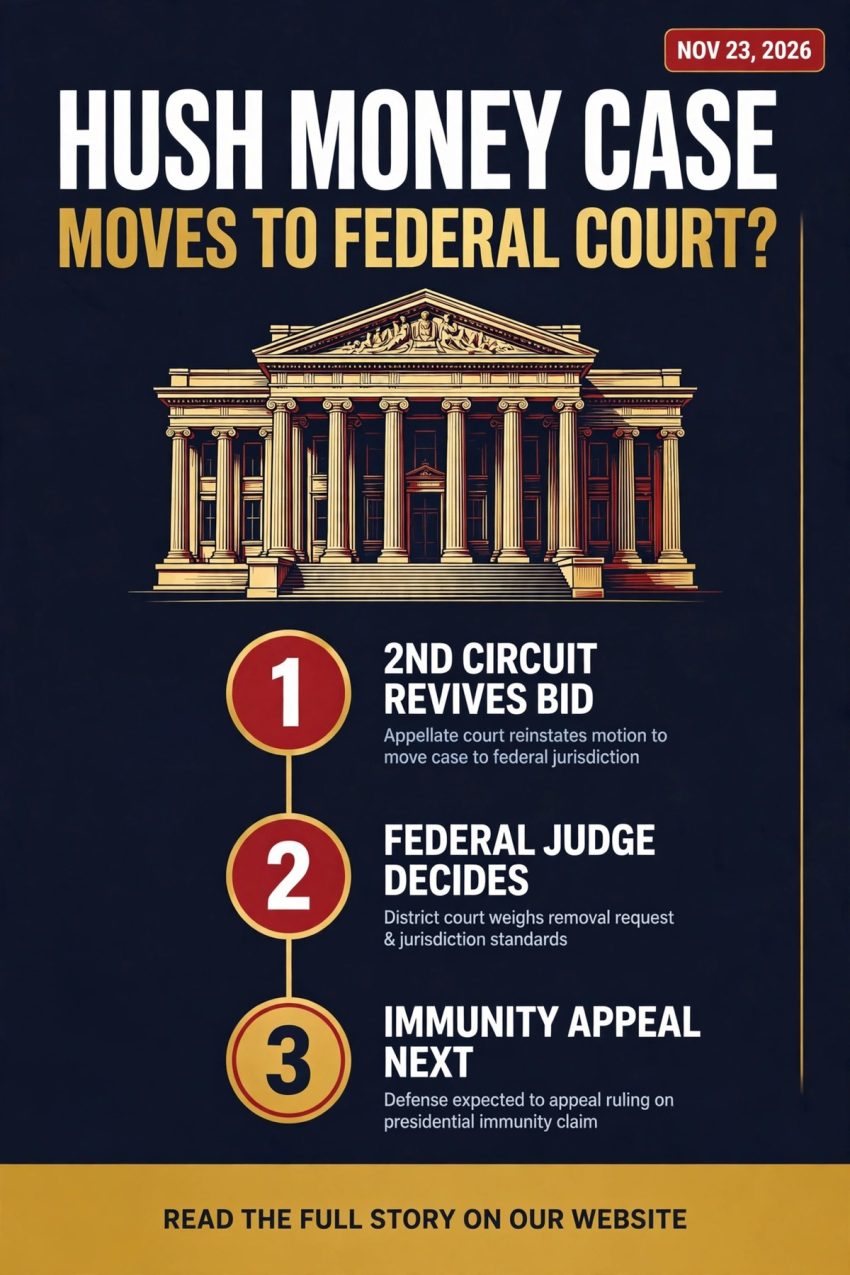
The Trump hush money transfer bid is alive again. On Monday, November 23, 2026, a three-judge panel of the 2nd U.S. Circuit Court of Appeals revived President Donald Trump’s effort to move his New York hush money criminal case into federal court — reopening a path for him to argue that his conviction should be thrown out on presidential immunity grounds. The panel reversed a lower-court decision that had kept the case locked in New York state court, and ordered a federal judge to promptly decide whether the federal court in Manhattan should take control of it.
The ruling does not erase the conviction. Trump was tried and convicted in state court on 34 felony counts of falsifying business records tied to a $130,000 payment to adult film performer Stormy Daniels, whose allegations of an affair had threatened to upend his 2016 presidential campaign. The conviction stands. What changed on Monday is where the case goes next — and which court gets to decide whether presidential immunity applies.
What the Trump Hush Money Transfer Bid Ruling Means
In a brief unsigned two-page order, the panel — Judges Raymond J. Lohier Jr., John M. Walker Jr. and José A. Cabranes — found that the late U.S. District Judge Alvin Hellerstein had made two errors. First, Hellerstein “erred in holding that removal is categorically unavailable in a state criminal case” after a conviction — in other words, the panel said a convicted defendant can still ask to move a state case to federal court. Second, Hellerstein erred in denying that Trump had good cause to seek removal twice: once after his indictment, and again after his trial.
The panel sent the case back to the district court and told it to decide promptly whether the Manhattan federal court should keep the case. If the transfer is granted, the federal court would first adopt the existing state-court judgment — and Trump could then ask the 2nd Circuit itself to set aside the verdict on immunity grounds. The panel said a fuller opinion explaining its decision would follow at a later date.
Why Hellerstein Kept Saying No
Hellerstein had rejected Trump’s transfer requests three times, most recently in August 2026. In that ruling, he concluded that the bid came too late and had not presented legally sufficient new grounds — and he rejected the immunity framing for the charged conduct, writing that “paying hush money to an adult film star or engaging in a cover-up of an embarrassment are not subsumed in presidential immunity.”
The 2nd Circuit had already sent the case back once before, after Hellerstein’s second denial, finding that he had failed to weigh “important issues relevant” to the president’s request. Monday’s order is the second time the appeals court has sided with Trump in his quest for federal-court intervention. The ruling came a week after the three judges spent more than an hour questioning Trump’s lawyer and a state prosecutor. Steven Wu, chief of the appeals division at the Manhattan District Attorney’s office, had urged the panel to uphold Hellerstein’s ruling and leave the case in state court. The Manhattan District Attorney’s office declined to comment after the ruling.
It is not yet clear which federal judge will take up the matter. Hellerstein, who had rejected the transfer requests three times, died in October at age 92, and the case has not yet been reassigned.
The State Appeal Is Now Frozen
Monday’s order also set in motion a halt to proceedings in Trump’s simultaneous state-court appeal. The order directs the lower court to ask that no further proceedings take place in the state courts while the removal question is pending. That effectively freezes Trump’s appeal before New York’s Appellate Division, which heard arguments on November 5 and has not yet ruled — and could prevent that court from ruling indefinitely while the federal question is sorted out.
That freeze is a significant part of the win for Trump. A ruling in his favor on the transfer would set off a legal merry-go-round: the case would return to the 2nd Circuit, where he could argue that the verdict should be discarded because of presidential immunity. His lawyers have made such arguments before in various courts — but this time they would be doing so in a forum that has now sided with him twice in his quest for federal court intervention.
What Happens Next
Three steps now decide the case’s future. First, a federal judge — yet to be assigned — must promptly rule on whether the Manhattan federal court retains the case. Second, if the case moves, the federal court adopts the state judgment and Trump appeals to the 2nd Circuit on immunity grounds. Third, the 2nd Circuit will issue its fuller opinion explaining Monday’s order, which may shape how the lower court handles the transfer question.
None of those steps erases the 34 counts by itself. The conviction remains in place, and Trump was sentenced in January 2025 to an unconditional discharge — no jail time, fine or probation. What Monday’s ruling does is reopen a door Hellerstein had closed: a federal forum, and a fresh immunity argument, in the only criminal conviction ever returned against a sitting or former American president.
This poll is not scientific — it reflects the views of readers who choose to vote.
Related coverage
- Trump judicial nominees blocked by Republican senators
- House Democrats’ Trump investigation
- Reitz warns Warren to preserve records
1 thought on “2nd Circuit Revives Trump’s Bid to Move Hush Money Case to Federal Court”