
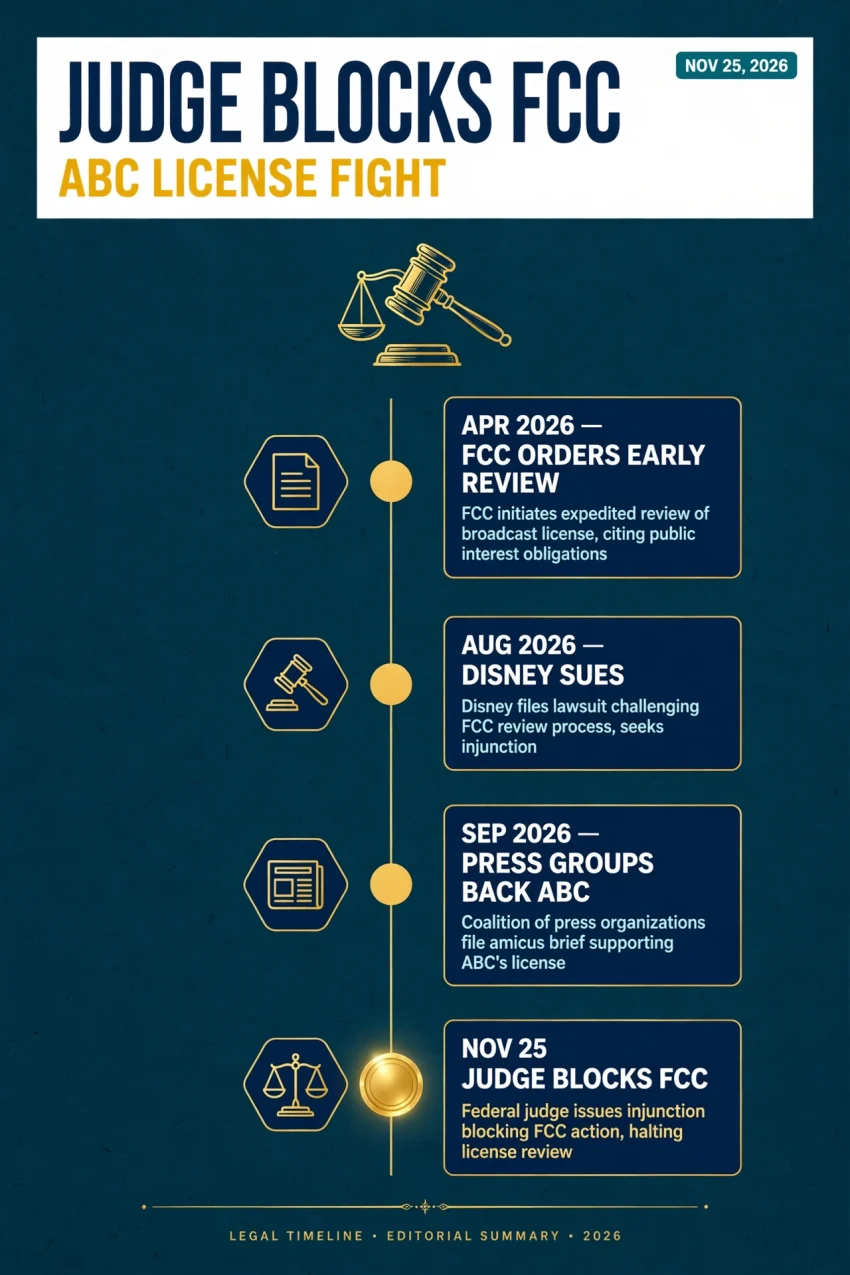
A federal judge on Wednesday blocked the Federal Communications Commission from conducting an early review of ABC’s broadcast licences, agreeing with the network that the Trump administration was chilling its free speech rights. U.S. District Judge Loren AliKhan in Washington, D.C., granted ABC’s request for a temporary restraining order and a preliminary injunction on First Amendment grounds, and denied the FCC’s motion to dismiss Disney’s lawsuit. “This is not a close case,” AliKhan wrote in her decision. The FCC ABC license ruling is a significant First Amendment decision — and a direct judicial rebuke of a regulator accused of using licensing power to punish a broadcaster for its programming.
The ruling pauses the early renewal proceedings while the lawsuit continues. It is not a final judgment resolving the case, and it is not a blanket prohibition on the FCC’s investigative authority. But it is a clear victory for Disney, which went to court in August to defend its ABC stations from the FCC’s pressure campaign, and it raises a question that now sits at the centre of American media law: can a government regulator fast-track licence reviews of a broadcaster it has publicly criticised?
Table of Contents
FCC ABC license ruling: what the judge decided
AliKhan issued the preliminary injunction on Wednesday, November 25, after weighing evidence that Disney’s lawyers said showed the early licence renewal proceedings were a retaliatory act. The judge concluded that Disney had “sufficiently cast the early license renewal proceedings as a retaliatory act”, and found that ABC and its co-plaintiffs are likely to succeed on their First Amendment retaliation claim. The ruling covers eight ABC-owned television stations, including stations in New York, Los Angeles and Chicago.
The judge also denied the FCC’s motion to dismiss the lawsuit, meaning the case will proceed. AliKhan, who was nominated by former President Joe Biden, said ABC had detailed “a campaign of retaliation against them in response to their exercise of their First Amendment rights”, which on its own is an “irreparable injury”. That finding matters because it does not depend on the FCC actually revoking a licence: the judge found that the threat of losing broadcast licences could chill protected expression even before the agency made a final renewal decision.
An ABC spokesperson said: “Today’s decision is an important victory for the First Amendment. We thank the court for its careful consideration.” The FCC disputed the portion of the ruling granting relief, saying it was “wrong on the facts and wrong on the law”, according to Just the News. The commission has not said whether it will appeal.
The April order that started it
The dispute began in April 2026, when the FCC, chaired by Brendan Carr — a close ally of President Donald Trump — ordered eight ABC-owned stations to submit renewal applications for their broadcast licences years ahead of their normal schedules. ABC’s licences were not due for renewal for several years, and the FCC virtually never demands early renewal paperwork. The order came shortly after President Trump called for the firing of late-night host Jimmy Kimmel.
The sequence is the heart of the case. AliKhan wrote that Carr “has taken President Trump’s rhetoric as his marching orders”, and that “it is no coincidence that President Trump criticized Mr. Kimmel’s skit on social media and the very next day defendants initiated the early license renewal proceedings.” The FCC ABC license ruling rests on that timeline: a presidential attack on a comedian’s sketch, followed within a day by an extraordinary licensing demand against the comedian’s network.
Disney’s lawsuit, filed in August, documented the FCC’s unusual steps to investigate and challenge ABC’s stations. The commission said the review was necessary to ensure the stations were serving the public interest, and it was part of a broader investigation into Disney’s hiring practices, which the administration claimed was the basis for the licence review. The judge found that explanation unconvincing against the weight of the public record.
Why the judge called it retaliation
The FCC ABC license ruling turns on a First Amendment principle that is easy to state and hard to apply: the government may not punish a speaker for disfavoured speech. Disney did not need to prove that the FCC had already revoked a licence, or even that it intended to. It needed to show that the early renewal proceedings were likely motivated by a desire to punish ABC for its critical content — and that the proceedings themselves, by threatening the stations’ licences, chilled the network’s editorial decisions.
AliKhan found that Disney cleared that bar. She relied on public statements by President Trump and FCC Chairman Carr targeting ABC’s programming and editorial decisions, and on the timing of the April order. The Reporters Committee for Freedom of the Press, which filed a friend-of-the-court brief in September urging the result, said the court recognised that “this is ‘not a close case'” — but also that it is a novel case, forced on ABC by the administration’s punitive actions, “and therefore all the more important that the federal judiciary stepped in to vindicate First Amendment rights.”
The ruling also fits a wider pattern of the courts pushing back on executive pressure this week. On the same day, a second judge blocked Trump’s birthright citizenship order, and the Fifth Circuit ruled 9-8 that proxy voting in Congress is unconstitutional — a reminder that the judiciary is currently deciding, case by case, where the limits of executive and legislative power lie. The Second Circuit, meanwhile, revived Trump’s bid to move his hush-money case to federal court, showing the same courts ruling in different directions on different questions.
What the ruling does — and does not — decide
The FCC ABC license ruling pauses the early renewal proceedings while the lawsuit continues. The FCC cannot take further action on the early renewal of the eight stations’ licences until the case is resolved or the injunction is lifted. That is a real constraint: it stops the pressure campaign in its tracks for as long as the litigation runs.
But the ruling does not decide the case. A preliminary injunction is a prediction, not a verdict: the judge found ABC is likely to succeed, not that it has already won. The underlying lawsuit will continue, the FCC can appeal the injunction, and the commission retains its ordinary licensing authority — including the power to review ABC’s licences when they come up for renewal on their normal schedule. As one trade publication noted, the ruling is not a blanket prohibition on the FCC’s investigative authority, and it does not strip the agency of its role as the broadcast regulator.
That distinction matters for what comes next. If the FCC appeals, a higher court will test whether AliKhan’s reading of the retaliation evidence holds. If it does not, the commission could revive the early renewal proceedings — although the publicity of this ruling makes that a politically costly step. And if Disney ultimately wins, the case will stand as a precedent limiting how far any administration can go in using licensing power against broadcasters it dislikes.
What to watch next
Three things will decide where the FCC ABC license ruling leads. First, whether the FCC appeals the injunction — and, if it does, how quickly a higher court acts. Second, whether the commission complies quietly or tests the edges of the order with new demands on ABC or other broadcasters. Third, how the case affects the wider media landscape: other networks will be watching whether the ruling deters similar pressure, and whether Congress takes any interest in the FCC’s use of its licensing power.
For now, the eight stations’ licences are untouched, the early renewal proceedings are frozen, and the First Amendment argument Disney made in August has been endorsed by a federal judge in the strongest terms available at this stage of a case. The FCC ABC license ruling does not end the fight over broadcast licences and political speech — but it has drawn a line the administration cannot cross while the case is pending, and it has done so with a sentence that will be quoted for a long time: “This is not a close case.”
(Poll results are reader opinion, not scientific.)