
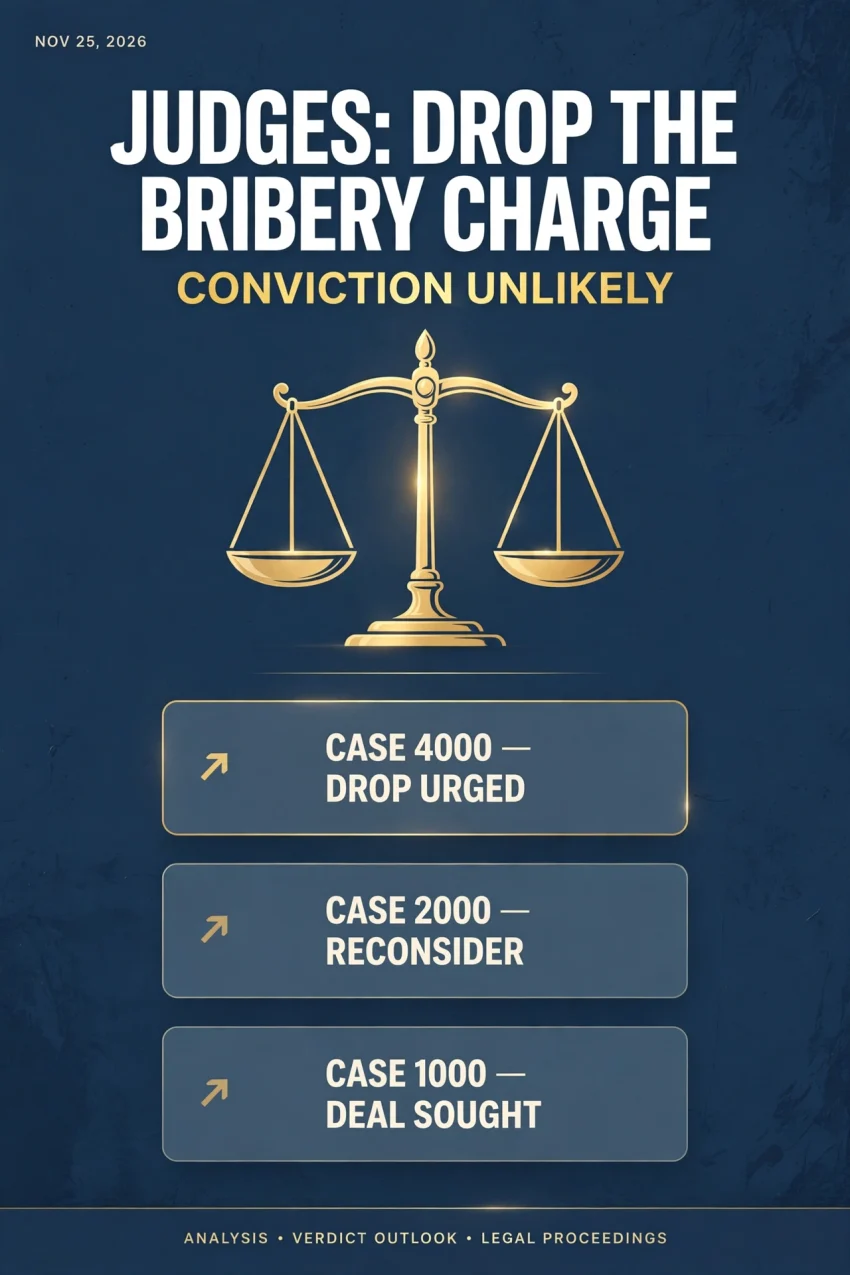
The judges hearing Benjamin Netanyahu’s corruption trial told prosecutors on Wednesday, 25 November, that they should drop the bribery charge in the most serious of the three cases against the Israeli prime minister. The Netanyahu Case 4000 recommendation is the most significant turn in a trial that has run for years — but it is a recommendation, not a ruling. The judges said a conviction in the case looks unlikely; they did not acquit Netanyahu, dismiss the charge, or end the trial. Attorney General Gali Baharav-Miara, who attended the hearing at the judges’ direction, said she would review the court’s statements with the prosecution, which has asked for several days to respond.
Table of Contents
Netanyahu Case 4000: what the judges actually said
The hearing took place at the Jerusalem District Court before the three judges hearing the case: Rivka Friedman-Feldman, who presides over the trial, Moshe Bar-Am and Oded Shaham. According to a court spokesperson, Judge Friedman-Feldman told the attorney general that the bribery charge in Case 4000 should be dropped because a conviction was unlikely. “It seems to us that the bribery charge presents considerable difficulties,” the court said. “There is serious doubt as to whether the evidentiary foundation supports this allegation.”
The judges went further than a single case. They suggested the prosecution reconsider the charge in Case 2000, and seek a deal in Case 1000 — in effect, a proposed path to winding down the whole trial: drop the bribery case, rethink the second case, settle the third. The court emphasised that its recommendations were not final decisions or a judgment in the corruption trial. That distinction is the single most important fact in this story. Headlines calling this an acquittal or a dismissal would be wrong. What happened on Wednesday was the panel hearing the evidence telling the prosecution, in open court, that it does not believe the bribery case can be won.
The Netanyahu Case 4000 recommendation carries weight precisely because it comes from the judges who have been hearing the evidence, not from Netanyahu’s lawyers or his political allies. A trial panel does not usually tell prosecutors to abandon their flagship charge. When it does, it is a signal about how the evidence has landed after years of testimony — and a warning that pressing on risks an acquittal that would be worse for the prosecution than a negotiated withdrawal.
The three cases, explained
Netanyahu Case 4000 is the case the judges want dropped. Prosecutors allege that Netanyahu granted regulatory favours to Bezeq Telecom Israel, then owned by his friend, the millionaire businessman Shaul Elovitch, whose company also owned the Walla news website. In return, prosecutors say, Netanyahu received favourable coverage on Walla. The regulatory benefits are valued at around 1.8 billion shekels (about 500 million dollars), according to Reuters. Netanyahu faced a charge of bribery and another charge of fraud and breach of trust in this case. The alleged exchange — regulatory help for friendly coverage — is what prosecutors call the quid pro quo, and it is the element the judges say is weakest. According to the Globes report of the hearing, Judge Friedman-Feldman said the quid pro quo element rests mainly on a single meeting at which instructions were allegedly given. That narrow foundation is why the judges doubt the charge can be proved.
Case 2000 is the case the judges want reconsidered. Prosecutors alleged that Netanyahu sought favourable coverage in one of Israel’s top newspapers, Yedioth Ahronoth, in exchange for limiting the circulation of one of that paper’s main rivals. The other party in the alleged arrangement was Arnon (Noni) Mozes, the newspaper’s publisher. The judges recommended prosecutors reconsider the charge because of doubts that Netanyahu’s actions in this case constituted a criminal offence at all — a broader doubt than in Case 4000, where the question is whether the evidence proves the charge, rather than whether the conduct was criminal in the first place.
Case 1000 is the gifts case. Prosecutors allege Netanyahu received gifts from wealthy businessmen. The judges urged Netanyahu’s attorneys to come to an agreement with prosecutors on this case — in other words, to negotiate a plea deal rather than fight it to a verdict. Of the three cases, this is the one the judges see as resolvable by agreement, and a deal here would let both sides claim something: the prosecution a conviction of some kind, Netanyahu an end to the trial without the bribery charge hanging over him.
Netanyahu denies wrongdoing and has pleaded not guilty. He has not been convicted of any offence, and he is presumed innocent, as are his co-defendants Shaul and Iris Elovitch and Arnon Mozes. Nothing the judges said on Wednesday changes that status. It changes the prosecution’s prospects, not the defendant’s legal position.
Not the first time the judges have said this
The Netanyahu Case 4000 recommendation was not a bolt from the blue. The judges had already recommended in June 2023, and again in June 2026, that the prosecution drop the bribery count in the indictment. The prosecution did not take that advice then, and the trial continued. That history matters for two reasons. First, it shows the judges’ doubts about the bribery charge are long-standing and considered, not a sudden reaction to a single witness. Second, it shows the prosecution has ignored the same advice before — so there is no guarantee it will follow it now.
The attorney general’s response will be the next decisive moment. Baharav-Miara attended Wednesday’s hearing because the judges directed her to, and she said she would review the court’s statements with the prosecution. The prosecution has asked for several days to respond. That pause is normal: dropping the most serious charge against a sitting prime minister is not a decision any prosecutor takes in an afternoon, and the attorney general will need to weigh the judges’ view against the prosecution’s own reading of the evidence, the public interest, and the political storm that will follow either way.
If the prosecution accepts the Netanyahu Case 4000 recommendation and drops the bribery charge, it would be a major legal win for Netanyahu, the longest-serving prime minister in Israel’s history, whose trial has shadowed his premiership for years. If it refuses, the trial continues — but with the panel that will deliver the verdict having said, on the record, that it doubts the flagship charge can be proved. Either way, Wednesday’s hearing has changed the shape of the case.
The political reaction — and what it does not settle
Coalition ministers reacted within hours, calling for an end to the trial. Aryeh Deri, leader of the Shas party, said the judges’ recommendation “proves once again what everyone already knows: there is no bribery.” That is a political claim, not a legal finding, and it should be reported as one. The judges did not say there was no bribery. They said the bribery charge presents considerable difficulties and that there is serious doubt whether the evidentiary foundation supports the allegation. The gap between “the prosecution may not be able to prove this” and “nothing happened” is the gap between a courtroom and a campaign rally, and it is worth keeping in view.
The reaction also underlines how much of this trial has always been political as well as legal. Netanyahu’s supporters have long argued the cases are a political persecution; his critics argue that a prime minister facing bribery charges should not be able to govern while the trial runs. The Netanyahu Case 4000 recommendation will be claimed by both sides: supporters as vindication, critics as a reason to ask whether the system is treating a prime minister differently from anyone else. Neither reading is settled by what the judges said. What is settled is narrower and more concrete: the panel hearing the evidence thinks the bribery charge should be dropped, the second case reconsidered, and the third settled by agreement.
What happens next
The immediate timetable belongs to the prosecution. Baharav-Miara and her team will review the judges’ statements over the coming days and then decide: drop the Case 4000 charge, as the judges suggest; refuse and press on; or find a middle path, such as amending the charge or seeking a broader negotiated settlement covering all three cases. A negotiated settlement would be the cleanest exit for everyone: the prosecution avoids a high-profile acquittal on its flagship charge, Netanyahu avoids the risk of conviction, and the trial that has dominated Israeli politics for years comes to an end.
But a deal is not guaranteed. Prosecutors who have spent years building a bribery case do not abandon it lightly, and any deal would need Netanyahu’s agreement too — including on the terms, which could involve an admission of some kind or a penalty in the gifts case. The judges’ proposal gives both sides cover to negotiate. Whether they take it will become clear when the prosecution responds in the coming days.
Beyond the courtroom, the timing adds another layer. The recommendation landed in the same week that Israel’s military spokesman said the country is ready to strike Iran alone if necessary, and that Prime Minister Netanyahu had convened his security cabinet. A prime minister facing a court that doubts his prosecution’s case, while also weighing a possible military confrontation, is a prime minister under pressure on two fronts at once. The trial and the security situation are separate stories, but they share the same decision-maker — and the same week.
The Netanyahu Case 4000 recommendation is therefore best read as a turning point, not an ending. The most serious charge against a sitting prime minister has been described by the judges hearing the case as unlikely to end in conviction. The prosecution now has days to decide whether to accept that judgment or fight on. Until it does, the charge stands, the trial continues, and the only thing that has changed is the prosecution’s confidence — and everyone else’s reading of where this trial is heading.
(Poll results are reader opinion, not scientific.)