
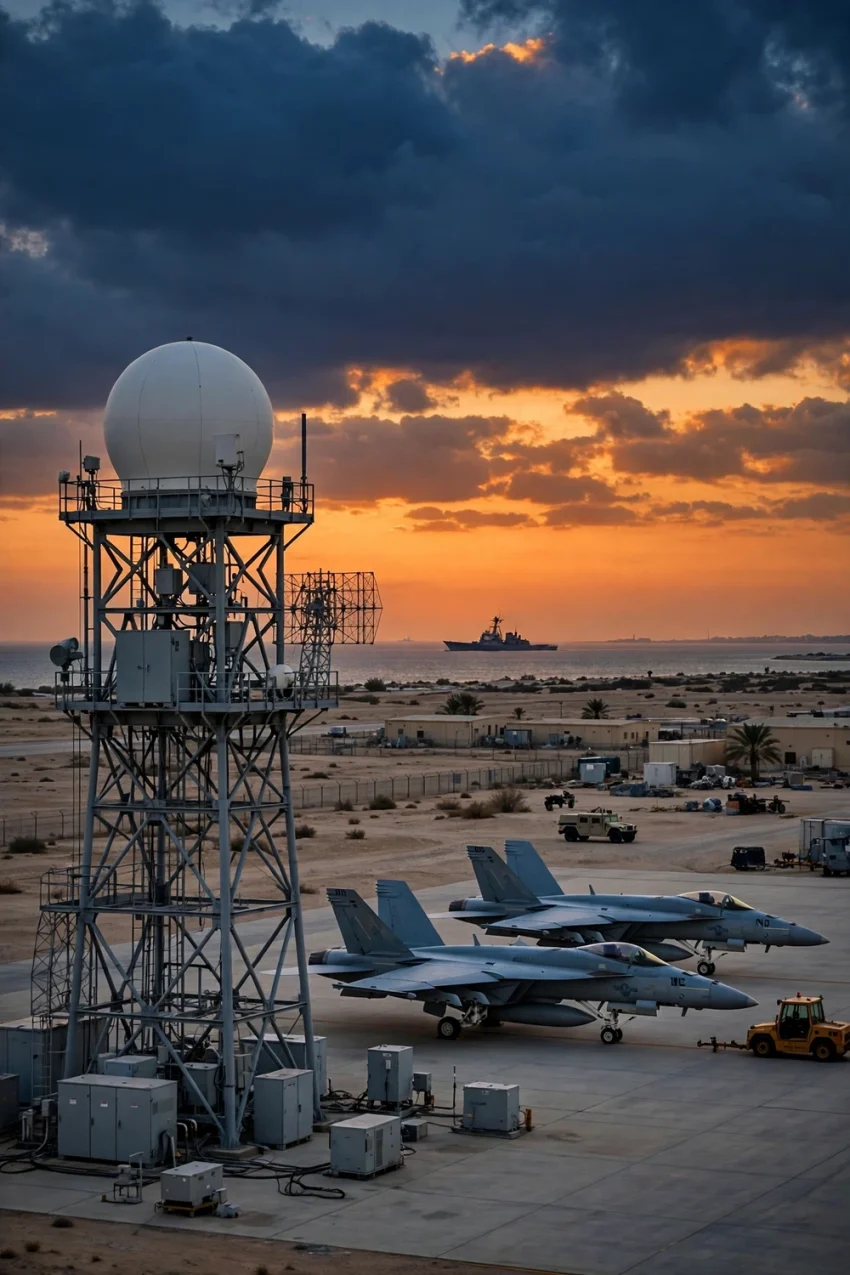
The Iran Bahrain drone attack of Tuesday 17 November 2026 was the sharpest escalation in the US–Iran war in months — and it ended the same day with American fighter jets striking Iranian soil.
The Iran Bahrain drone attack and the American response that followed show how fast this war can move. Iran’s Islamic Revolutionary Guard Corps (IRGC) fired one-way attack drones across the Persian Gulf at a US radar facility at Sheikh Isa Air Base in southern Bahrain. Hours later, US jets carried out precision strikes on an IRGC missile launch site on Qeshm Island, in the Strait of Hormuz. Both sides agree the exchange happened. They disagree sharply about what it achieved — and that disagreement is the story.
In this article:
- What Happened in the Iran Bahrain Drone Attack
- Three Attacks in Five Days
- Why Iran Keeps Targeting US Radar
- US Jets Strike Qeshm Island
- Qeshm Island and the Strait of Hormuz Stakes
- Three US Carriers in the Gulf
- Talks and Strikes on the Same Day
- What Is NOT Confirmed — Read This Before Sharing
- What Happens Next
What Happened in the Iran Bahrain Drone Attack
The Iran Bahrain drone attack began in the early morning of Tuesday 17 November, when the IRGC launched one-way attack drones at the US radar facility at Sheikh Isa Air Base in southern Bahrain. Bahrain’s Interior Ministry sent mobile alerts to residents urging them to stay calm and go to the nearest safe location, and explosions were heard in the capital, Manama.
Bahrain’s Defence Force said its air defences intercepted and destroyed the incoming attacks before they reached their targets. US Central Command (CENTCOM) said: “Multiple Iranian one-way attack drones launched by the IRGC today towards Bahrain were intercepted without any damage to U.S. equipment or injury to American personnel” — and labelled the IRGC’s claim that the radar was hit “FALSE”.
The exact number of drones fired on 17 November was not stated by CENTCOM, and no casualty or damage figures have been reported. There is no independent confirmation that any radar was hit.
Three Attacks in Five Days
Tuesday’s attack was not a one-off. The Iran Bahrain drone attack on 17 November was the third Iranian attack on US targets in Bahrain in five days, after a roughly two-month lull in such strikes.
| Date | What the IRGC claimed | What the US / Bahrain said |
|---|---|---|
| Fri 13 Nov 2026 | IRGC claimed it destroyed a US early-warning radar in Bahrain | CENTCOM said it shot down two Iranian drones; no injuries or damage. |
| Sun 15 Nov 2026 | IRGC said it launched six drones at a US air-defence radar at the Al-Riffa helicopter base near Riffa | Bahrain said its air defences intercepted several attacks. |
| Tue 17 Nov 2026 | IRGC said its combat drones “precisely targeted” the radar at Sheikh Isa Air Base | Bahrain Defence Force and CENTCOM said the drones were intercepted; CENTCOM called the radar-hit claim “FALSE”. |
The pattern is the point. Three attacks in five days, all aimed at the same kind of target: American radar in Bahrain.
Why Iran Keeps Targeting US Radar
Radar is not a random target. It is the eyes of a US base — the system that detects incoming missiles and drones and guides air defences. Knock out the radar and the base is blind, even if no aircraft or building is destroyed.
Tehran-based security analyst Mostafa Najafi told the Associated Press that the attacks mark a shift in Iran’s strategy: from waiting and retaliating to targeting the operational capability of US bases — their radar. Tehran said the strike was retaliation for what it called continued violations of Iranian airspace by US military drones, and it also warned Bahrain over its alliance with Washington. No evidence for the airspace claim was published.
That is why the “did the radar get hit?” question matters so much after the Iran Bahrain drone attack. If Iran can degrade US radar, the balance of the air war changes. If it cannot — if every drone is intercepted, as CENTCOM says — then the attacks are a show of defiance that costs Iran drones and invites retaliation. The truth, for now, is unconfirmed either way: the IRGC’s claim is disputed, and no independent verification exists.
US Jets Strike Qeshm Island
Hours after the Iran Bahrain drone attack, a US military official told CBS News and Reuters that US fighter jets carried out precision strikes on an IRGC missile launch site on Qeshm Island in the Strait of Hormuz. The official described the strikes as self-defence “in response to IRGC aggression targeting U.S. personnel and assets”. The US official did not explicitly name the Bahrain attack as the trigger.
Iranian media, citing an Iranian official, said the strike did not damage infrastructure. Hormozgan deputy governor Ahmad Nafisi said no residential, commercial or infrastructure sites were damaged. No US damage assessment has been published.
What is NOT confirmed: the extent of any damage on Qeshm Island is unknown. Iranian officials say nothing was damaged; the US has published no damage assessment. Treat both as claims, not facts, until independent evidence appears.
Qeshm Island and the Strait of Hormuz Stakes
Qeshm Island sits in the Strait of Hormuz, the narrow waterway between Iran and Oman through which about one-fifth of the world’s oil and liquefied natural gas supplies passed before the war. The strait is now partly blocked by Iran, and shipping through it is one of the war’s biggest global stakes.
Bahrain, meanwhile, hosts the headquarters of the US Navy’s Fifth Fleet — which is why the island kingdom keeps finding itself on the front line of a war it did not start. The US–Iran war began on 28 February 2026, nearly nine months ago. The Iran Bahrain drone attack and the Qeshm strike show it is not winding down. It is widening — from the battlefield to the radar stations and missile sites that decide who can see, and who can shoot, across the Gulf.
Three US Carriers in the Gulf
The backdrop to the exchange is the largest US naval buildup in the region in years. The aircraft carrier USS Theodore Roosevelt (CVN-71) entered CENTCOM’s area on 15 November, joining the USS George Washington and the USS George H.W. Bush — three US carrier strike groups now operating in the region. CENTCOM confirmed the Roosevelt’s arrival.
A carrier strike group is a floating air base: a carrier with dozens of fighter jets, escorted by cruisers, destroyers and submarines. Three of them in one theatre means the US can sustain round-the-clock air operations — and, as the Iran Bahrain drone attack and the US response showed, answer an attack on its radar within hours.
Talks and Strikes on the Same Day
Remarkably, the Iran Bahrain drone attack and the exchange of fire happened on the same day as diplomacy. Qatari and Iranian officials met on 17 November for Qatari-mediated talks aimed at “bridging perspectives”, according to Qatari spokesman Majed Al Ansari.
The talks-vs-strikes tension is the central question of this war: whether the two sides are fighting to improve their bargaining position, or fighting because the talking has already failed. Tuesday gave evidence for both readings — and no answer yet.
What Is NOT Confirmed — Read This Before Sharing
Here is what remains unconfirmed about the Iran Bahrain drone attack:
- The IRGC’s claim that the radar at Sheikh Isa was hit: CENTCOM labelled it “FALSE”. No independent confirmation exists. Do not share it as fact.
- The number of drones fired on 17 November: not stated by CENTCOM. Unconfirmed.
- Damage on Qeshm Island: Iranian officials say none; no US damage assessment published. Unconfirmed.
- The IRGC’s claim that a ship carrying LNG and two oil tankers caught fire in the Strait of Hormuz: Reuters could NOT independently verify this. Unconfirmed.
- A reported Iranian drone launch toward Kuwait: mentioned in one report only. Unconfirmed unless a second source confirms it.
What Happens Next
Watch three things after the Iran Bahrain drone attack. First, whether Iran launches a fourth attack on Bahrain — and whether it changes target. Second, whether the US publishes a damage assessment for Qeshm, and whether further strikes follow. Third, whether the Qatari-mediated talks survive the exchange of fire, or whether Tuesday’s strikes were the sound of diplomacy failing.
The radar war is the war to watch. Whoever controls the skies over the Gulf controls what happens next — and the Iran Bahrain drone attack showed both sides intend to fight for them.
Poll: Should the US keep striking Iranian missile sites after the Bahrain drone attacks?
- YES
- NO
- NOT SURE
Note: This is a public opinion poll, not a scientific survey. Results show how readers of this article voted.
Read More
- Ukraine Donbas NATO Membership: Zelensky Reveals US Swap
- Gaza Aid Tents Blocked: 150,000 Held as Winter Storm Hits
- Trump Xi Putin Meeting: First Trilateral Summit in Shenzhen
- Global Conflicts
Sources
- Associated Press via The Washington Sun — https://www.washingtonsun.com/defense/iran-fires-drones-us-radar-facility-bahrain
- Reuters via Algemeiner — https://www.algemeiner.com/2026/11/17/iran-attacks-us-military-radar-system-bahrain-despite-talks-mediators/
- Al Jazeera — https://aljazeeranews-mggx1uo47w.edgeone.app/news/2026/11/15/iran-says-it-targets-us-radar-in-bahrain-what-do-we-know
- CBS News (via Daily Inference) — https://dailyinference.news/articles/2026-11-17-developing-us-says-it-struck-iranian-missile-site-after-bahrain-drone/
3 thoughts on “Iran Bahrain Drone Attack: US Jets Strike Qeshm Island”