
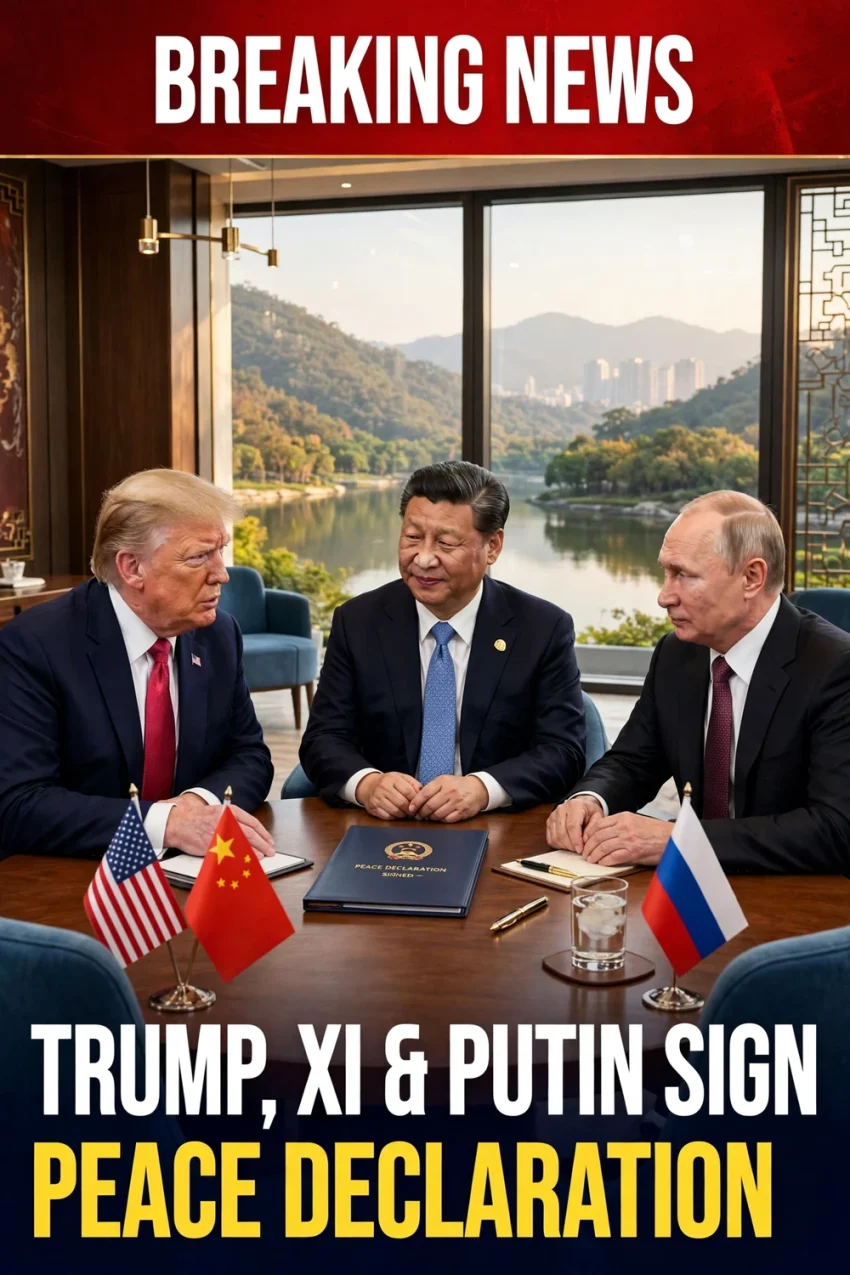
SHENZHEN, China — For the first time in history, the leaders of the United States, China and Russia sat down together — and walked out with a joint declaration. On Thursday 19 November 2026, US President Donald Trump, Chinese President Xi Jinping and Russian President Vladimir Putin held a 90-minute trilateral summit at Kylin Villa in Shenzhen, on the sidelines of the APEC summit, and agreed a four-point “Declaration Toward Peace”. The Trump Xi Putin peace declaration reaffirms that a nuclear war “cannot be won and must never be fought”, and pledges nuclear-risk dialogue, UN reform, stable energy supplies and curbs on international courts.
The meeting itself was the headline. Trump said, “We are really making history”, and added: “No peace was ever forged by declining opportunities for engagement.” Putin said the three countries had “numerous shared interests”, including Ukraine. Xi said that “when major powers live in harmony, the world is at peace”. No joint press appearance followed, and Trump flew back to Washington after the meeting.
The declaration was released not by the White House, but by China’s state news agency Xinhua and the Kremlin. Its wording — broad pledges, no deadlines, no enforcement mechanism — is already fuelling debate over whether Thursday was a genuine turning point or a staged photo opportunity.
A First in Modern Diplomacy
No American, Chinese and Russian leader had ever met in this format before, and the summit was confirmed only days in advance — the White House confirmed the meeting on 13 November.
Before it, Trump met Xi and Putin separately, referring to both men as friends. Trump had insisted nuclear arms control be a central topic, despite China’s past objections to joining arms talks with Washington and Moscow, whose arsenals are far larger. At the opening, Trump told them giving up nuclear weapons was “not an easy thing to do”.
The meeting lasted 90 minutes. Afterwards, none of the three presidents made an immediate public statement.
New START, the last US-Russia nuclear arms treaty, expired in February 2026, leaving the world’s two largest nuclear powers without a binding arms-control agreement — the backdrop to everything discussed in Shenzhen.
Nimda Pulse previewed the summit earlier this week — see our report on the first-ever Trump-Xi-Putin trilateral meeting in Shenzhen.
What the Trump Xi Putin peace declaration says
According to the text released by Xinhua and the Kremlin, the four points are:
1. Nuclear restraint and dialogue. The three leaders reaffirmed that “a nuclear war cannot be won and must never be fought”, and said their countries would keep talking about reducing nuclear risks and preventing proliferation. This was the centrepiece — and the point Trump had pushed hardest to include.
2. Reform of the United Nations. The declaration pledges UN reform so it can better respond to global challenges. No specific reforms or timetable were named.
3. Energy supplies. The leaders agreed to increase the production and supply of refined petroleum products for all countries and to keep energy flows stable.
4. Immunity of state officials. The declaration upholds the immunity of state officials in international courts, and says the ICC and similar institutions must not abuse their jurisdiction. The language is widely seen as aimed at the ICC, which issued an arrest warrant for Putin after Russia’s full-scale invasion of Ukraine in 2022.
What It Does NOT Do
The limits of the declaration are as important as its contents.
No deal on Ukraine. The leaders exchanged views on the war in Ukraine, but the declaration does not mention Ukraine at all. There is no ceasefire, no peace roadmap and no agreed next step for a war now in its fifth year. For the latest on the battlefield, see our report on the third strike on the Crimea Bridge and the Israeli ground operation that crossed the Gaza ceasefire line.
No deal on Iran. Iran was also discussed, but the declaration does not mention it either — no agreement on its nuclear programme, no de-escalation step, no Middle East roadmap.
No binding arms-control limits. The declaration commits the three countries only to “a dialogue” on reducing nuclear risks — no cap on warheads, no limit on delivery systems, no verification regime, no timetable. With New START expired since February 2026, there is still no replacement treaty.
No enforcement, no timetable. Nothing in the declaration is binding — no dates, no review meetings, no consequences if any signatory ignores it. That is the core of the scepticism: three governments that disagree profoundly have agreed to keep talking — and that is all they have agreed. The Trump Xi Putin peace declaration is a promise to talk, not a deal.
Why It Matters — and What Happens Next
Even with those limits, Thursday’s meeting matters for three reasons.
First, the format itself is new: the leaders of the world’s three largest nuclear-armed states have never sat together before, and a joint text creates a channel that did not exist a week ago. Whether it is used again is the first real test: a second meeting would signal Shenzhen was a beginning, not a one-off.
Second, the nuclear language is the first joint statement of its kind from all three capitals. The phrase “a nuclear war cannot be won and must never be fought” echoes earlier US-Russian statements, but it has never before carried the signatures of Washington, Beijing and Moscow together. With the last arms-control treaty lapsed, even a declaratory commitment carries symbolic weight — if real negotiation follows.
Third, the declaration’s silences are themselves a signal. The absence of Ukraine and Iran, and the inclusion of the ICC language, show the limits of what the three leaders could agree. Smaller countries have voiced unease, fearing their interests might be disregarded when the biggest powers settle things among themselves.
What happens next is unwritten: no date for further talks, no named negotiators, no work programme. Separately, Trump and Xi extended the US-China trade truce in their bilateral meeting, although the details were not disclosed. The world will now watch for a follow-up meeting, a concrete proposal from any pledge, and whether the warm words survive the wars the declaration avoided. For context on how international courts handle state responsibility, see our report on the ICJ’s ruling that Myanmar committed genocide against the Rohingya.
Thursday was a historic day in Shenzhen. Whether the Trump Xi Putin peace declaration becomes a historic turning point will be decided not by the words signed, but by what the three leaders do next.
POLL
Do you think the Trump-Xi-Putin peace declaration will lead to real progress on nuclear arms control?
- YES
- NO
- NOT SURE
This is not a scientific survey — it reflects the views of Nimda Pulse readers only.
Sources
- Reuters (via BusinessDay): Xi, Trump and Putin pledge nuclear restraint and UN reform
- Associated Press (via TT News): Trump, Xi, Putin agree on oil, UN reform and nuclear dialogue
- Seoul Economic Daily (Reuters–Yonhap): U.S., China, Russia Hold First Trilateral Summit, Declare No Winners in Nuclear War
Declaration contents as released by China’s Xinhua news agency and the Kremlin, 19 November 2026.
3 thoughts on “Trump, Xi and Putin Sign Historic Peace Declaration in Shenzhen”