
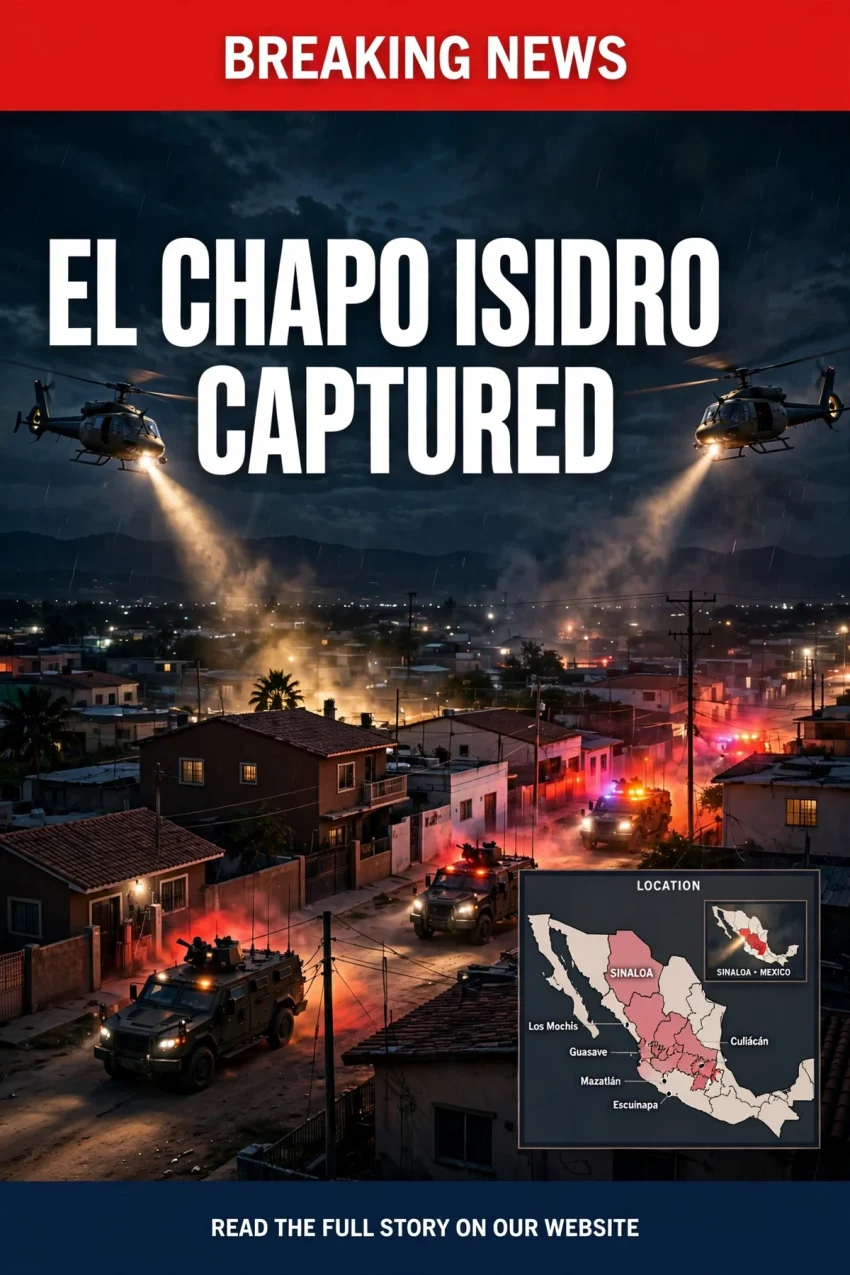
El Chapo Isidro Captured in Mexico Raid
El Chapo Isidro captured — that is the news Mexico woke up to on Saturday 21 November 2026. Mexican special forces seized Fausto Isidro Meza Flores, known as “El Chapo Isidro”, in a raid on a house in Guasave, Sinaloa, on Friday night, 20 November. Mexico’s Defence Ministry and Security Secretary Omar García Harfuch announced the capture on Saturday. Meza Flores was one of the FBI’s Ten Most Wanted Fugitives, with a $5 million reward on his head, and Washington accuses him of spending two decades flooding the United States with fentanyl, cocaine and heroin.
The raid was not clean. Troops came under gunfire and explosives before entering the house, and 11 people died — four soldiers and seven gunmen. Eight people were detained. For Mexico’s government it was a prize chased for years — and a question now dominates what follows: will he be sent to the United States, or stay in Mexico?
First, the name needs clearing up. Meza Flores is NOT related to Joaquín “El Chapo” Guzmán, the former Sinaloa Cartel leader now serving a life sentence in the United States. The shared nickname is a coincidence, not a family tie. “El Chapo Isidro” built his own organisation and his own two-decade record — and it is that record, not the famous name, that put him on the FBI’s most-wanted list.
Who Is El Chapo Isidro?
Fausto Isidro Meza Flores is the alleged leader of the Beltrán Leyva organisation and of his own group, the Meza-Flores Transnational Criminal Organization, also known as Los Mazatlecos. The FBI added him to its Ten Most Wanted Fugitives list in February 2025, offering $5 million for his capture. Then-acting FBI Director Brian Driscoll said he was accused of spending 20 years flooding the United States with fentanyl, cocaine and heroin.
His organisation is described as an ally of the Los Mayos faction of the Sinaloa Cartel, and his group, Los Mazatlecos, has operated around Guasave for years.
The United States wants him on serious charges: American indictments from 2012 and 2019 accuse him of conspiracy to distribute drugs in US territory, alongside a firearm possession charge. In Mexico, he faces an arrest warrant for organised crime and health-related crimes. He is wanted on both sides of the border — and both countries now have a claim on what happens to him next.
The Raid in Guasave: 11 Dead
Mexican special forces carried out the operation on Friday night, 20 November, with help from US intelligence. Troops moved on a house in Guasave where Meza Flores was believed to be hiding, came under gunfire and explosives from gunmen defending it, fought their way in and detained eight people — including Meza Flores, his alleged second-in-command Germán, known as “Serafín”, and an alleged financial operator known only as José.
The cost was heavy: four soldiers and seven gunmen were killed, 11 dead in total. The Defence Ministry said troops remain in Sinaloa to protect residents, a sign the government expects retaliation.
After the raid, Meza Flores was flown by Mexican Air Force aircraft to Mexico City and handed to federal prosecutors. Whether the state’s reach holds as the organisation regroups is the real test.
El Chapo Isidro Captured: Will Mexico Extradite Him?
The capture answers one question and opens a bigger one. El Chapo Isidro captured is a fact; what happens to him now is not decided. There is no extradition decision yet, and no hearing date has been set. Mexico holds him on its own warrant, and the United States holds an extradition warrant — but the path from a Mexican cell to an American courtroom is political as much as legal.
There are two routes. The formal one is the extradition treaty: a request, a court process, a decision by a Mexican judge and the government — slow, and challengeable at every step. The faster route is the one Mexico has used repeatedly in the past year: expulsion under national security law. Between February 2025 and January 2026, Mexico transferred 92 cartel suspects to the United States through expulsions, bypassing the treaty process entirely. That precedent makes a fast transfer possible for Meza Flores too, but it has not been confirmed for him, and neither government has said which route will be used.
The stakes are high. For Washington, a US trial would be presented as proof that pressure on Mexico is working. For Mexico City, the decision tests sovereignty: a quick handover pleases Washington, but the expulsion route has critics at home who say it sidesteps the courts. The choice will also signal the wider security relationship — one that has already produced striking cooperation this year, including the US–Venezuela military deal (https://nimda.in/us-venezuela-military-deal/).
Mexico’s problem — a state trying to reassert control over territory and organisations that have operated beyond its reach — is the same problem other governments are wrestling with, from Baghdad’s negotiated entry into the militia stronghold of Iraq Jurf al-Sakhar (https://nimda.in/iraq-jurf-al-sakhar/). The methods differ; the question is the same: can the state take back control without a war?
What the Capture Means for US–Mexico Security
The operation was, by Mexico’s own account, a joint effort: Mexican special forces on the ground, US intelligence helping to find the target. For years, security cooperation between the two countries has swung between close partnership and open distrust. A successful joint operation against a target as significant as Meza Flores suggests the partnership is functioning — at least for now.
It also matters for the fentanyl crisis: American officials describe his organisation as a major supplier of fentanyl, cocaine and heroin to the United States. His capture will not end the trade — the organisation, its routes and its customers remain — but it removes a leader and disrupts a network.
There is a caution here, too. High-value arrests in Sinaloa have repeatedly been followed by violent backlash: gunmen blocking roads, burning vehicles and attacking security forces. That is why troops remain in Sinaloa to protect residents, as Harfuch said on Saturday. The capture is a victory; the days after a capture are when ordinary people in Sinaloa are most at risk.
What Happens Next
- Now: Meza Flores is in federal custody in Mexico City, held on the Mexican warrant while prosecutors build their case.
- In the coming days: watch for the first sign of which route Mexico will take — a formal extradition request through the courts, or a fast expulsion like the 92 transfers of the past year.
- No hearing date yet: no extradition decision has been announced and no hearing date exists.
- In Sinaloa: troops remain deployed to protect residents, and the risk of retaliatory violence remains high.
- The organisation: with its leader and his second-in-command in custody, watch for a succession struggle — and for whether the Los Mayos alliance holds.
El Chapo Isidro captured is the end of a 20-year manhunt and the start of a political decision that will shape US–Mexico relations for months. He is not related to Joaquín “El Chapo” Guzmán, and his fate will not be decided by a nickname. It will be decided by a government weighing sovereignty, security and its relationship with Washington. For now, the FBI’s most-wanted cartel boss is in a Mexican cell, and two countries are deciding what happens next.
Vote: Should Mexico extradite El Chapo Isidro to the US immediately? — YES / NO / NOT SURE
Sources: Associated Press via NPR Illinois (https://www.nprillinois.org/2026-11-21/mexico-detains-top-cartel-boss-el-chapo-isidro-setting-off-violence); Reuters via LA Post (https://www.lapost.com/content/mexico-captures-top-drug-lord-el-chapo-isidro-latest-in-string-of-captures).
Results are shown with vote counts and are not scientific.