
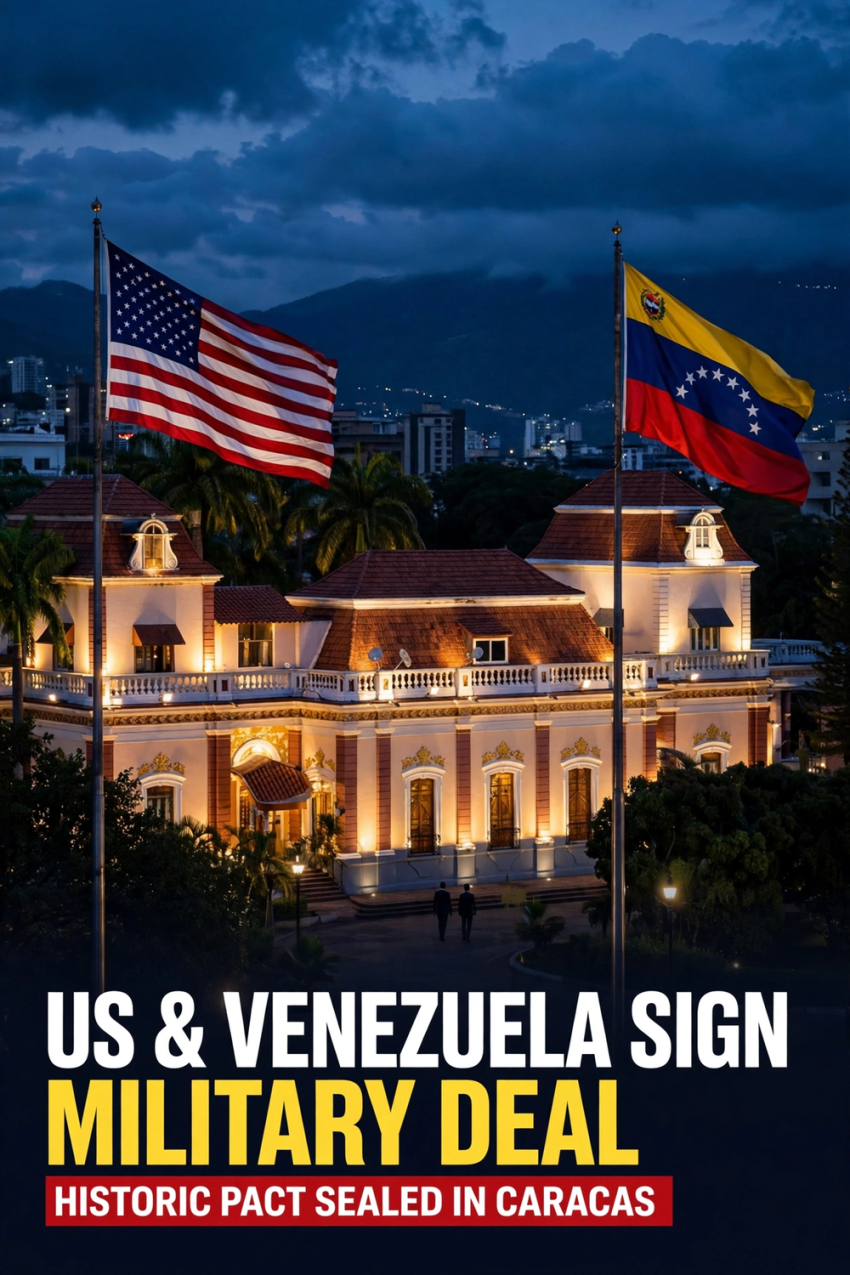
The US Venezuela military deal was signed on Wednesday 18 November 2026, when US Defense Secretary Pete Hegseth made an unannounced visit to Caracas and met interim President Delcy Rodríguez at the Miraflores presidential palace. The agreement restores military cooperation between the United States and Venezuela for the first time in more than two decades, covering joint training, intelligence sharing and access to more American defence equipment and capabilities. Hegseth called it a “historic agreement” that “reestablishes a renewed military partnership” between the two countries.
The Pentagon did not announce the trip in advance, and the visit was broadcast on Venezuelan state media. It was the first visit to Venezuela by a sitting US defence secretary since the 3 January 2026 US military raid in Caracas that captured then-President Nicolás Maduro. Maduro was taken to New York with his wife, Cilia Flores, to face federal drug-trafficking and weapons charges; he has pleaded not guilty, and his trial is set for June 2027. Rodríguez, Maduro’s former vice-president, now leads the interim government, which President Donald Trump has backed.
What the US Venezuela military deal covers
Under the US Venezuela military deal, the two countries’ armed forces will train together, share intelligence and cooperate on counter-narcotics and counterterrorism operations, Hegseth said. He described the arrangement as “training together, partnering together, sharing intelligence, more defense equipment and capabilities together”. Rodríguez said the deal would strengthen training for Venezuela’s armed forces, give them access to new technologies and help confront “common threats”. Venezuela’s Defence Minister Gustavo González López was present at the signing, according to CNN.
Few details have been released, and neither government has published the text of the agreement. It is a military cooperation agreement — not a treaty or a formal defence pact — and the Pentagon has not said when joint training will begin, which units will take part, or what equipment will be supplied. Reuters reported that the agreement covers joint training, intelligence sharing and other aspects of US–Venezuelan military cooperation, and that Hegseth said the partnership would mean a significant increase in joint action against drug-trafficking groups.
From raid to partnership: a dramatic reversal
Hegseth framed the agreement as the latest step in a rapid transformation of the relationship. He said Venezuela had gone “from our most aggressive regional threat to a compliant security partner” in under 12 months, and credited “close cooperation” with Rodríguez’s interim government for allowing officials “to stabilize Venezuela and rid it of narco-terrorists once and for all”, according to the Associated Press.
The US Venezuela military deal caps a ten-month shift that began with the January raid. Military cooperation between the two countries dates back to 1951, but was terminated in 2005 by then-President Hugo Chávez. The new agreement therefore restores defence ties that had been broken for 21 years — a point Hegseth underlined by calling the visit part of a “reestablishment of our defense partnership”.
Why Caracas matters now
The US Venezuela military deal also comes as Washington deepens its involvement in Venezuela on several fronts at once. Hegseth said the partnership would mean more strikes against drug cartels in the region, and the Caracas stop is the first on a four-country Latin America trip. He is the latest member of President Trump’s cabinet to travel to Venezuela, following visits by the Interior and Energy secretaries focused on the country’s oil reserves and critical minerals, the Associated Press reported.
In August, a separate deal gave the producer North American Blue Energy Partners long-term access to 17 Venezuelan oilfields containing about a fifth of the country’s oil reserves, through a partnership with the US government, Reuters reported. Hegseth also discussed that oil partnership in Caracas, presenting Venezuelan oil as a way to reduce reliance on Middle Eastern supplies.
The agreement lands amid a crowded global security picture. Washington is juggling several crises at once — from the attack on the Crimea bridge in the Russia–Ukraine war to the peace declaration signed by Trump, Xi and Putin in Shenzhen and the Houthi missile strike on Riyadh’s PIF Tower. The Venezuela deal adds a new military dimension to US policy in its own hemisphere.
Timeline: Wednesday 18 November 2026
- Morning, Caracas: Hegseth arrives in the Venezuelan capital on a visit the Pentagon did not announce in advance. Venezuelan state television broadcasts footage of his arrival.
- Miraflores Palace: Hegseth meets interim President Delcy Rodríguez at the presidential palace. The military cooperation agreement is signed, with Venezuela’s Defence Minister Gustavo González López present.
- US Embassy, Caracas: Hegseth addresses diplomats and military officials from both countries, announcing the deal and calling it a “historic agreement” that reestablishes a renewed military partnership.
- Later on Wednesday: Hegseth is expected to continue his Latin America trip, with Colombia among the next stops, according to Al Jazeera.
- The background: On 3 January 2026, US special forces captured then-President Nicolás Maduro in a nighttime raid on Caracas. Military cooperation between the two countries had been terminated in 2005 by Hugo Chávez, ending a partnership that dated back to 1951.
What happens next
Several questions remain unanswered. The Pentagon has not released the text of the agreement, a timetable for the first joint training, or details of the equipment and capabilities the US will supply. The first public test of the deal will be whether joint training and intelligence sharing actually begin — and whether the promised increase in action against drug-trafficking groups follows.
The deal is also likely to draw scrutiny in Washington, where US policy towards Venezuela remains contested, and in Caracas, where Rodríguez’s interim government faces questions about its political future. No date has yet been announced for Venezuela’s next presidential election. TBS News, citing Reuters, reported that both Rodríguez and Hegseth publicly welcomed the agreement at the presidential palace — but what it means in practice will only become clear once the two militaries start working together.
Question: Do you support the US–Venezuela military cooperation deal?
YES / NO / NOT SURE
Note: This poll is not a scientific survey.
Sources
4 thoughts on “US Venezuela Military Deal: Hegseth Signs Historic Pact in Caracas”