
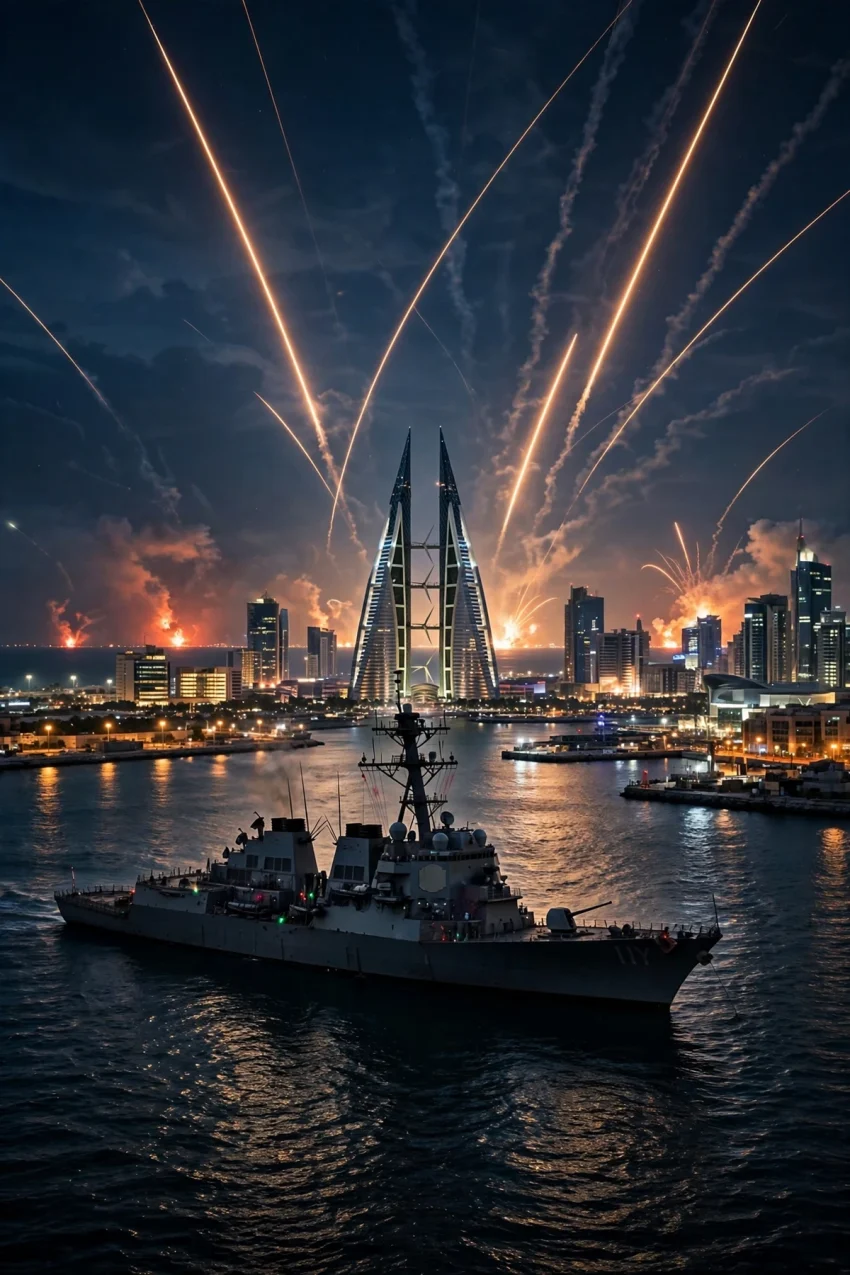
Iran attacks US bases in Bahrain in a combined missile-and-drone strike launched on Saturday night, 21 November 2026, in the fourth Iranian attack on the island in nine days. Iran’s Islamic Revolutionary Guard Corps (IRGC) Aerospace Force said it targeted US military positions in Bahrain and claimed it hit the radars of two US Patriot air-defence systems. But the claim has not been confirmed by the United States, and Bahrain’s own account of the night tells a different story: a civilian industrial facility was hit, a fire broke out, and nobody was hurt.
The attack is the latest escalation in a confrontation building for more than a week around the Gulf, and it comes on the same night at least three oil tankers were attacked near the Strait of Hormuz. No casualties have been reported anywhere in this attack.
What Iran Claims
According to a statement from the IRGC carried by its Sepah News outlet and Iranian state agency IRNA, the IRGC Aerospace Force launched a combined missile-and-drone attack against US military positions at the Al-Riffa and Awali Sakhir bases in Bahrain. The statement claimed the strike hit the radars of two US Patriot air-defence systems.
The IRGC said the attack was retaliation for what it described as repeated violations of Iranian airspace by US MQ-1 Predator and MQ-9 Reaper drones, and for an attack on a radar installation on Iran’s Hengam Island.
There is, however, a significant discrepancy inside Iran’s own reporting of the strike. The semi-official Fars news agency earlier named different targets: Sheikh Isa Air Base and the US naval facility at Juffair, home of the US Navy’s Fifth Fleet headquarters in Manama. Those two namings do not match. The IRGC statement names Al-Riffa and Awali Sakhir; Fars named Sheikh Isa and Juffair. Neither version has been independently confirmed, and the mismatch is itself a reason to treat the precise details of the Iranian account with caution.
What Bahrain Says
Bahrain’s account of the night differs sharply from Tehran’s. The Bahrain Interior Ministry said an Iranian attack hit a civilian industrial facility, causing a fire but no injuries. The ministry first urged residents to move to the nearest safe location, later issued an all-clear, and then issued a second alert.
The Bahrain Defence Force said its air defences intercepted a number of Iranian aerial attacks, and that falling debris and shrapnel caused material damage, with no casualties. Bahrain called the strike a “heinous Iranian attack” and described it as part of a “systematic hostile approach” by Tehran.
Taken together, the Bahraini account describes an attack that was largely intercepted, with the damage confined to a civilian industrial site and debris — and, crucially, no one killed or injured. That stands in contrast to the IRGC’s claim of successful strikes on US air-defence radars.
What the US Has Said So Far
US Central Command had not immediately responded to Reuters’ request for comment on the IRGC’s claims as of Sunday morning. That means the claim that US Patriot radars were hit remains unconfirmed. It should not be reported as fact.
What Washington has said, firmly, is that a separate Iranian claim from Saturday is false. CENTCOM denied an Iranian claim that it had damaged a US F-16 over the Gulf, saying: “Iran did not attack a US F-16 fighter aircraft yesterday – at all; all US military fighter jets in the Middle East are safe and accounted for.”
The pattern is now familiar. Iran claims it has hit US radar systems; the US denies it. The same cycle played out earlier in this confrontation, and it is playing out again after Saturday night’s attack. Until CENTCOM responds, the only verified facts are Bahrain’s: an attack happened, air defences intercepted a number of incoming weapons, a civilian facility caught fire, debris caused material damage, and no one was hurt.
Iran Attacks US Bases in Bahrain: A Pattern, Not an Isolated Strike
Saturday night’s attack was the fourth Iranian attack on Bahrain in nine days, and the pattern behind it matters as much as the attack itself.
On 13 November, Iran claimed it had hit a radar in Bahrain; the Pentagon denied it. On 15 November, six Iranian drones targeted Al-Riffa. On 17 November, Iran made a third radar claim, which CENTCOM called false, saying the drones had been intercepted with no damage to US equipment and no injuries. In each case, Iran claimed a strike on US radar; in each case, the US said no such damage occurred.
That history is the context for Saturday night. It does not prove the latest claim is false — only the US military can confirm or deny what happened to its own equipment — but it does mean the claim that Iran attacks US bases in Bahrain and hit American radars should be treated as an Iranian assertion, not as an established fact, until there is independent or official confirmation.
The wider Gulf picture is also deteriorating. On the same Saturday, at least three oil tankers were attacked near the Strait of Hormuz, in a separate incident covered in our report on the escalating tanker war in the Strait of Hormuz. The earlier rounds of this confrontation — including the drone attack on Bahrain and the US strikes on Qeshm Island that followed — are covered in our earlier report on the Iran Bahrain drone attack and US strikes on Qeshm Island.
Why This Matters — and What Happens Next
- The US response is the decision that matters most. Reuters reported last week that President Trump told senior advisers he does not plan to escalate attacks on Iran unless provoked by Iran or the Houthis. Trump told Axios on Thursday that there would be no decision on new Iran strikes until after 1 January. Whether Saturday night’s attack counts as the kind of provocation that changes that calculation is now the central question in Washington.
- Bahrain is not a peripheral target. The island hosts the headquarters of the US Navy’s Fifth Fleet, the command responsible for American naval operations across the Gulf, the Red Sea and the Arabian Sea. An attack on Bahrain is, by definition, an attack on the centre of the US military presence in the region.
- The tanker convoy at Kharg Island is still waiting. A convoy of more than 14 tankers remains staged at Iran’s Kharg Island, with no departure confirmed. Its movement — or continued stillness — will be one of the clearest signals of whether Tehran intends to escalate the confrontation at sea.
- The verification gap will close, one way or the other. CENTCOM’s response, when it comes, will settle whether any US equipment was hit. Until then, the gap between Iran’s claims and Bahrain’s account is the story — and every claim in this article should be read with its attribution attached.
- Congress is already part of this fight. The Senate recently rejected a war powers resolution on Iran, as covered in our report on the Senate Iran war powers resolution. Any US retaliation would revive that debate immediately, and with it the question of who decides when America goes to war.
For now, the situation is tense but contained: an attack happened, it was largely intercepted, nobody was hurt, and the most dramatic claim attached to it is unconfirmed. That could change quickly. What happens next depends on what Washington concludes about Saturday night — and on whether Iran attacks US bases in Bahrain again, and how the US answers if it does.
This poll is not a scientific survey. It reflects the views of readers who choose to vote and is not representative of the wider public.
Sources
- Reuters, via Devdiscourse — Bahrain says Iranian attack hits industrial facility as air defences intercept attacks: https://www.devdiscourse.com/article/international/4010463-bahrain-says-iranian-attack-hits-industrial-facility-as-air-defences-intercept-attacks?amp
- Xinhua, via People’s Daily Online — reporting on the IRGC statement and the Bahrain attack: https://peoplesdaily.pdnews.cn/world/er/30053611030
- ANI / Al Jazeera reporting, via WebIndia123 — coverage of the attack and the conflicting target claims: https://news.webindia123.com/news/Articles/World/20261122/4522880.html
- IRGC statement via Sepah News / IRNA (as reported by the above outlets)
- Bahrain Interior Ministry and Bahrain Defence Force statements (as reported by the above outlets)
- US Central Command statement on the F-16 claim (as reported by the above outlets)