
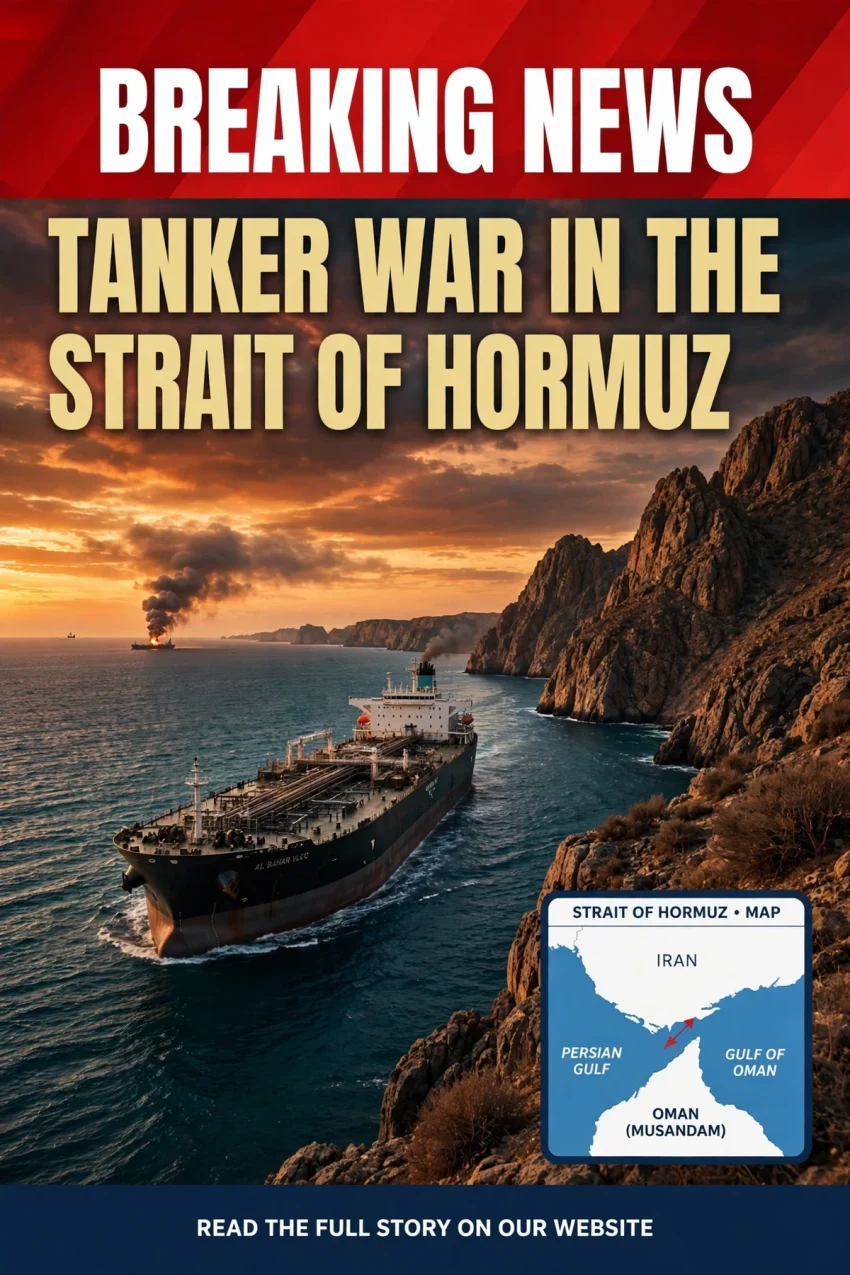
Hormuz Tanker Attacks: 4 Tankers Hit in 3 Days
The Hormuz tanker attacks are escalating into something the shipping world now calls a tanker war. On Saturday 21 November 2026, two more tankers were struck by unknown projectiles near Khasab, Oman, at the entrance to the Strait of Hormuz — the narrow waterway that carries nearly a fifth of the world’s crude oil. It was the fourth tanker hit near Khasab in three days, and roughly the nineteenth attack on shipping in the strait in November. No one was hurt on Saturday, no vessel has been named, and no one has claimed responsibility. But the maritime threat rating is now SEVERE, further attacks are rated “highly likely” in the next 24 to 48 hours, and traffic through the strait is falling fast.
This is no longer a series of isolated incidents. Four hits in three days, about 19 attacks in November, a SEVERE rating, traffic down sharply — the pattern is a sustained campaign against commercial shipping in one of the world’s most important chokepoints. The question is no longer whether the tankers are being targeted. It is who is doing it, and whether the United States will answer with force.
Saturday’s Strikes: What UKMTO Reported
The details come from the United Kingdom Maritime Trade Operations centre, UKMTO, the British maritime security agency that monitors shipping in the region. Its warnings 215-26 and 216-26, issued at around 0500 and 0550 UTC on Saturday 21 November, reported two strikes. The first hit a tanker on its stern as it sailed out of the strait, about 11 nautical miles north of Khasab. The second struck a tanker in its engine room, about 17 nautical miles east of Khasab. In both cases the weapon was an unknown projectile. No casualties were reported, and the environmental impact — whether any oil leaked — remained unknown.
It is not immediately clear whether the two reports involved the same vessel, and no vessels have been named. No flags, owners or cargoes have been identified. A day earlier, on Friday 20 November, another tanker was struck near Khasab and caught fire. That makes four tankers hit near the same Omani port town in three days — a concentration that points to a deliberate campaign in a single stretch of water, not random violence.
Khasab sits on Oman’s Musandam Peninsula, at the entrance to the Strait of Hormuz. Before the start of the Iran war, the strait carried nearly one-fifth of global crude oil supplies. Every attack on a tanker there is a warning to the rest: this waterway is no longer safe.
The Mine Claim — Unverified
Iran’s navy said on Saturday that an oil tanker had caught fire after hitting a naval mine in a restricted area east of the Strait of Hormuz, a claim also carried by the Islamic Revolutionary Guard Corps through state media. But Reuters could not independently verify the Iranian account, and could not establish whether it referred to any of the incidents reported by UKMTO. The mine claim is unverified — an Iranian claim, not a confirmed fact.
The two accounts describe different weapons — a mine and a projectile. Until independent evidence appears, the honest position is that two tankers were struck by unknown projectiles on Saturday, and that Iran has offered a separate, unverified explanation that may or may not describe the same events.
The same caution applies to another claim circulating on Saturday: Iranian state media claimed an American MQ-9 drone had been shot down. That comes from a single source — Iran’s state media — and there is no US confirmation. It is an unconfirmed claim, and nothing more.
Hormuz Tanker Attacks: A Six-Month Conflict Reaches the Shipping Lanes
The Hormuz tanker attacks did not come out of nowhere. They are the latest phase of a US–Iran conflict running for about six months. The United States has sunk five Iranian tankers. Iran has attacked ten ships. The US is blockading Iranian ports, and the Treasury imposed fresh sanctions on Iran on Friday. On Saturday, US Central Command disabled a commercial vessel in the Gulf of Oman for ignoring blockade warnings — routine blockade enforcement, with no casualties and no vessel named.
The pattern is escalation by increments: each side raising the pressure on the other’s shipping, each step stopping short of open war. The tanker attacks fit that pattern — serious enough to frighten shipowners, costly enough to disrupt trade, and ambiguous enough to leave room for denial.
The costs are already visible. The Joint Maritime Information Center, JMIC, rates the threat to shipping as SEVERE and says further attacks are “highly likely” in the next 24 to 48 hours. Strait traffic is falling: last week saw 115 outbound and 148 inbound transits, against 139 and 169 the week before, and traffic is now about 65% below pre-conflict levels, according to UKMTO’s weekly overview.
What It Means for Oil — and for the Decision in Washington
The economic stakes are straightforward. The Strait of Hormuz is the route for nearly a fifth of the world’s crude oil, and a sustained campaign against tankers there threatens supply, pushes up insurance and freight costs, and feeds into the price of oil everywhere. Markets have absorbed shocks before — the global market rout that sent the S&P 500 into correction (https://nimda.in/sp-500-correction-global-market-rout/) showed how quickly fear travels — but a shipping war in Hormuz is a different kind of risk: not a one-day sell-off, but a slow strangulation of the route itself.
The political stakes are higher still, and they sit in Washington. President Trump has said there will be no decision on new strikes against Iran until after 1 January, according to an Axios report of a phone interview on Thursday. That sits awkwardly against a CBS report that a possible US or Israeli assault could come within two to four days — planning only, and contradicted by Trump’s delay. There has been no US response yet to the two Saturday strikes. Attacks continue while the response is debated, and every new strike raises the pressure to answer.
The region’s wider tensions frame that decision, from the negotiated entry of Iraqi troops into the militia stronghold of Iraq Jurf al-Sakhar (https://nimda.in/iraq-jurf-al-sakhar/) to the striking security realignments of the past week, including the US–Venezuela military deal (https://nimda.in/us-venezuela-military-deal/). The Hormuz campaign is one front in a wider contest over who controls the region’s waterways, its oil and its shipping lanes.
What Happens Next
- Next 24–48 hours: JMIC rates further attacks as “highly likely”. Watch for new UKMTO warnings — the pattern of the past three days suggests the next strike will come near Khasab.
- The named vessel question: no vessel has been named in the Saturday strikes. If a flag, owner or cargo is identified, it will tell us who is being targeted and why.
- The US response: there has been no American response yet. Trump’s stated position is no decision on new Iran strikes until after 1 January — watch whether the tanker campaign forces that timetable to move.
- The mine claim: Iran’s account remains unverified. Any independent evidence would change the picture materially.
- Traffic and oil: with strait traffic about 65% below pre-conflict levels, watch insurance rates, freight costs and oil prices for the market’s verdict.
The Hormuz tanker attacks have turned the Strait of Hormuz into a war zone for commercial shipping. Four tankers in three days, about 19 attacks in November, a SEVERE threat rating and traffic down by two-thirds — the numbers tell their own story. The ships keep sailing, for now, because the world still needs the oil. But every strike makes the next sailing a harder decision: how long can the world’s most important oil route stay open under fire?
Vote: Should the US respond militarily to the Hormuz tanker attacks? — YES / NO / NOT SURE
Sources: Reuters via SRN News (https://srnnews.com/tanker-hit-by-unknown-projectile-near-omans-khasab-ukmto-says/); Reuters via gCaptain (https://gcaptain.com/two-tanker-incidents-reported-near-oman-vessel-hit-mine-east-of-hormuz/).
Results are shown with vote counts and are not scientific.
3 thoughts on “Hormuz Tanker Attacks: 4 Tankers Hit in 3 Days”