
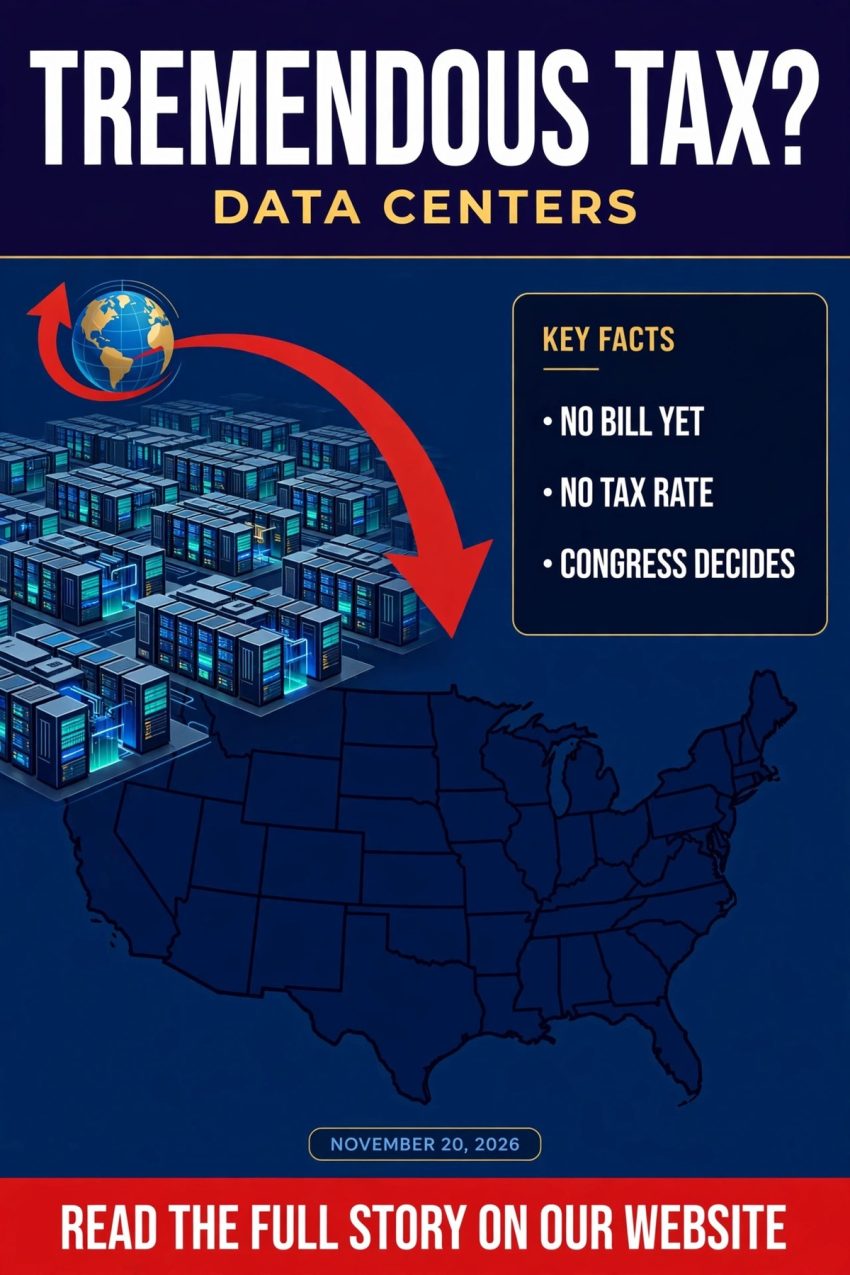
President Donald Trump says American companies that build data centers outside the United States will face a “tremendous tax” — a warning aimed squarely at the Big Tech firms racing to build the artificial intelligence infrastructure of the next decade. But as of today, there is no tax rate, no bill, no executive order and no enforcement date behind the threat. The question now is not just what Trump said, but whether anything he said can actually become law — and what it means for the companies, the workers and the power grid caught in the middle.
What Trump actually said about overseas data centers
Trump made the remarks at a White House press conference on Friday, November 20, 2026, shortly after returning from a trip to Asia. “We’re not going to allow our companies to build data centers outside of our country,” he told reporters, adding that companies that build abroad anyway would face a “tremendous tax” — or, in some accounts of the briefing, “tremendous penalties.”
His stated reason was China. “We’re not allowing data centers to go into other countries because China will take all of them,” Trump said, arguing that keeping AI computing capacity inside the United States is essential to staying ahead of Beijing.
There is one detail readers should know about: news outlets do not agree on a single word of the quote. The Associated Press and Newsweek report Trump as saying, “If they do that, they can. But we’re going to put a tremendous tax on them” — a tax on a permitted activity. NBC News transcribed the same passage as “If they do that, they can’t” — a ban backed by a tax. No official transcript of the briefing has been published, so the exact wording remains unsettled. Either way, the direction of travel is the same: pressure on US companies to build at home.
Trump also made clear the idea had not gone through the usual process. “I haven’t even said that to my people,” he admitted — meaning his own staff had not been briefed on the policy before he announced it in public.
Which companies would the data center tax hit?
The threat, if it ever becomes policy, would land hardest on the US cloud and AI giants that already operate data centers around the world: Amazon, Google, Microsoft, Meta and Oracle. All five have built or announced overseas data center capacity, in many cases because customers, regulators or latency requirements demand servers close to where the users are.
Trump singled out Alphabet’s build in Finland during the briefing, according to reports, and the wider industry has billions of dollars in overseas data center agreements already signed. A tax on that spending would not just hit the tech companies — it would hit the construction firms, chip suppliers and local economies tied to those projects, at home and abroad.
So far, the companies have said little. Microsoft declined to comment to Newsweek, and Amazon, Google, Microsoft and Oracle did not immediately respond to requests for comment, according to CNBC’s reporting. The Data Center Coalition, an industry group, was the only organisation to issue a public response in the first days after the announcement.
Can Trump actually impose a data center tax?
Here is where the threat meets the Constitution. Article I, Section 8 of the US Constitution gives Congress — not the president — the power to levy taxes. A binding tax on overseas data center construction would need legislation, and there is no bill in Congress. As of November 21, no executive order, presidential memorandum, congressional bill or Treasury guidance had been published, according to Axios.
The politics make a bill unlikely in the near term. Democrats won majorities in both chambers of Congress in the November midterm elections, according to post-election reporting, and take office in January. A Republican president’s tax on corporate investment abroad is not expected to pass that Congress.
That does not mean the threat is empty. The White House has another, narrower lever that is already law: a Commerce Department chip-export rule that took effect on November 19, the day before Trump’s remarks. The rule requires a licence to ship advanced AI chips to any data center anywhere in the world that provides more than 12 million aggregate total processing performance to customers headquartered in China or other restricted countries. It does not tax buildings — it controls who can use the computing power inside them. That distinction matters: a data center in Finland serving Finnish banks is unaffected, while a facility renting capacity to a Chinese-headquartered customer is not.
What happens next for AI data centers and the US power grid
Even without a law, the announcement changes the calculation for every company planning its next data center. Site selection, power contracts and lease negotiations all now carry a new political risk, and chief financial officers will have to weigh whether an overseas build announced today could become a tax liability tomorrow.
If even a fraction of the overseas investment now planned is redirected to the United States, it lands on a power grid already under strain. US power demand is projected to hit records through 2027, driven heavily by AI data center growth. More domestic construction means more competition for the same constrained grid — and higher costs for everyone drawing power from it, from data centers to households.
The 90-day test is simple: if no executive order, Commerce Department rule or congressional bill appears by mid-February 2027, the threat will have deflated on its own, and hyperscalers will resume overseas builds with no penalty. Until then, the uncertainty itself is the policy.
What this means for you
- If you work in tech, construction or energy, watch for a formal rule — not a press conference — before changing plans.
- If you invest in Big Tech, the story to follow is not the tax threat itself but the Commerce Department’s chip-export licensing, which is already in force.
- If you live near a planned data center, the pressure to build in the US — in states like Texas, West Virginia and California, which Trump named — could bring construction and power demand to your area sooner than expected.
Related reading on the Trump data center tax: Nvidia’s board reinstated Jensen Huang as CEO after the SEC probe rocked the chipmaker; A federal appeals court ruled House proxy voting unconstitutional; Trump says he will resume Iran strikes after the New Year if no deal is reached. More Trump data center tax coverage in US Economy.