
Nvidia reinstates Jensen Huang as president and chief executive officer, effective immediately — just 11 days after the board accepted his resignation. The board voted unanimously on Sunday, November 22, and announced the decision before Monday’s market open, in a reversal that stunned Wall Street and sent Nvidia shares soaring.
The return caps an extraordinary 11 days: a celebrated founder forced out over reported affairs and suspected foreign-intelligence links, a board that said it would not bring him back, and a president demanding his return. Investors treated it as the all-clear: Nvidia added roughly $960 billion in market value in premarket trading, and the wider market staged one of its biggest rallies in years.
What happened: the board’s unanimous vote
Nvidia said its board voted unanimously to reinstate Huang after “a series of discussions and meetings” with him left directors satisfied “with respect to Mr. Huang’s candor and ability to lead NVIDIA.” The decision was disclosed in a Form 8-K filing. Huang returns as president, chief executive officer and a member of the board — all three roles he gave up on November 12.
The board said it had received input from senior levels of the United States government, and based on that input, it is confident the reinstatement “poses no national security risk.” Chair Harvey Jones said: “The Board believes Jensen is the right person to lead NVIDIA, and that his reinstatement is in the best interests of our stockholders, employees, partners and customers.”
Huang said he was “honored to return to NVIDIA and lead one of the most consequential technology companies in the world at the beginning of a new industrial revolution.” Kress returns to her role as chief financial officer, and Jones remains board chair.
The board’s vote means Nvidia reinstates Jensen Huang as president, CEO and board director — six days after Jones said on the November 17 earnings call that the board “does not intend to reinstate Jensen as CEO.”
Why Huang left 11 days ago
The crisis began on October 29, when The New York Times reported Huang had been the target of a suspected Chinese intelligence effort. The Times reported an extramarital affair with Alice Huang — no relation — a former executive at Megaspeed, a Singapore-based data-centre company and Nvidia customer. US officials suspected she had been recruited by China’s Ministry of State Security; the Times later reported US intelligence is said to show she was in touch with the ministry from spring 2025 through fall 2026.
Those allegations remain unproven: Attorney General Todd Blanche said the Justice Department had reached no conclusion about whether Alice Huang was a spy, CNN reported the intelligence did not prove she had acted as one, and Singapore said there was insufficient evidence she had committed the suspected offences. Megaspeed said she had left the company in August 2025.
On November 8, Huang told Nvidia employees he had been unfaithful to his wife and apologised to his family and colleagues. The board opened an investigation the same day and later formed a committee of independent directors, which retained independent counsel, to examine whether Huang had been the target of a foreign intelligence effort. On November 11, the Times reported a second relationship, with an Nvidia executive who reported to Huang. The board met that day and accepted his resignation, announced on November 12, with Kress becoming interim chief executive and Jones board chair.
Eleven days later, Nvidia reinstates Jensen Huang — the same board that accepted his resignation now says it is satisfied with his candor and ability to lead. On November 17, Huang posted on X that he would return if the board decided it was in the shareholders’ best interest. That evening, Jones ruled it out on the earnings call. Six days later, the board changed its mind.
Trump, Bessent and the government’s role
President Donald Trump had repeatedly called for Huang’s return, and on Monday he praised the decision on Truth Social, writing that the board had made “the correct and proper decision.” Trump added: “The Country needs Jensen’s leadership at NVIDIA in order to ensure the Success and Prosperity of not only the Company, but the American Economy.”
Treasury Secretary Scott Bessent also shifted: he had earlier said Nvidia should look outside the company for its next chief executive, but on CBS’s Face the Nation on Sunday he said: “Well, I said they should go to the outside, but he’s on the outside now.” Bessent added Nvidia still needs to provide answers as it faces scrutiny from Congress and federal investigators.
The board said it took input from senior levels of the US government before voting, and that the input left it confident the return poses no national security risk. Nvidia has also formed a new National Security and Export Control Committee to oversee trade compliance and national-security risks.
Wall Street’s relief rally
Nvidia reinstates Jensen Huang — and Wall Street erupted.
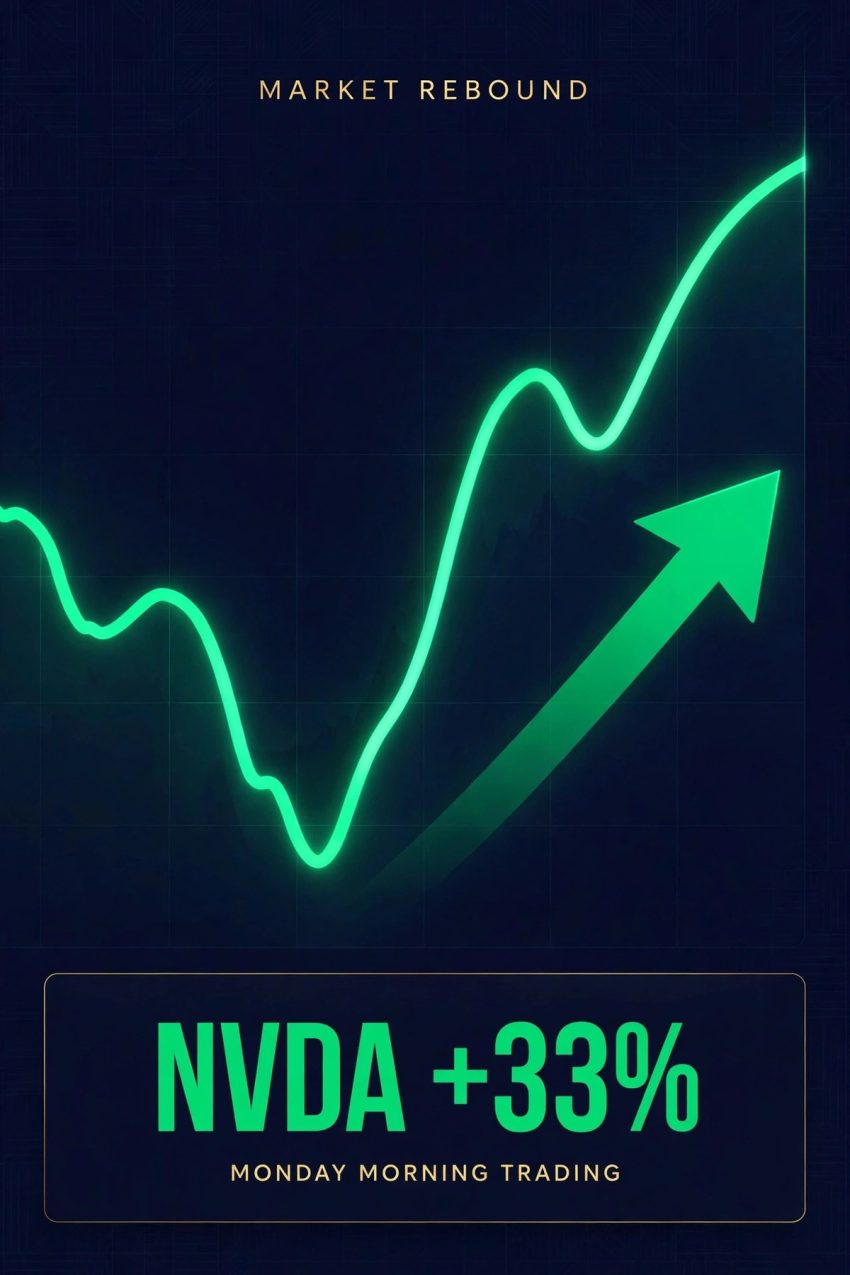
In Monday morning trading, Nvidia shares jumped about 33% to $167.12 at around 10:15 a.m. Eastern time, after rising 30% to 31% in premarket trading. Friday’s close was $125.53, after the stock fell about 14% that day. The rebound added roughly $960 billion in market value in premarket trading.
The rally spread: the Nasdaq rose about 7% in Monday morning trading, opening 7.3% higher, the S&P 500 gained about 4.8% and the Dow rose about 2.8%, up 1,365 points. The S&P 500 ended seven straight days of declines and was on track for one of its best days since 2020.
The scale is clearest against last week: the Nasdaq fell 10.02% last week, the S&P 500 fell 8.61% and the Dow fell 8.02% — the Nasdaq’s and the Dow’s worst weeks since the March 2020 COVID selloff, and the S&P 500’s worst since April 2025. By Friday’s close, the S&P 500 and the Dow had both entered correction territory, more than 10% below their record closes, and the Nasdaq had wiped out its gains for the year.
Nvidia had been at the centre of the selloff: the stock fell nearly 23% last week and had dropped almost 49% from its October 6 record high through Friday’s low. Even after Monday’s surge, $167.12 was still well below the $186.40 level from before the scandal first broke. The business underneath is still growing: Nvidia’s third-quarter results on November 17 beat expectations and raised its outlook, with revenue of $115.8 billion, up 103% on a year earlier. The market’s message was that the leadership question, not the business, had been the problem.
What happens next
- The independent investigation continues. The board’s committee of independent directors, with independent counsel, is still examining the reports that Huang was the target of a foreign intelligence effort. Huang has pledged to cooperate.
- Huang faces Congress on December 1. He has agreed to a voluntary transcribed interview with three House committees: Foreign Affairs, the Select Committee on the Chinese Communist Party and Intelligence. Nvidia’s general counsel, Tim Teter, is due before the same committees on December 2.
- The SEC probe is unresolved. The Wall Street Journal reported on November 17 that the SEC opened a civil investigation into whether Nvidia’s disclosures misled investors; Reuters reported on November 20 that enforcement staff are examining potential accounting issues. Neither the SEC nor Nvidia has confirmed the probe and no charge has been filed; an investigation is not evidence of wrongdoing.
- The delayed 10-Q is still to come. Nvidia broke with usual practice and said its quarterly filing would arrive in “the coming weeks” rather than alongside its results. Investors will read it closely for any restatement.
- California’s subpoena is open. Attorney General Rob Bonta subpoenaed Nvidia on November 19, asking whether advanced chips or confidential information may have reached China and whether Nvidia misled investors about that risk. It is an investigative step, not a filing of charges.
The fact that Nvidia reinstates Jensen Huang does not close the book on the questions that forced him out 11 days ago. The investigations, the testimony and the delayed filing are all still ahead. But for one Monday morning, investors got the outcome they wanted — the founder back in charge and the stock roaring. The next test is whether the rally holds once the market turns back to the unanswered questions.
Vote: Should Nvidia have brought Jensen Huang back as CEO? Cast your vote below — YES, NO or NOT SURE.
This poll is not a scientific survey.
Sources
- NVIDIA — “NVIDIA Board Reinstates Jensen Huang as President, CEO and Board Director” — (November 23, 2026)
- Morningstar — “AI Stocks Surge After Huang Returns to Nvidia — Update” — (November 23, 2026)
- CNN — “Nvidia board reinstates Jensen Huang as CEO” — (November 23, 2026)
2 thoughts on “Nvidia Reinstates Jensen Huang as CEO in Stunning Reversal”