
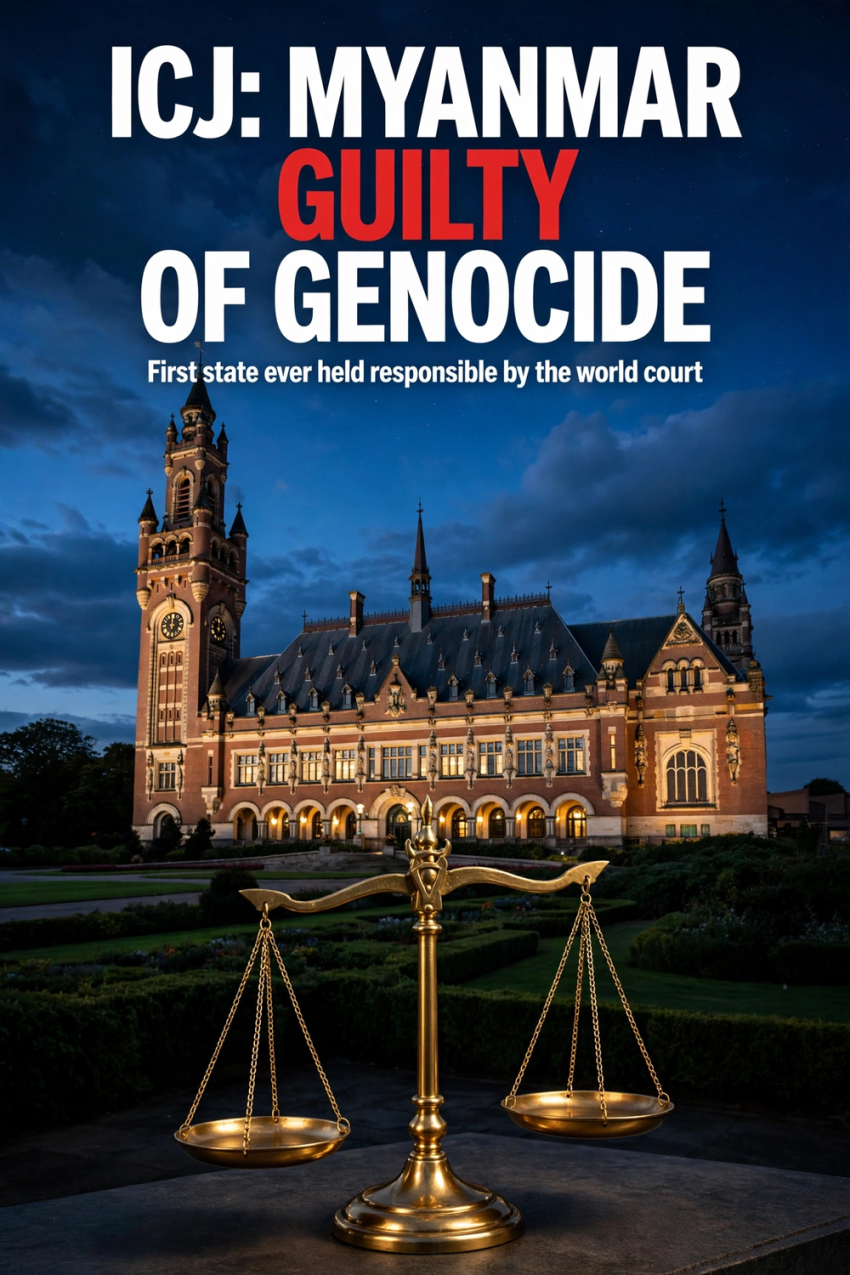
The ICJ Myanmar Rohingya genocide ruling, delivered on Thursday 19 November 2026 at the Peace Palace in The Hague, found that Myanmar committed genocide against the Rohingya group in northern Rakhine State during its 2017 military operations. By nine votes to six, the 15-judge panel — presided over by Court President Judge Yuji Iwasawa — rejected Myanmar’s argument that the campaign was a legitimate counter-insurgency operation. It is the first time the International Court of Justice has ever held a state responsible for genocide.
Judge Iwasawa said: “The court finds that Myanmar’s security forces killed thousands of Rohingya civilians, perpetrated widespread acts of sexual violence as well as acts of extreme violence against children and attacked fleeing Rohingya.” The court found the evidence showed about 10,000 Rohingya were killed. It concluded the “only reasonable inference” from the pattern of conduct was an intent to destroy a substantial part of the Rohingya population in northern Rakhine State — the specific intent that genocide requires.
What the court ordered
The ICJ Myanmar Rohingya genocide ruling orders Myanmar to investigate suspected genocide perpetrators and prosecute them if warranted, to provide assurances of non-repetition, and to facilitate the safe and dignified return of displaced Rohingya to their places of residence and the reunification of families. Myanmar also has an obligation to make reparations — but the amount and modalities of compensation are to be determined at a later stage of the proceedings, and Myanmar should report within two years on how it will adopt restitution.
The court also ruled, by 11 votes to 4, that Myanmar violated its obligation to punish genocide, and by the same 9–6 margin that it violated its obligation to prevent genocide. But by 14 votes to 1, the court found Myanmar had not publicly incited genocide.
The case: seven years to a verdict
The Gambia brought the case against Myanmar at the International Court of Justice on 11 November 2019, with the backing of the 57-member Organisation of Islamic Cooperation. It alleged that Myanmar breached the 1948 Convention on the Prevention and Punishment of the Crime of Genocide during its military campaign against the Rohingya in Rakhine State in 2017. Myanmar has consistently denied genocide, saying its campaign was a legitimate counter-terrorism operation responding to attacks by the Arakan Rohingya Salvation Army (ARSA) on police posts in August 2017.
In August 2017, Myanmar’s security forces began a sweeping campaign in northern Rakhine State — mass killings, mass rape and village burnings, according to refugee accounts and a 2018 United Nations Independent International Fact-Finding Mission, which concluded there was sufficient information to infer genocidal intent and recommended senior generals be investigated and prosecuted for genocide. More than 730,000 Rohingya — mostly Muslim, in a Buddhist-majority country — fled across the border into Bangladesh. About 1.2 million Rohingya now live in the Cox’s Bazar refugee settlement in Bangladesh, the world’s largest refugee camp. The United States has classified the Rohingya crisis as genocide.
The road to the verdict ran through provisional measures in January 2020, when the ICJ unanimously ordered Myanmar to take all measures within its power to prevent genocidal acts, ensure its military did not commit them, preserve evidence, and report on compliance. In July 2022 the court rejected Myanmar’s preliminary objections to its jurisdiction, and public hearings on the merits were held from 12 to 29 January 2026 at the Peace Palace, including closed-door testimony from Rohingya witnesses. On 3 November 2026 the court announced it would deliver its judgment on 19 November.
Why this ruling is historic
The judgment is only the third time the ICJ has ruled on the merits of a genocide case, and the first in more than a decade. The court has never before found a state responsible for committing genocide — proving specific intent, the intent to destroy a group in whole or in part, has been the key obstacle in earlier cases. The ICJ Myanmar Rohingya genocide ruling is final and legally binding, and cannot be appealed. But the court has no enforcement force of its own: if Myanmar ignores it, The Gambia could ask the UN Security Council to act. The court settles disputes between states — it can find Myanmar responsible, but it cannot try individuals; that is the duty of the International Criminal Court.
What it means for Gaza and international law
Legal observers were watching the reasoning closely for clues relevant to other Genocide Convention cases — including the case brought by South Africa against Israel over Gaza, where a final ruling is not expected before 2029. The court’s approach to intent and state responsibility in the ICJ Myanmar Rohingya genocide ruling will be studied by lawyers on all sides of that case. It also matters for the ground operation in Gaza itself: read our report on the Israeli ground operation crossing the ceasefire line in central Gaza. The ruling also tests how international law handles state responsibility more broadly — a question that runs through other conflicts, including the sanctions debate covered in our report on the UK sanctioning Israeli settlements in the West Bank.
No reaction from Myanmar’s government had been reported by early evening on 19 November; Myanmar has consistently denied genocide. The Gambia had also asked for full citizenship for the Rohingya — the court did not order citizenship in the parts of the judgment reported so far.
Should the world act on the ICJ ruling against Myanmar?
- YES
- NO
- NOT SURE
This poll is not a scientific survey.