
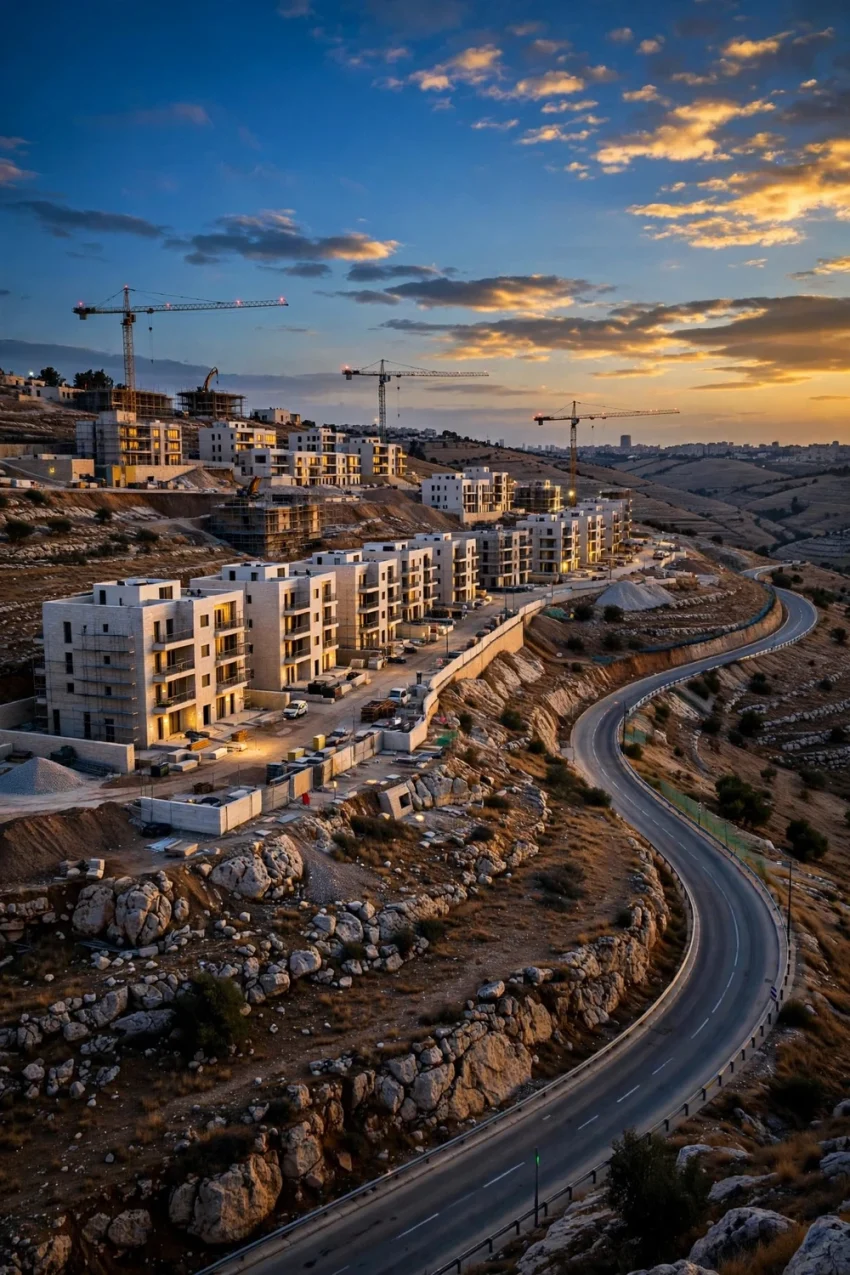
The UK sanctions Israeli settlements package announced on Tuesday 17 November 2026 is Britain’s sharpest move yet against West Bank settlement building.
Eight Israeli construction and property companies face asset freezes and director disqualifications, and the activist group Tzav 9 — which the Foreign Office says has blocked humanitarian aid trucks heading to Gaza — was sanctioned alongside them. The Foreign, Commonwealth and Development Office (FCDO) named nine entities in total.
The UK sanctions Israeli settlements package is the story because of its timing. The sanctions landed days before the final deadlines of the E1 tender, a planned settlement area east of Jerusalem that critics say would split the West Bank in two. Britain’s message to the firms involved was blunt: do not bid, do not build, do not profit.
In this article:
- Who Was Hit: The Eight Firms
- What the Sanctions Actually Do
- E1 Explained: The 1,234-Home Project
- “Protecting the Two-State Solution Is the North Star”
- The Backlash: Countermeasures and “Economic War”
- The Bigger Picture: Settlements Then and Now
- Timeline: From Warning to Sanctions
- What Happens Next
Who Was Hit: The Eight Firms
Most news reports name only three of the eight firms. Here is the full list, as reported by The Times of Israel. The UK sanctions Israeli settlements list covers companies that build, supply, plan or market housing and infrastructure in West Bank settlements:
- Har Hevron Development Company Ltd.
- Hemdat Shomron Ltd.
- S.A.G. (Velvel) Construction and Development Ltd.
- Lev HaHar Yazamut Ltd.
- Harey Zahav.
- Ariel Residential Judea & Samaria Ltd.
- Ami Gvirtzman Architects 2021 Ltd.
- Z.F. Building Company Ltd.
The ninth sanctioned entity is Tzav 9, the activist group the Foreign Office says has blocked aid trucks bound for Gaza. Tzav 9 is one of nine sanctioned entities — not the lead story. The lead is settlements and E1.
What the Sanctions Actually Do
The UK sanctions Israeli settlements designations impose asset freezes and director disqualifications on the firms, aimed at disrupting their flows of finance and their ability to support further construction.
In practice, that means frozen funds in British jurisdiction and named directors barred from running companies — tools designed to make settlement building harder to finance and harder to manage.
The UK sanctions Israeli settlements designations were made under the UK’s expanded Global Human Rights and International Humanitarian Law sanctions regime. The framework was expanded in September 2026, and the expansion legislation was laid before Parliament on 13 October 2026.
One honest caveat, reported by The Guardian: the practical impact remains uncertain, because the extent of the companies’ reliance on British financial services has not been established. Sanctions bite hardest when the target actually uses the sanctioning country’s banks and markets. Whether that is true here is not yet known — and that uncertainty is part of the story, not a footnote to hide.
E1 Explained: The 1,234-Home Project
E1 is the reason the UK sanctions Israeli settlements package was announced now. It is a planned settlement area adjacent to Ma’ale Adumim, east of Jerusalem, and critics say it would bisect the West Bank and cut it off from East Jerusalem — fragmenting the land Palestinians hope will form a future state.
The numbers are concrete. The Israel Land Authority is due to open bids on Thursday 19 November for tenders covering 1,234 housing units in the E1 corridor. The E1 plan received final approval in August 2025 after years of delays.
The UK has called for the E1 tender to be withdrawn. Foreign Secretary Ed Miliband put it in the starkest terms: “Do not bid, do not build, and do not profit from the destruction of the two-state solution.” On 19 October he had already warned firms “not to proceed with bids for E1 construction tenders” and warned of “legal and reputational consequences”. Tuesday’s sanctions are the follow-through on that warning.
“Protecting the Two-State Solution Is the North Star”
Miliband framed the UK sanctions Israeli settlements package around the two-state solution — the idea of an Israeli state and a Palestinian state living side by side. “Protecting the two-state solution is the North Star of this Government’s approach,” he said.
On Tzav 9, he added: “We will not stand by while those blocking desperately needed aid deepen the intolerable suffering of civilians in Gaza.”
The UK says settlements are a flagrant breach of international law. That position is not new — but sanctioning the builders, rather than only condemning the policy, is a step Britain had not taken before in this form. The Times of Israel noted this is the first time Britain has sanctioned Israeli entities since the Knesset election last month.
The Backlash: Countermeasures and “Economic War”
The UK sanctions Israeli settlements announcement drew a swift and furious reaction from Israel. Caretaker foreign minister Gideon Saar said Israel views the sanctions “with the utmost gravity” and “will take countermeasures against the British move”. Saar had previously called the accusations “outrageous lies” in September.
Settler leaders went further. Yesha Council head Israel Ganz said Britain had “declared economic war against Israel”. Beit El mayor Shai Alon called the move “the new antisemitism”. Settler leader Yossi Dagan of the Samaria Regional Council said: “we will build even more”.
The Palestinian Authority welcomed the sanctions. In Israel’s parliament, Democrats lawmaker Gilad Kariv said the caretaker government must halt the E1 tender. No immediate response from the Israeli government or Foreign Ministry was reported on 17 November.
The reactions tell you why this story matters beyond the eight firms. For Britain, it is a test of whether sanctions can slow a settlement project with a hard deadline — Thursday’s bid opening. For Israel’s settler movement, it is a provocation to build faster. For Palestinians, it is a rare moment of international action on an issue they have raised for decades.
The Bigger Picture: Settlements Then and Now
The UK sanctions Israeli settlements move comes against the long growth of the settler population. The number of settlers in the occupied West Bank, including East Jerusalem, has risen from about 270,000 in 1993, the year of the Oslo Accords, to about 770,000 today, according to figures cited by The Guardian.
That growth is the backdrop to every argument about E1. Supporters of the settlements say building is a right and a security necessity. Critics — including the British government — say each new neighbourhood makes a contiguous Palestinian state harder to draw on a map, and that E1, sitting between Jerusalem and the eastern West Bank, is the project that would make it hardest of all.
Britain acted alone in announcing the sanctions on Tuesday. France and Canada were reported in a Guardian briefing on 21 October to be working with the UK on settlement-related measures — but that is not confirmed for this package, and the 17 November announcement was a UK-only action.
Timeline: From Warning to Sanctions
The UK sanctions Israeli settlements timeline runs from warning to action:
| Date | What happened |
|---|---|
| September 2026 | UK expands its Global Human Rights and International Humanitarian Law sanctions regime. |
| 13 Oct 2026 | Expansion legislation laid before Parliament. |
| 19 Oct 2026 | Miliband warns firms not to bid for E1 tenders, citing “legal and reputational consequences”. |
| 17 Nov 2026 | Britain sanctions eight firms + Tzav 9 — nine entities in total. |
| 19 Nov 2026 | Israel Land Authority due to open bids for 1,234 E1 housing units. |
What Happens Next
Thursday 19 November is the first test of the UK sanctions Israeli settlements package: do the bids for the 1,234 E1 homes go ahead as planned, and does any firm pull out after Miliband’s warning? Then comes Israel’s promised countermeasures — what form they take, and whether they escalate a diplomatic row into something bigger.
The deeper question is whether asset freezes on eight firms can change the arithmetic of a settlement project backed by a government and a movement that has just promised to “build even more”. The Guardian’s caveat hangs over the whole package: if the firms barely use British finance, the sanctions are a signal, not a brake. If they do, Thursday could look very different from what the tender schedule promises.
Either way, the UK sanctions Israeli settlements package means Britain has crossed a line it had not crossed before — from words about settlements to sanctions on the people building them.
Poll: Should Britain sanction firms building Israeli settlements in the West Bank?
- YES
- NO
- NOT SURE
Note: This is a public opinion poll, not a scientific survey. Results show how readers of this article voted.
Read More
- Gaza Aid Tents Blocked: 150,000 Held as Winter Storm Hits
- Rwanda Return Hub: Five EU Countries Plan Pilot for 2027
- Trump Xi Putin Meeting: First Trilateral Summit in Shenzhen
- World News
Sources
- Reuters (Andrew MacAskill), 17 Nov 2026 — https://wnflsports.com/2026/11/17/britain-sanctions-israeli-settlement-builders-gaza-aid-blocking-activists/
- The Times of Israel (via Intelligence Report), 17 Nov 2026 — https://intelligencereport.org/2026/11/17/uk-sanctions-israeli-settlement-firms/
- The Guardian (via Suaragarut), 17 Nov 2026 — https://suaragarut.id/en/uk-sanctions-israeli-settlement-firms
- AP (via Guled Gurey), 17 Nov 2026 — https://guledgurey.com/en/uk-sanctions-israeli-firms-west-bank-settlements/
1 thought on “UK Sanctions Israeli Settlements: 8 Firms Hit Over E1”