
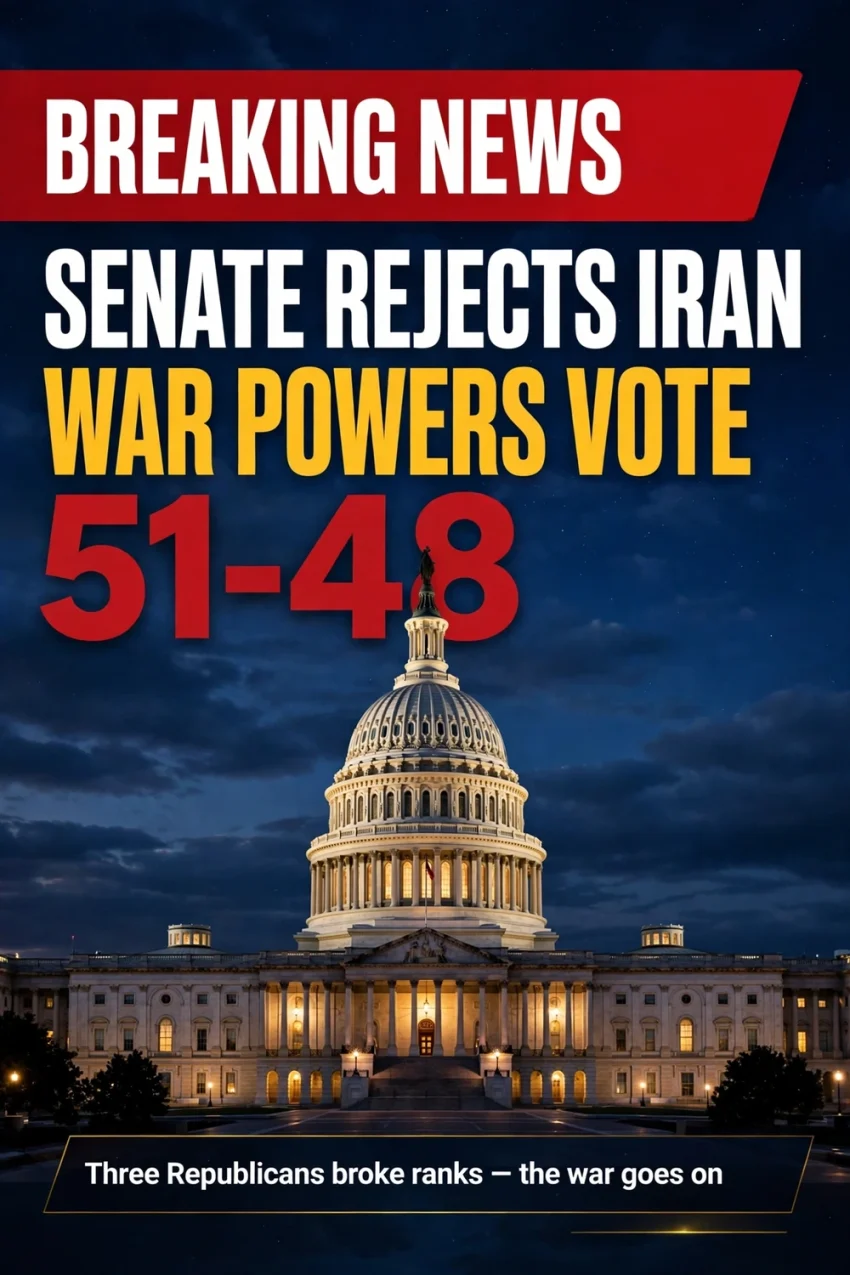
The Senate Iran war powers resolution was rejected 51–48 on Thursday 19 November 2026, in the first war-powers vote in either chamber since the 3 November midterm elections. Three Republicans broke ranks to support it, and one Democrat voted against it — but the resolution still fell short, and the war in Iran goes on.
The vote was the first test of Republican support for the war since voters handed Democrats both chambers. Yet the resolution would not have ended the war even if it had passed. The real fight now moves to the money: government funding runs out on 11 December.
How the Senate Iran war powers resolution vote broke down
The Senate voted on H.Con.Res. 93, a concurrent resolution directing President Donald Trump to remove US armed forces from hostilities with Iran unless Congress had declared war or passed a specific authorisation. It invoked Section 5(c) of the War Powers Resolution of 1973.
The roll call — Senate roll-call vote 269, taken on Thursday afternoon — broke down as follows:
| Side | Votes | Who |
|---|---|---|
| YES — back the resolution | 48 | 43 Democrats, 2 independents (Angus King and Bernie Sanders), 3 Republicans |
| NO — reject the resolution | 51 | 50 Republicans, 1 Democrat (John Fetterman of Pennsylvania) |
| Did not vote | 1 | Sen. Chris Murphy (D-Conn.), recovering from a stroke suffered last month |
The three Republicans who voted yes were Susan Collins of Maine, Lisa Murkowski of Alaska and Rand Paul of Kentucky. Sen. Thom Tillis of North Carolina, who backed a similar resolution in September, voted no this time. Reuters reported the vote as the 21st congressional war-powers vote since the war began.
The resolution had passed the House on 15 September 2026 by 220–204, sponsored by Rep. Seth Moulton, a Massachusetts Democrat. The war began on 28 February 2026, when the United States and Israel launched a campaign against Iran. No ceasefire is in force.
What H.Con.Res. 93 was — and what it could not do
A war-powers resolution sounds like a switch Congress can flip to end a war. In this case, it was not — and the limits explain why Thursday’s vote changes little on its own.
First, H.Con.Res. 93 was a concurrent resolution. As such, it would never have reached the President’s desk and could not have been vetoed — but it also could not, by itself, compel the President to act. The Washington Post noted that the White House ignored a similar resolution Congress passed in June, and that this one would not have forced Trump to end the war.
Second, the constitutional argument behind it is real but contested. Supporters, led by Sen. Tim Kaine of Virginia, argue that only Congress can declare war. The White House and its allies argue the President has the authority to act. That disagreement is the heart of the war-powers debate — and it is why the vote matters politically even though the resolution itself was non-binding in practice.
Democrats won both chambers in the 3 November midterms and take control in January 2027, with a projected 56–44 Senate majority. Their argument is that they cannot wait until January while the war continues — but Thursday’s vote shows the Senate Iran war powers resolution was a political marker, not a legal brake.
The $48.3 billion cost — and the money fight ahead
If the vote itself changed nothing, the numbers attached to it did land. At a Senate Armed Services Committee hearing on Thursday, Pentagon deputy comptroller Arthur Miller told Sen. Richard Blumenthal the conflict had cost $48.3 billion as of 13 November 2026 — up from just over $47 billion in October, according to The Hill. That is the cost as of 13 November, not a final total.
The Pentagon has also requested $350 billion in additional defence money, according to the Washington Post and CBS; Sen. Rand Paul cites $450 billion in his own writing. The two figures should not be merged into a single number.
That is why the next deadline matters more than Thursday’s vote. Government funding expires on 11 December 2026, and without action the federal government shuts down on 12 December. Congress leaves for the Thanksgiving recess and returns on 30 November, leaving about 11 days to reach a deal. Democrats are debating whether to attach limits on Iran-war funding to the must-pass funding bill. Senate Majority Leader John Thune, a South Dakota Republican, said he is “increasingly concerned that the Democrats may try to initiate another, a third government shutdown this year.” Sen. Tim Kaine, who led the push for the resolution, rejects the shutdown framing.
Fresh overnight, Sen. Tammy Duckworth, an Illinois Democrat, announced she will vote against any government funding bill that does not defund the Iran war, according to Daily Politicus, citing Semafor reporting. Duckworth’s position is hers alone, not the position of the Democratic caucus, and it would be wrong to claim Democrats as a whole will force a shutdown on 11 December. They are still debating.
President Trump returns to Washington from Asia on Friday 20 November and holds a White House news conference at noon. He has said he will decide on Iran “after January 1st” — a marker for deliberation, not a decision to strike. No White House reaction to the vote was reported by The Hill as of Thursday evening.
Timeline: from the House vote to the funding deadline
- 15 September 2026 — House passes H.Con.Res. 93 by 220–204.
- 19 November 2026 — Senate rejects the resolution 51–48; Duckworth announces her funding-bill position overnight.
- 20 November 2026 — Trump returns to Washington; White House news conference at noon.
- 30 November 2026 — Congress returns from the Thanksgiving recess.
- 11 December 2026 — Government funding expires; shutdown on 12 December without action.
- 1 January 2027 — Trump’s stated marker for deciding on Iran; new Congress takes over.
What happens next
Thursday’s vote tells us three things. First, the Republican majority is not united on the war: three of its senators voted to curb the President. Second, the Democratic minority is not united either: John Fetterman voted with the majority to reject the resolution. Third, the vote itself was never the decisive moment. The decisive moment is the funding bill.
Watch the 11 December deadline. If Democrats attach Iran-war funding limits to it, the White House must choose between signing a bill that restricts the war or vetoing the funding that keeps the government open. For the wider picture, see our report on the US strikes on Qeshm Island after the Iran–Bahrain drone attack, and on the House Democrats’ Trump investigations.
Should Congress force an end to US military operations in Iran?
- YES
- NO
- NOT SURE
This poll is not a scientific survey. Results show the views of readers who chose to vote on this page.
Sources
- Reuters (Patricia Zengerle), “US Senate rejects resolution curbing Trump’s Iran war powers”, 19 November 2026.
- The Washington Post, “Senate rejects resolution to block Trump from striking Iran”, 19 November 2026 (published 19:46 UTC, updated 21:04 UTC).
- J News Network, “Senate rejects Iran war-powers resolution, 48-51”, 19 November 2026.
- The Hill, 19 November 2026; Daily Politicus citing Semafor, 20 November 2026 (00:06 UTC).
4 thoughts on “Senate Iran War Powers Resolution Fails 51–48”