
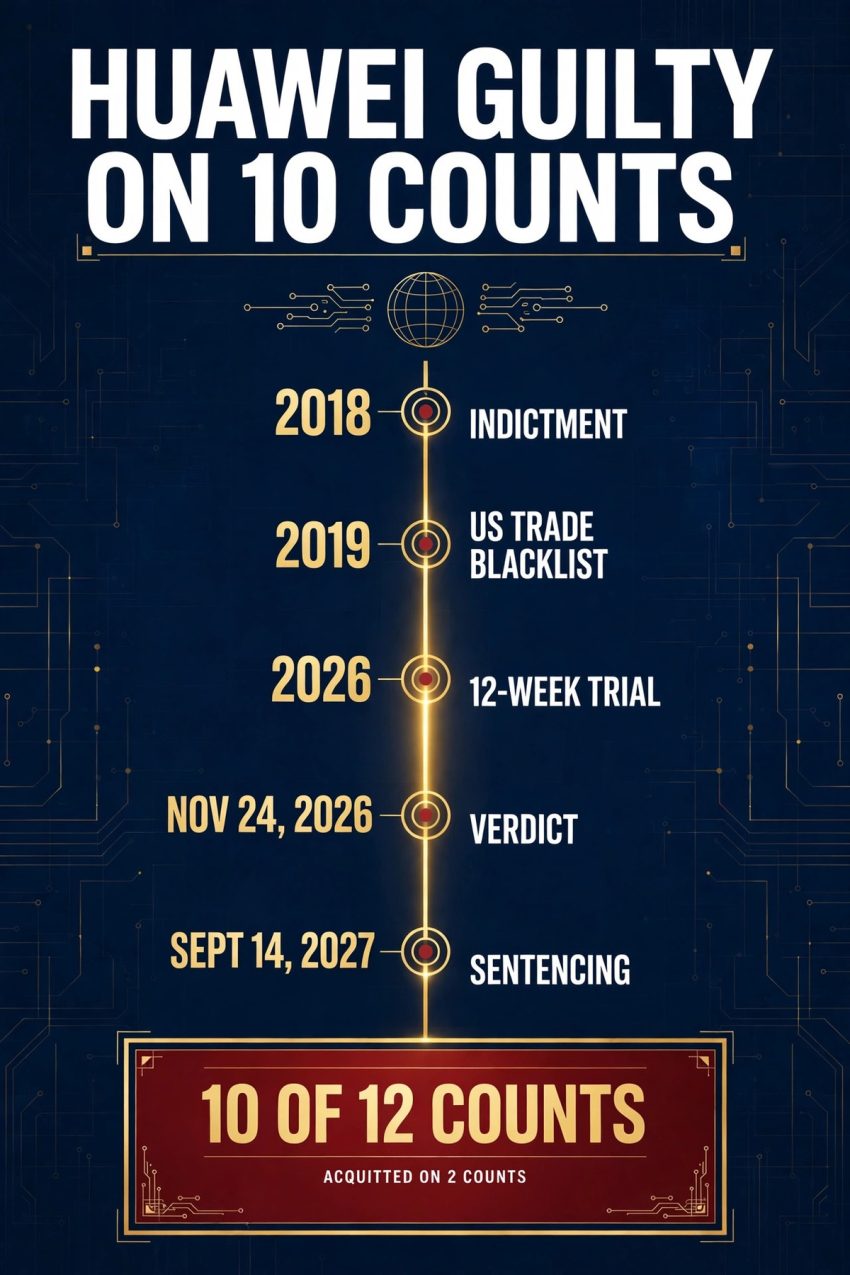
A federal jury in Brooklyn, New York, convicted Huawei Technologies and three of its subsidiaries on Tuesday, November 24, 2026, on 10 of 12 criminal counts — closing one of the most consequential corporate prosecutions in recent American history. The Huawei guilty verdict found the Chinese telecommunications giant guilty of bank fraud, wire fraud, violations of US sanctions against Iran, conspiracy to steal trade secrets, conspiracy to defraud the United States, and conspiracy to commit money laundering.
The jury acquitted Huawei on the two remaining counts: racketeering conspiracy and conspiracy to obstruct justice. Sentencing is scheduled for September 14, 2027, before US District Judge Ann Donnelly, with fines, forfeiture and restitution expected but amounts not yet set.
The verdict followed a 12-week trial in the Eastern District of New York, according to the US Department of Justice, after jurors deliberated for about four days. Prosecutors called more than 60 witnesses; the defence called 15.
What the Huawei guilty verdict means: 10 convictions, 2 acquittals
The Huawei guilty verdict was a split decision, and both sides claimed part of it as a win. The convictions cover the core of the government’s case; the acquittals rejected its most sweeping claim — that Huawei operated as a criminal enterprise under the Racketeer Influenced and Corrupt Organizations Act (RICO).
US Attorney Joseph Nocella Jr., whose office prosecuted the case, said: “Today’s verdict is a step towards accountability for Huawei’s criminal activities, which includes yearslong collaboration with sanctioned entities in Iran, repeated lies to banks, and blatant thefts from U.S. technology companies.”
Huawei welcomed the acquittal on the racketeering charge, saying it “confirms that these allegations lack factual basis and vindicates our consistent position over the past eight years,” while maintaining that the convictions are “without legal or factual merit.” Its lead lawyer, Brian Heberlig, said he had “profoundly mixed emotions,” describing the racketeering count as the prosecution’s lead charge — one aimed at portraying Huawei as “corrupt from top to bottom.”
The three subsidiaries convicted alongside Huawei Technologies Co. Ltd. are its Chinese subsidiary Huawei Device Co. Ltd. and its US subsidiaries Futurewei Technologies Inc. and Huawei Device USA Inc.
The Iran sanctions case: how Huawei misled the banks
At the heart of the Huawei guilty verdict is the company’s business in Iran. Prosecutors said Huawei operated there under the name Skycom, which it presented as an independent business partner but which the government proved was a wholly-owned subsidiary. Huawei provided turnkey services for an internet backbone and broader mobile network access in Iran, and helped the Iranian government — including Zaeim, a component of the Iranian intelligence apparatus — monitor and censor internet users, according to the Justice Department.
The 2018 indictment alleged that Huawei misled HSBC, Standard Chartered and BNP Paribas about its business dealings in Iran, falsely telling banks, journalists and the US government that it did not assist Iran’s government, military or intelligence community and that it complied with all applicable sanctions. In reality, prosecutors said, its Iranian business continued for at least another decade.
Those lies unlocked billions of dollars in credit and loans, and access to US-dollar clearing services — the plumbing of the global financial system that a company under sanctions would otherwise be cut off from. The jury convicted Huawei of conspiracy to violate the International Emergency Economic Powers Act (IEEPA), substantive IEEPA violations, bank fraud conspiracy, bank fraud, wire fraud conspiracy and wire fraud.
The case first became public in December 2018, when Canadian authorities detained Huawei chief financial officer Meng Wanzhou at the request of the United States over allegedly misleading an HSBC banker about Huawei’s business in Iran. Prosecutors presented jurors with a statement attached to Meng’s deferred prosecution agreement in which she acknowledged that the company illegally conducted business in Iran. Reuters stories from 2012 and 2013 that helped expose Huawei’s activities in Iran were also discussed during the trial.
The sanctions case also connects to the wider US–Iran confrontation that Nimda Pulse has been covering. The Senate recently voted on whether to restrain US military action against Iran — read our report on the Senate Iran war powers vote — and unverified claims about shipping in the Strait of Hormuz have kept the region on edge, as we reported in our Hormuz mine claims coverage. The full charges are set out in the Justice Department’s announcement of the verdict.
The trade secrets allegations: Cisco, T-Mobile and more
The second half of the case concerned the alleged theft of American technology. Prosecutors added trade-secret charges in 2020, alleging a two-decade conspiracy to steal trade secrets from US technology companies, and the Huawei guilty verdict upheld that charge.
During the trial, prosecutors sought to prove that Huawei stole source code from Cisco Systems for its routers, took antenna technology from wireless company Quintel, and hired a professor to gain access to a circuit board developed by semiconductor company CNEX. Jurors watched a video that, according to prosecutors, showed a Huawei employee slipping a piece of a T-Mobile testing robot, known as “Tappy,” into his backpack, and heard about a Huawei engineer sneaking into a Fujitsu booth at a trade show to photograph a device.
Huawei’s defence was that the banks knew about its Iranian operations and competed for its business anyway, and that the government had cherry-picked a handful of incidents and tried to turn them into a 20-year conspiracy. “Huawei didn’t steal its way to success,” Heberlig told jurors in closing arguments. “It earned it, plain and simple.” The jury disagreed on 10 counts — but by acquitting on racketeering, it rejected the claim that the incidents added up to a criminal enterprise.
What happens next: sentencing, appeal and US–China fallout
The Huawei guilty verdict does not end the case. Sentencing is set for September 14, 2027 — more than nine months away — and the amounts of any fines, forfeiture and restitution have not been set. Huawei has said it will review the verdicts and take legal action, and an appeal is expected once sentencing is complete.
It also lands at a delicate moment in US–China relations, days after the Trump–Xi–Putin summit in Shenzhen. The 2019 trade blacklist that restricted Huawei’s access to US technology remains in force, and the convictions could further squeeze its access to global banks and dollar-clearing services.
For American companies, the message from prosecutors was blunt: fraud, sanctions evasion and the theft of intellectual property “are not business strategies, they are serious crimes.” Whether the September 2027 penalties match that rhetoric — and whether an appeal unwinds any convictions — will determine how much this verdict changes the world’s biggest telecoms equipment maker.
This poll is not a scientific survey. Results reflect the views of readers who choose to vote.
1 thought on “Huawei Guilty Verdict: Convicted on 10 of 12 Counts in Brooklyn Trial”