
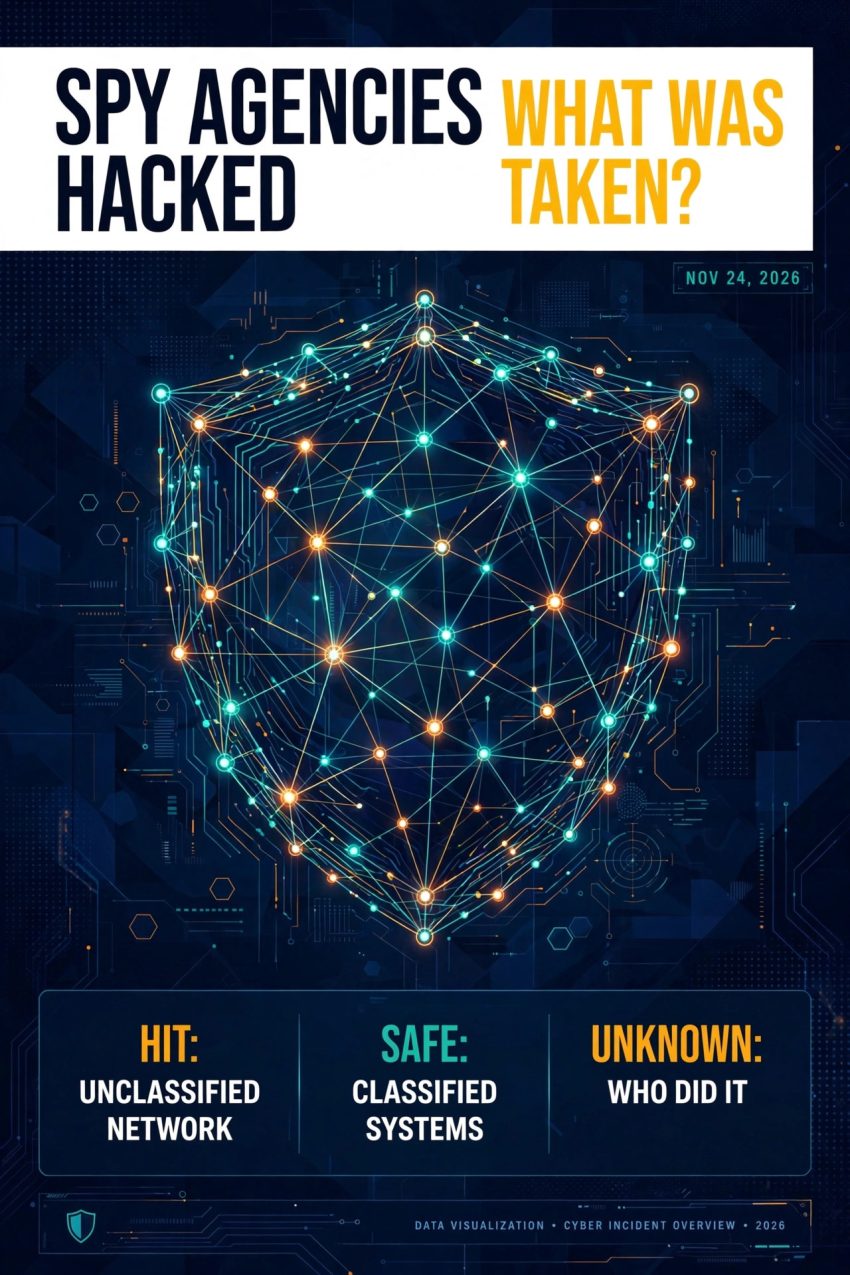
The CIA ODNI breach was first reported on Tuesday 24 November, and it is the most serious intrusion into American intelligence systems disclosed in weeks — but also one of the most carefully qualified. Hackers broke into an unclassified network used by the Central Intelligence Agency and the Office of the Director of National Intelligence to analyse publicly available information. Some unclassified data was exposed. No classified information was compromised, officials say, and the disruption has been resolved. What the attackers took, how they got in, and who they were remain unanswered — and the early signs pointing toward China are exactly that: early signs, not a finding.
Table of Contents
That distinction is the story. Everything below separates what officials and multiple news organisations have confirmed from what is still only suspected.
CIA ODNI breach: what was hit — and what was not
The network at the centre of the breach supports open-source intelligence, or OSINT — analysis built on information that can legally be obtained without classified access. According to the reporting, it draws on social media content, news reports, satellite imagery and data purchased from commercial vendors. The New York Times first reported the intrusion on 24 November, citing US officials and other people familiar with the matter. Reuters, CNN and the Associated Press all confirmed the broad outline the same day, each citing their own sources.
The CIA and the ODNI discovered the breach recently; neither agency has said publicly when the intrusion began or how long the attackers were inside. The National Geospatial-Intelligence Agency, part of the Pentagon, was also affected, according to two people familiar with the matter cited by the Times. The Times reported that information held by other government agencies was also believed to have been exposed, although the specific material compromised has not been identified.
What officials have been clear about is the limit of the damage. The ODNI said there had been “no disruptions to critical capabilities or classified systems”. A person familiar with the incident told the Associated Press the disruption had been resolved, and a CIA official told the Washington Examiner the affected network was disrupted and the issue fixed. The CIA itself declined to comment beyond that. In short: an unclassified analysis system was breached, classified networks were not, and the system is back up.
The Artex tool — and why it points at China, without proving it
The most striking detail in the reporting is the tool the attackers are believed to have used. Sources familiar with the investigation told the Times the suspected attackers appeared to have used Artex, an artificial-intelligence-powered hacking harness published online in July by a Chinese cybersecurity engineer known as “Autumn-27”. Artex was originally created for cyber defence, but criminals later adapted it for attacks, and security experts have linked it to dozens of hacking attacks on companies around the world. Nextgov first reported the Artex connection, and said the same tool is believed to have been used in a recent intrusion into the Defence Department’s Cyber Defense Command — though one source described that breach as low-impact.
Two sources told CNN that early indications point to the hack originating in China, though investigators had not established whether the Chinese government was directly involved. The Times’ sources pointed in a similar direction: some suggested China may be behind the breach, pointing to Artex. Beijing has repeatedly rejected such accusations.
None of this amounts to a confirmed attribution. The reporting is careful to describe the China link as an early indication from unnamed sources, and officials have not publicly blamed any country or group. The CIA ODNI breach is an investigation with a promising lead, not a finding — and anyone presenting the China link as proven fact is getting ahead of the evidence.
Why an “unclassified” breach still matters
It would be a mistake to shrug at the breach because no classified material was taken. OSINT is not a side project for American intelligence: the CIA and ODNI’s joint 2024–2026 open-source intelligence strategy calls for agencies to coordinate how they acquire public data, share it more widely across the intelligence community, and improve the tools analysts use to make sense of it. The breached network is the machinery that turns the open internet — social media, commercial satellite imagery, data bought from brokers — into intelligence insights.
That makes it a valuable target in a different way. An attacker inside the system could learn what American analysts are looking for, which questions they are asking, and which data sources they trust. A former intelligence official’s concern, reported by the Times, is that the string of disclosures has raised doubts about the security of government systems — including systems that were supposed to be among the best defended in the world.
The CIA ODNI breach is the latest in a run of incidents
The breach did not happen in isolation. It follows a series of cybersecurity incidents and technology outages across the US government and the private sector in recent weeks. Hours after the CIA and ODNI discovered their breach, the Treasury Department’s Financial Crimes Enforcement Network (FinCEN) reported unauthorised access to some of its systems and took them offline as a precaution. FinCEN confirmed on 25 November that it was investigating the incident. No connection between the separate incidents has been established, and officials said the CIA breach does not appear to be linked to the FBI intrusion.
The list keeps growing. The FBI has disclosed two separate breaches in recent weeks, including an intrusion into the NCIC police database reported earlier this month. (See the FBI’s NCIC database breach.) The Department of Agriculture was also breached. (See the Department of Agriculture breach.) The Pentagon and the Department of Homeland Security have been caught up in recent incidents, and the National Security Agency resumed normal operations after a three-day disruption to its classified communications network, which officials attributed to software patching rather than malicious activity.
The pattern is what worries current and former officials most. These are not isolated hacks of poorly defended systems. They are a wave of intrusions hitting agencies that are supposed to set the standard for American cybersecurity — and in several cases, the public still does not know what was taken or how the attackers got in. (See also the European Commission cyberattack.)
What to watch next
Four things would change this story. A public statement from the CIA or the ODNI identifying the attackers or describing what was taken. A congressional hearing or briefing that forces the details into the open. Any evidence linking the CIA ODNI breach to the FinCEN incident or the FBI intrusions — so far, officials say no such link has been found. And any sign that the breach went further than the unclassified network, which officials have so far firmly denied.
Until one of those happens, the honest summary is the one in the headline: America’s spy agencies were hacked, the damage was limited to unclassified material, the trail points in one direction — and the attribution is not yet proven.
Sources: Gizmodo, Cyberpresso, Insurance Business.
This poll is not a scientific survey — it reflects the views of nimda.in readers only.