
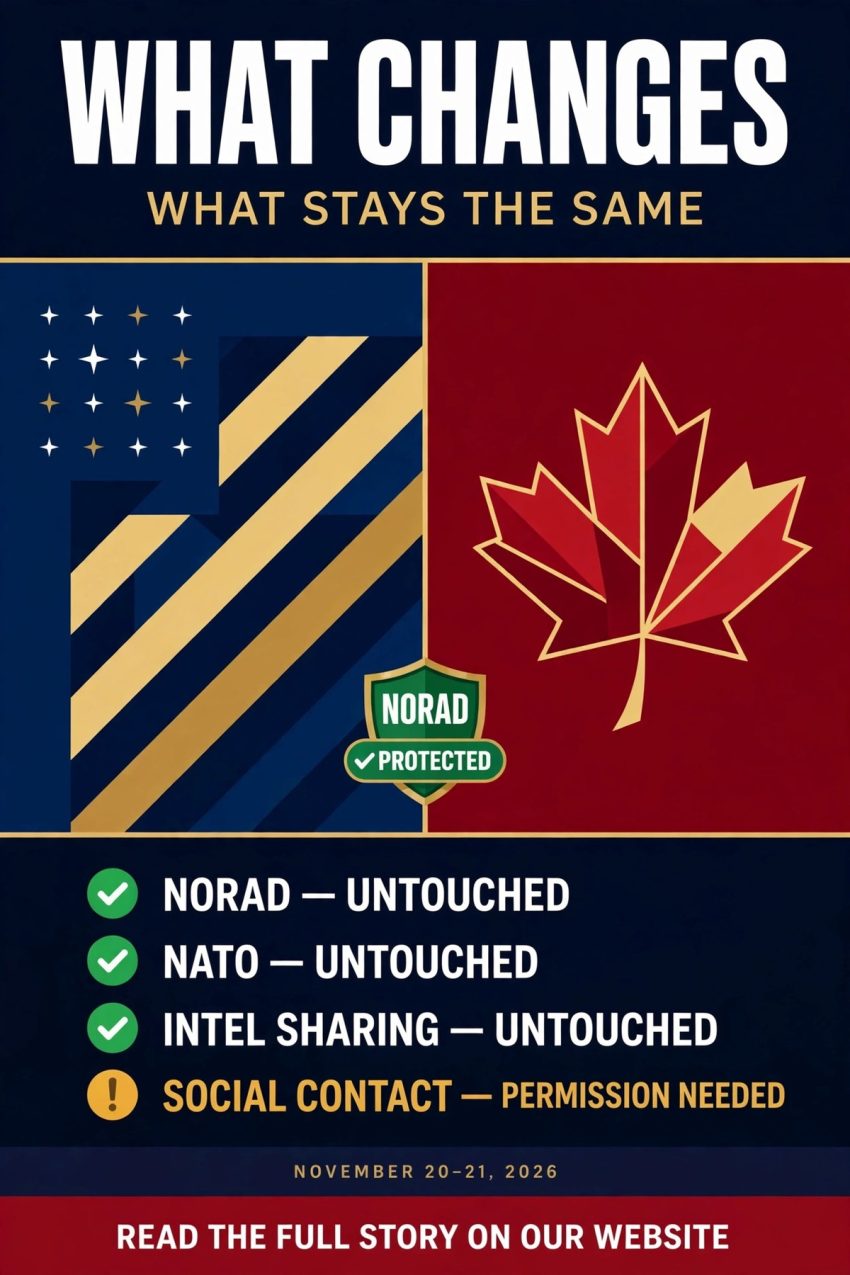
Defense Secretary Pete Hegseth has imposed new restrictions on how the United States military interacts with Canada, in a classified memo that has rattled one of the oldest alliances in the world — even as both governments insist that the core of the partnership is untouched. The memo, first reported by The Washington Post on Friday, November 20, 2026, limits meetings between American and Canadian generals and requires US personnel to seek permission before attending Canadian think-tank events or social engagements.
The document itself has not been made public. Nobody outside cleared Pentagon circles — including the reporters who broke the story — has read its text. What is known comes from officials briefed on it, an on-the-record Pentagon response, and US senators who discussed it publicly at the Halifax International Security Forum on Saturday, November 21. Here is what the Hegseth Canada memo actually changes, what it leaves alone, and why Washington is doing it now.
What the Hegseth Canada memo restricts
According to Senator Mike Rounds, a South Dakota Republican on the Senate Armed Services Committee who spoke to reporters in Halifax, the memo limits meetings between US generals and admirals and their Canadian counterparts to those that advance Pentagon objectives. American defense officials — in uniform and civilian — must now ask permission before attending Canadian think-tank events or social engagements, though they may still attend September 11 commemorations.
“It basically makes no changes in anything of formal activity, but it is suggesting in a roundabout way that there be less informal activity or social activities without permission,” Rounds said.
The Pentagon did not deny the memo exists. Chief Pentagon spokesman Sean Parnell said the department is “taking steps to ensure its engagements with Canada advance tangible US defense objectives and ultimately support a reinvigorated defense relationship.” The department, he said, is “prioritizing opportunities for bilateral cooperation that strengthens the defense of our Homelands and shared hemisphere, while supporting Canada’s ability to meet NATO obligations.”
Rounds said the memo was drafted months ago and signed only recently, and that it appeared motivated by pressure on Canada to spend more on defense. One US official familiar with the directive told The Washington Post the new restrictions would be seen as a “slap in the face” to the Canadians.
What the memo does NOT change: NORAD, NATO and intelligence
This is the part of the story that matters most — and the part the headlines have underplayed. Three pillars of the US-Canada defense relationship are explicitly untouched by the Hegseth memo:
- NORAD. The North American Aerospace Defense Command, the binational command headquartered in Colorado that watches North American skies and maritime approaches, continues without interruption. About 1,100 of its roughly 4,800 personnel are Canadian, working side by side with Americans in the world’s only binational military command.
- NATO cooperation. Joint planning and deployments under the NATO alliance are unaffected.
- Intelligence sharing. Defense intelligence cooperation — including the Five Eyes alliance of the US, Canada, the UK, Australia and New Zealand — is not covered by the memo, according to both Parnell and Rounds.
Canadian Defence Minister David McGuinty, speaking at the Halifax forum on November 21, said his government had not been shown the memo and had only learned of it that weekend. “It’s clear that there’s some sort of document we haven’t seen, not aware of the contents of it,” he said. “But I can assure Canadians, and I can assure anybody who’s interested, that Canadian-American cooperation on defense, security, and intelligence continues.” McGuinty added that he had seen “no evidence of any kind of change” in the military-to-military relationship so far.
Why now: defense spending and a fraying partnership
The memo did not appear out of thin air. It is the latest step in a bruising eighteen-month stretch between Washington and Ottawa. The two countries remain locked in a trade war, and President Trump has repeatedly raised the idea of annexing Canada — a threat Ottawa treats as serious even when Washington frames it as rhetoric.
The spending question is the sharpest edge. Canada was NATO’s long-running spending laggard and had not hit the alliance’s 2%-of-GDP target since the end of the Cold War. Prime Minister Mark Carney’s government accelerated spending to reach 2% in 2025–26 — half a decade ahead of the previous government’s schedule — and then signed NATO’s new pledge at The Hague: 5% of GDP by 2035. Ottawa’s own budget puts core defense funding at C$43.9 billion in 2024–25, rising to C$75.1 billion in 2026–27 and C$99.2 billion by 2030–31.
But Canada is also changing where the money goes. McGuinty used the Halifax forum to reassert Ottawa’s ambition to buy fewer weapons from Washington and produce more at home. “We’d like to procure less from the United States when it comes to military hardware and produce more of our own here in 10 core areas,” he told reporters. “And, if we can’t produce it here, we will partner with like-minded partners. And if we can’t partner, we will then buy as a third option.”
The memo also fits a wider Pentagon pattern. In July 2025, the department suspended participation in all think-tank and research institution events “until further notice.” The Canada memo extends that instinct — formal cooperation continues, informal contact now needs permission.
What happens next for the US-Canada alliance
The immediate test is whether the memo stays a paper restriction or starts biting in practice. Senators at Halifax sought to reassure their Canadian counterparts that the impact would be “negligible,” and Rounds himself said “there will be no real change” — while calling the leak of the memo “unfortunate.”
Three things to watch: first, whether any joint exercise, conference or officer exchange is actually cancelled or denied in the coming weeks; second, whether Ottawa’s new Defence Industrial Strategy — designed in part to depend less on US defense contractors — accelerates; and third, whether the trade dispute between the two countries spills further into the defense relationship. The memo’s own logic points that way: every bilateral military activity must now pass a transactional test, and a test can be failed.
The 86-year-old US-Canada defense partnership is not breaking. NORAD still watches the same skies, the intelligence still flows, and the generals still meet — just with more paperwork. But the informal trust that held the alliance together through decades of wars and crises is now something American officers need permission to practise. That, more than any single restriction, is what has Ottawa worried.
What this means for you
- If you live in Canada or near the border, nothing about continental defense changes overnight — NORAD and intelligence sharing are explicitly protected.
- If you follow US defense policy, watch whether the memo’s “permission” requirement blocks any real event in the next month — that is the test of whether it is symbolic or substantive.
- If you watch the trade war, the memo is a reminder that the US-Canada friction now reaches beyond tariffs into the military relationship itself.
Related reading on the Hegseth Canada memo: NATO sent AWACS aircraft to Poland after Russian missiles landed on NATO soil; Trump says he will resume Iran strikes after the New Year if no deal is reached; Al Qaeda aviation warning: FBI alerts airlines before Thanksgiving. More Hegseth Canada memo coverage in US Government.