
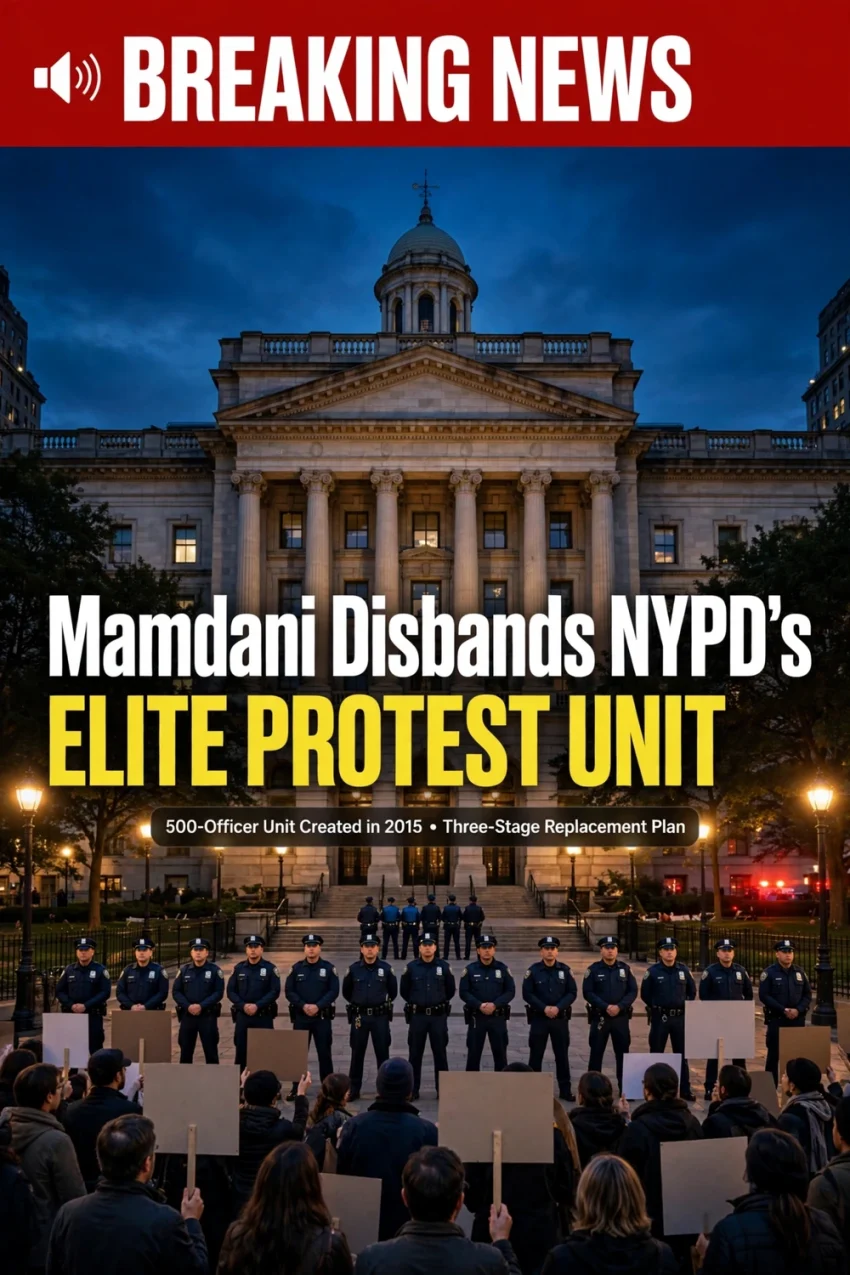
Mamdani disbands NYPD Strategic Response Group in his first major policing reform as mayor of New York City, keeping a central promise from his 2025 campaign and replacing the elite protest unit with unarmed civilian teams.
New York City Mayor Zohran Mamdani announced the plan on Monday, November 16, 2026, alongside Police Commissioner Jessica Tisch, whom he retained from the previous administration. The move dissolves a unit that has been at the centre of New York’s policing debate for a decade — and it has already split the city into cheering supporters and furious critics.
What Was the SRG — and Why Was It Controversial?
The Strategic Response Group is a roughly 500-officer unit created in 2015 to handle protest response and counterterrorism deployments. It was built as a rapid-response force: officers trained and equipped to deploy quickly to large demonstrations, emergencies and potential terror threats across the five boroughs.
But the SRG drew sustained criticism from public-safety advocates over its handling of protests. Its tactics at demonstrations — mass arrests, aggressive crowd control and the surrounding of protesters — made it one of the most controversial units in the NYPD. For Mamdani’s supporters, disbanding it was never a minor administrative change. It was the promise that defined his campaign’s approach to policing.
“During our campaign for mayor, I promised to disband NYPD’s Strategic Response Group, known as the SRG. Today, we are keeping that promise,” Mamdani said at the announcement.
Mamdani Disbands NYPD Strategic Response Group: The Three-Stage Replacement Plan
The plan to replace the SRG works in three stages, each with a different job — and very different powers.
First, a civilian-led Community Dialogue and De-escalation Division, known as the CDDD, will sit inside the Mayor’s Office of Community Safety. Its teams will be unarmed and will have no arrest powers. But the division will not be fully operational for at least another year, which means the civilian replacement is a promise for the future, not an immediate reality.
Second, an interim 30-member First Amendment Support Team — FAST — made up of NYPD officers trained in communication and de-escalation, will bridge the gap. The team is modelled on an approach used in Columbus, Ohio, and is designed to handle protests through dialogue rather than force while the civilian division is built.
Third, a new Patrol Support Division, or PSD, inside the Patrol Services Bureau will handle protest-related duties including mass arrests. The division takes over the operational work the SRG used to do, but under a different structure and with new restrictions on tactics.
The SRG’s counterterrorism functions, including heavy-weapons deployments at critical infrastructure, will be consolidated inside the NYPD’s Intelligence and Counterterrorism Bureau.
Kettling and Tear Gas Banned at NYC Protests
The announcement carried more than a reorganisation. It also banned some of the most controversial tactics in the NYPD’s protest playbook.
The plan formally bans kettling — the practice of surrounding protesters for mass arrests — and bars long guns and tear gas at First Amendment events. For civil-liberties advocates, the bans matter as much as the disbanding itself: they remove the tactics that produced the SRG’s most criticised moments, regardless of which unit is on the street.
Mamdani also endorsed the CURB Act, a bill by Councilmember Chi Ossé (Int. 0796-2026) to codify the changes into law. The bill had 25 City Council sponsors — one short of a majority, according to City & State reporting from November 13. Council Speaker Julie Menin has opposed the bill, which means the legislative fight over making the changes permanent is still ahead.
The Backlash: Police Union Versus Civil Rights Groups
Reaction to the announcement split sharply along the fault lines that have defined New York policing for years.
Police Benevolent Association President Patrick Hendry slammed the move as appeasing Mamdani’s “radical base” and warned about safety. The union’s argument is that removing an experienced, heavily trained unit leaves the city less prepared for large-scale unrest and terror threats, and that unarmed civilians cannot do the job officers did.
The Legal Aid Society took the opposite view. It celebrated disbanding “one of the NYPD’s most notorious units” but warned that the restructuring needs vigilant oversight so that SRG tactics are not simply repeated under a new name. That caution matters: the new Patrol Support Division will still handle mass arrests, and critics on both sides will be watching whether the change is real or cosmetic.
The fact that Commissioner Tisch stood beside Mamdani at the announcement is significant. Retaining the commissioner from the previous administration was meant to signal continuity and professionalism — and her presence gives the reform an institutional stamp that a purely political announcement would lack.
An Honest Timeline: What Is Still Unannounced
For all the detail in the announcement, the timeline is not fully pinned down — and that is the honest part of this story.
Tactic restrictions have been reported to begin in January, the unit itself is reported to dissolve in the spring, and the civilian division will not be fully operational until later in 2027. The mayor’s office has not announced a firm timetable, so the dates circulating in coverage are reported expectations, not confirmed deadlines.
That uncertainty is the real test of the plan. A reform announced in November 2026 will be judged not by the press conference but by what the streets of New York look like during the next major protest — and by whether the unarmed civilian teams are ready when they are needed.
Mamdani kept his campaign promise on day one of the reform. Whether the replacement works is a question that will take more than a year to answer.
More from Nimda Pulse: a senator was warned to preserve records amid a DOJ dispute ; Trump blamed Biden for the FAA ground stop ; US Politics news
Sources: New York Daily News (via Police1) — “Mamdani announces plan to dissolve NYPD’s Strategic Response Group”: https://www.police1.com/nyc-mayor-announces-plan-to-dissolve-nypd-protest-response-unit ; TML News — “Mamdani Disbands NYPD Protest Unit and Bans Kettling”: https://tmlnews.tech/stories/mamdani-disbands-nypd-strategic-response-group/
Poll
Should New York replace its police protest unit with unarmed civilian teams?
- YES
- NO
- NOT SURE
Results: YES — 0 votes · NO — 0 votes · NOT SURE — 0 votes. This is an informal reader poll, not a scientific survey.