
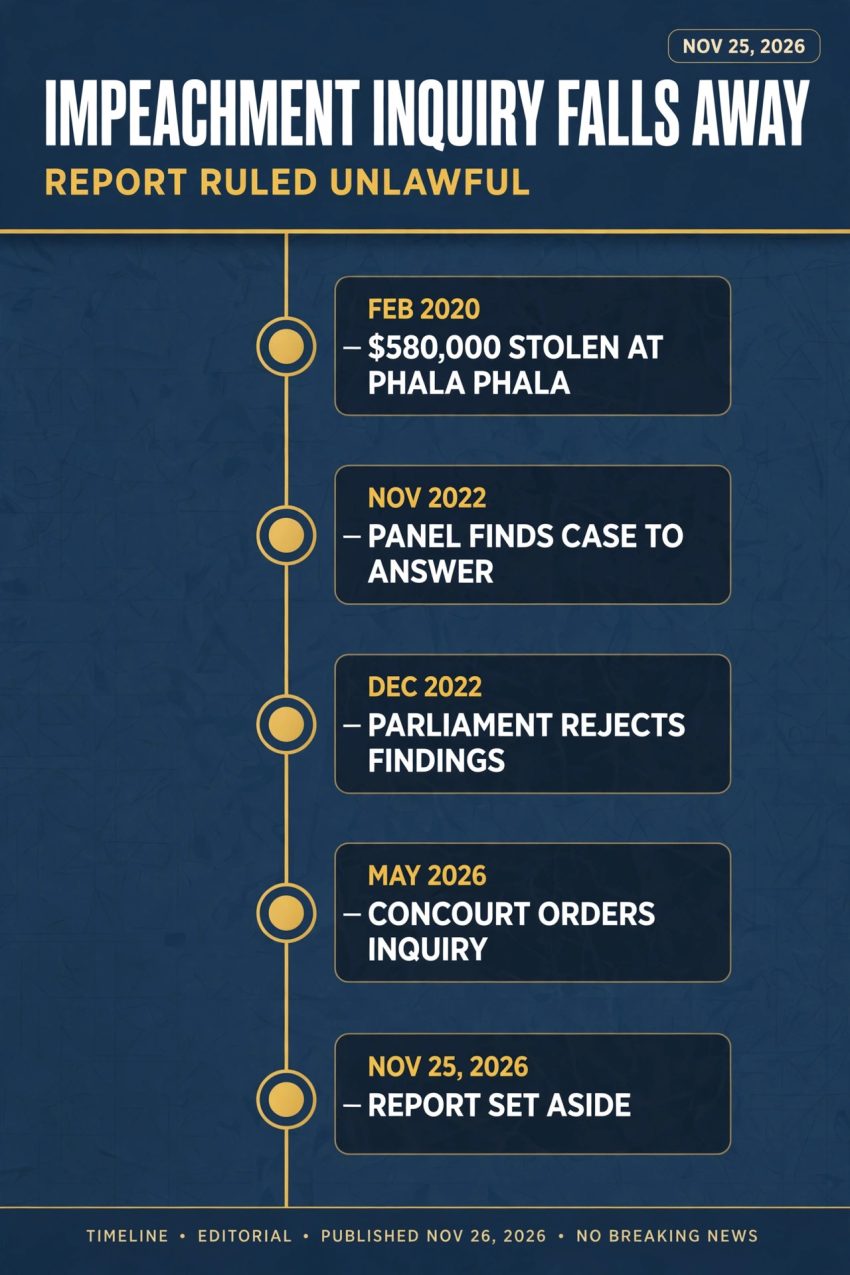
South African President Cyril Ramaphosa has won the biggest legal victory of his presidency. The Ramaphosa Phala Phala ruling, handed down by the Western Cape High Court on Wednesday, 25 November, declared unlawful and set aside the 2022 independent panel report that had found he may have a case to answer over the theft of foreign currency at his Phala Phala game farm — and with it, parliament’s impeachment inquiry falls away. Ramaphosa says he is studying the judgment. Parliament is seeking urgent legal advice. (See another court ruling that stopped a major political process this week.)
Table of Contents
Ramaphosa Phala Phala ruling: what the court decided
The Ramaphosa Phala Phala ruling was unanimous. A full bench — Judge President Nolwazi Mabindla-Boqwana, Judge Mark Sher and Judge Ncumisa Mayosi — found that the Section 89 panel, chaired by former chief justice Sandile Ngcobo, went beyond its lawful remit, asked the wrong questions and made several material errors of law. “As a result, the process it engaged in and the conclusions it came to were not rationally related to the object of [the rule], or the power and duty it was required to exercise,” Mabindla-Boqwana said. The court declared the report unlawful and set it aside in its entirety — and also set aside all steps taken by the National Assembly pursuant to the report.
The judges also found the panel had relied on information beyond the four charges Ramaphosa had been asked to answer. The ruling can be appealed, and opposition parties have signalled they will fight on — but while it stands, there is no report and no parliamentary process built on it. Impeachment committee chairperson Makashule Gana has sought urgent legal advice on whether the committee’s scheduled meeting on Thursday, 26 November, can proceed at all.
Ramaphosa has consistently maintained that his actions were lawful and that the report was fraught with inaccuracies. His office said on Wednesday that he notes the judgment and will study it, “in line with his respect for the rule of law including judicial independence.” He asked the court earlier this year to set aside the report — a review application that has now succeeded in full.
What the case was about
The scandal, known in South Africa as Farmgate, dates to February 2020, when thieves broke into Ramaphosa’s Phala Phala game farm in Limpopo and stole about $580,000 in US dollar bills hidden inside a sofa. The Section 89 panel, appointed by parliament in 2022, found prima facie evidence that Ramaphosa may have committed a serious violation of the Constitution and serious misconduct — in particular, that he may have broken the law requiring anyone in a position of authority to report the theft of R100,000 or more to the police, by reporting it instead to General Wally Rhoode of the Presidential Protection Unit. The panel had only 30 days to conclude its report.
The long road from 2022 to today
Parliament rejected the panel’s findings in December 2022. But on 8 May 2026 the Constitutional Court ruled lawmakers had erred and ordered them to establish a committee to investigate the president’s conduct. That committee was set up — and in August the Western Cape High Court ordered its hearings paused pending this review application. The Ramaphosa Phala Phala ruling now removes the foundation the committee was built on. The court’s message was blunt: the panel misunderstood its mandate and exceeded the powers it was given. (See recent world news.)
What the ruling does not decide
This is the part most coverage gets wrong. The court did not find that Ramaphosa did nothing wrong. It ruled on the panel’s process — its mandate, its questions, its legal reasoning — not on the facts of the 2020 theft. The judges made clear the decision should not be read as meaning the president must automatically escape parliamentary scrutiny. The Ramaphosa Phala Phala ruling kills the report; it does not settle the underlying questions about the cash, the sofa, or who knew what in 2020.
What happens next
Three things to watch. First, whether the ruling is appealed — and by whom. Second, what parliament does with its impeachment committee: with the report and all steps taken under it set aside, the committee has no basis to proceed unless a court revives it. Third, the politics: the ruling removes a threat that has shadowed Ramaphosa since 2022, but the Farmgate questions will keep being asked. The Ramaphosa Phala Phala ruling ends the inquiry as it stood; it does not end the argument. (See world leaders under pressure.)
Sources: Sowetan, Moneyweb, SA Government.
This poll is not a scientific survey — it reflects the views of nimda.in readers only.