
A Sputnik-S nuclear satellite could be launched into orbit as early as December 2026, according to Western intelligence services — a claim that, if true, would put the first nuclear weapon ever in orbit and break a treaty Russia signed nearly 60 years ago. The warning comes from a joint investigation by German broadcasters NDR and WDR and the newspaper Süddeutsche Zeitung, published on Monday 23 November and reported by Reuters the same day.
But this is an intelligence assessment, not a confirmed event. No government has publicly produced the satellite, a photograph of it, or a launch order. Russia has dismissed the reports. What follows is what the reports actually claim, what is independently on the record, what is not confirmed — and what would happen if the claim turned out to be true.
What the German Investigation Reports
Reuters reported from Frankfurt on 23 November that NATO members’ intelligence services “have concluded that Russia plans to launch a satellite armed with a nuclear weapon into space this year”, citing the German investigation. According to that reporting:
- The satellite is named Sputnik-S.
- It was assembled several years ago and is stationed in the Moscow region.
- Western services, including Germany’s foreign intelligence service, the BND, and the German armed forces, have exchanged intelligence on the system.
- Intelligence warnings circulated among several NATO countries in early November said the satellite could be launched within 60 days.
- Germany’s military Space Command considers a December launch possible, although no final decision by Moscow has been publicly confirmed.
The investigation also reported that military officials had briefed senior German government figures, including Defence Minister Boris Pistorius, about the threat. Germany’s Defence Ministry declined to answer questions, citing confidentiality.
NATO Secretary General Mark Rutte and German Chancellor Friedrich Merz addressed the reports publicly in Berlin on Monday 23 November. Rutte said: “I can assure you, we will always make sure that we defend every inch of NATO territory,” and added that the alliance’s defence planning included threats in space, with response options that were not always visible to the public.
Why December? The Timeline Behind the Warning
The December date is not a launch announcement — it is the outer edge of an intelligence estimate. The chain of warnings runs like this:
- February 2024: US intelligence first warned publicly about a Russian nuclear anti-satellite capability. The White House confirmed at the time that it involved a space-based weapon that would breach the Outer Space Treaty, but stressed it was not yet deployed. Russia denied the assertions.
- March 2026: The US intelligence community’s annual threat assessment repeated that Russia was developing a satellite designed to carry a nuclear weapon.
- October 2026: The US Defense Intelligence Agency (DIA) published its “Challenges to Security in Space 2026” assessment, stating plainly: “Russia is developing a satellite designed to carry a nuclear weapon.” The DIA warned that countermeasures would be extremely limited once such a device was in orbit.
- Early November 2026: Intelligence warnings shared among several NATO countries said the satellite could be launched within 60 days and would be operational shortly afterwards.
- 23 November 2026: The German investigation reported that NATO intelligence services now expect a launch this year, with December possible.
None of the new details has been confirmed on the record, and earlier warnings did not lead to a launch. That history is part of the story: the capability has been warned about for nearly three years without a launch taking place.
What One Blast from a Sputnik-S Nuclear Satellite Could Do — the Consequence That Matters
The reason this story matters is not the satellite itself. It is what a nuclear detonation in orbit would do to everything else up there.
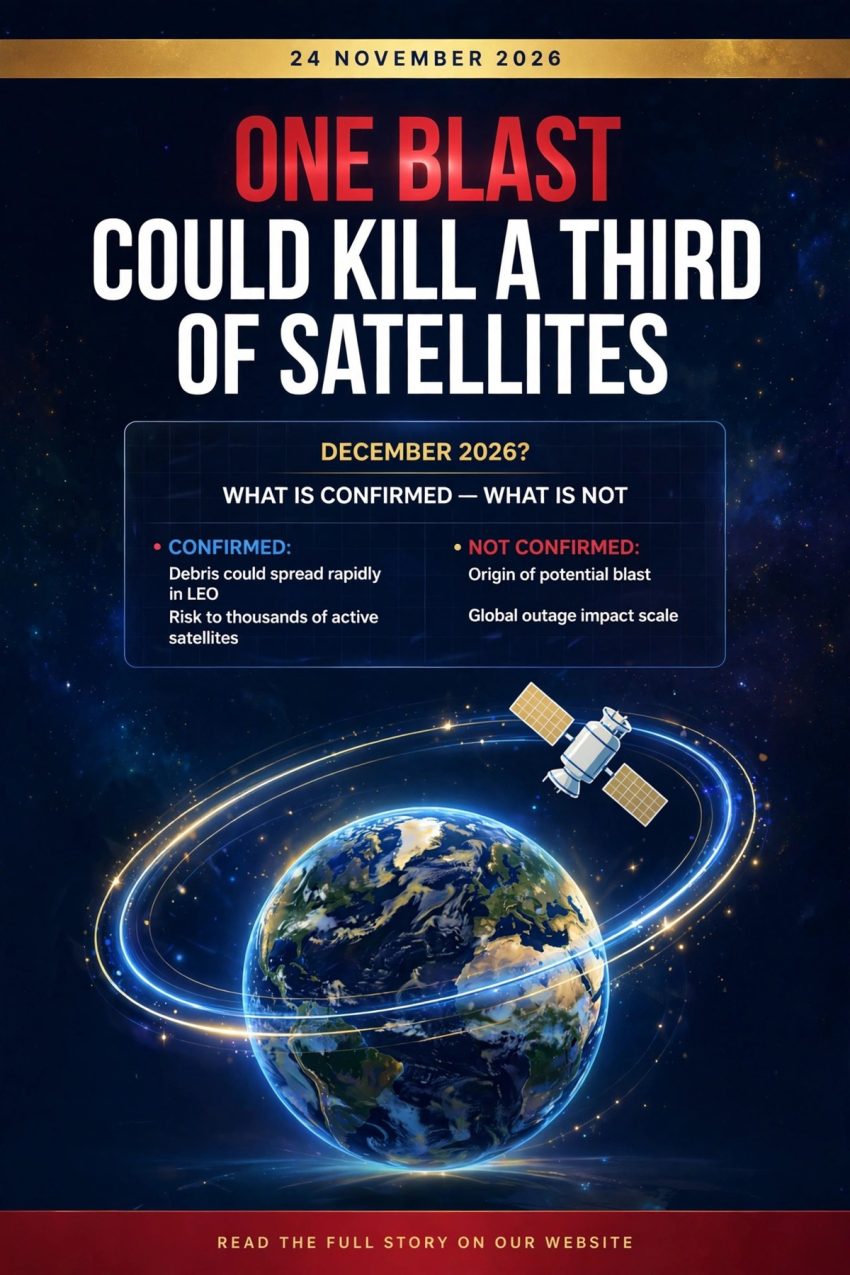
US Space Command chief General Stephen Whiting has warned that a nuclear explosion in space could disable around one-third of satellites in low Earth orbit within hours or days, with more failing in the months that follow as radiation levels rise. The DIA’s October 2026 assessment warned of the “rapid and sudden loss or degradation of thousands of satellites”. A 2025 RAND study for the US government, cited in reporting on the story, found that a single burst of 110 kilotons or more at 400 kilometres altitude could put up to about 20 percent of satellites in low Earth orbit at risk immediately, and a large fraction more over the following months.
The weapon, as described in the reporting, is an anti-satellite weapon — designed to destroy other satellites, not to strike targets on the ground. A detonation would create an electromagnetic pulse and a high-altitude particle cloud that could disable or destroy satellites used for GPS navigation, phone networks, banking systems, weather forecasting and military communications. US officials have alleged that Russia has for years been developing a nuclear weapon capable of destroying entire satellite networks, such as SpaceX’s Starlink system that Ukrainian troops have been using, Reuters reported.
The Outer Space Treaty 1967 — the Rule It Would Break
Deploying a nuclear weapon in orbit would violate Article IV of the 1967 Outer Space Treaty, which bars states from placing objects carrying nuclear weapons or other weapons of mass destruction in Earth’s orbit. Russia is a signatory to the treaty. The DIA has said explicitly that such a deployment would violate the treaty.
The treaty’s history is relevant here. It was written in the 1960s precisely because both superpowers had tested the idea of nuclear weapons in space — and concluded that a single detonation could damage their own satellites as badly as anyone else’s. In April 2024, Russia vetoed a UN Security Council resolution reaffirming the ban on nuclear weapons in space, according to reporting on the story.
Western suspicion has also focused for years on Kosmos 2553, a satellite Russia launched in February 2022 — five days before the full invasion of Ukraine — into an unusually high orbit about 2,000 kilometres up, in a region of intense natural radiation. Western experts suspect it is a test platform for components of a nuclear anti-satellite weapon. Russia calls it a scientific research satellite.
What Russia Says
Russia has rejected the reports. Kremlin spokesman Dmitry Peskov said on Monday 23 November that the German reports should not be taken seriously, questioning their reliance on unnamed sources and unverified claims, according to The Moscow Times. Russia’s embassy in Germany said it had no information about the alleged deployment, rejected the allegations as “unfounded insinuations” and part of a propaganda campaign, and insisted that Russia’s space programme serves exclusively peaceful purposes and complies with international law.
That denial is, in itself, not new: Russia denied the US assertions in 2024 as well. But it is the official position on the record, and it is why this story must be reported as an intelligence assessment — not as a confirmed fact.
NATO Russia Satellite Launch — What Happens Next
If the assessment is right, December is weeks away — and there is very little anyone can do to stop a launch once it happens. The DIA’s warning is blunt on this point: once such a satellite is in orbit, there would be hardly any effective countermeasures, and its use could not be prevented. That is why the story broke in Germany, and why it was briefed to ministers rather than merely published: the window for diplomacy, deterrence or public pressure is before a launch, not after one.
What to watch in the coming days: whether any NATO government confirms the December timeframe on the record; whether Russia issues a further denial or offers any transparency about Sputnik-S; whether the United States raises the issue publicly; and whether satellite-tracking data shows any unusual launch preparations. None of those has happened yet.
What is confirmed — and what is not
- Confirmed: Reuters reported on 23 November 2026 that German media (NDR/WDR/Süddeutsche Zeitung) say NATO intelligence services have concluded Russia plans to launch a nuclear-armed satellite this year; the DIA’s October 2026 assessment says Russia is developing a satellite designed to carry a nuclear weapon; the 1967 Outer Space Treaty bans nuclear weapons in orbit; Russia has denied the claims.
- Assessed, not confirmed: That the satellite is named Sputnik-S, was assembled years ago and is stored in the Moscow region; that a launch could come as early as December 2026; that the warhead exists or is live.
- Estimates, attributed: General Whiting’s estimate that about a third of low-Earth-orbit satellites could fail within hours or days of a detonation; the RAND study’s 20 percent figure.
- Not confirmed: Any launch order, any photograph or document proving Sputnik-S exists, or any independent verification of the December timeframe.
Why This Story Matters Beyond Space
A nuclear weapon in orbit would not be a battlefield weapon. It would be a weapon against the infrastructure the modern world runs on — the same satellites that guide ships, time financial transactions, forecast weather and carry military communications. That is why the warning, even unconfirmed, has drawn a public response from the NATO Secretary General and the German Chancellor within hours of publication.
It is also the latest sign of how far the confrontation between Russia and the West has spread — from the battlefield in Ukraine to the Baltic Sea, to South Korean airspace, and now to orbit. Earlier today, Nimda Pulse reported on Russian military aircraft entering South Korea’s air defence identification zone near Ulleung Island: Russian Aircraft Enter South Korea Zone — Jets Scrambled. And NATO has just sent AWACS surveillance aircraft to Poland after Russian missiles landed on NATO soil: NATO Sends AWACS to Poland After Russian Missiles Land on NATO Soil.
Related reading on Nimda Pulse: Trump Resume Iran Strikes After the New Year and Zelenskyy Trump Peace Deal: 95% There, Donbas Blocks It. More world news: World News on Nimda Pulse.
The poll below is for readers’ views only and is not a scientific survey.