
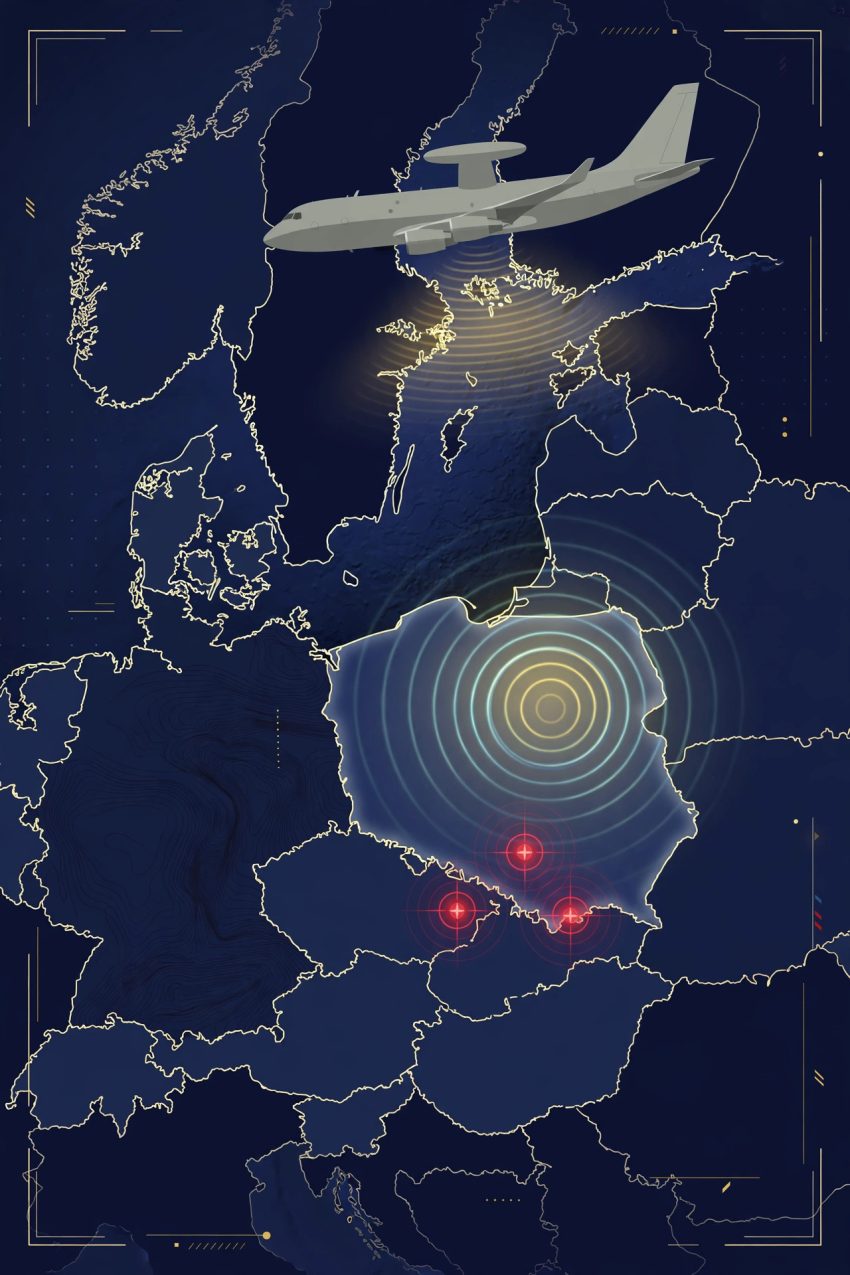
NATO sends AWACS to Poland in the alliance’s first concrete military response after three Russian cruise missiles landed on Polish territory. The decision was announced on Monday, November 23, after an extraordinary meeting of the North Atlantic Council in Brussels, convened at Poland’s request. NATO’s top commander has authorised the forward deployment of an Airborne Warning and Control System (AWACS) aircraft and is examining whether to send more assets to the alliance’s eastern flank.
What NATO Decided on Monday
Polish Deputy Defence Minister Pawel Zalewski announced the decision after the Council meeting, telling reporters: “An AWACS early-warning aircraft will be made available to Poland.” NATO spokeswoman Allison Hart later confirmed that the Supreme Allied Commander Europe (SACEUR), General Alexus Grynkewich, had authorised the forward deployment. Hart said SACEUR “is now examining the deployment of additional assets as he continues to assess our deterrence and defence posture in Poland and elsewhere.” In a post on X, she described the airspace violations as a “dangerous” incident for which Russia bears “full responsibility”, adding: “All Allies stand in full solidarity with Poland.”
Three Russian Missiles Landed in Poland on Friday
The decision follows Friday’s incident, when three Russian Kh-101 cruise missiles entered Polish airspace during a massive Russian attack on Ukraine and crashed in the south-east of the country. Debris was recovered in Nowy Lipowiec in the Lublin region and in Rudnik nad Sanem and Molodycz in the Podkarpackie region. Polish prosecutors said preliminary findings indicated all three missiles were manufactured in Dubna, near Moscow, in the fourth quarter of 2026. No one was hurt and no critical infrastructure was damaged. Polish F-16s and Swedish Gripen fighters patrolled overnight, Patriot air defences were activated, and two NATO AWACS aircraft already flew over Poland during the incident. Polish Prime Minister Donald Tusk called the incursion a deliberate provocation by Moscow. Russia has made no public comment on the missiles.
No Article 4 — But NATO Is Weighing More Assets
Poland has not formally invoked Article 4 of the NATO treaty, which provides for consultations when a member feels its security is threatened, and there has been no talk of an Article 5 collective-defence response. But the AWACS decision is the alliance’s first formal military step since the missiles fell. NATO Secretary General Mark Rutte visited Warsaw on Saturday, a day after the incident, and guaranteed that NATO will “defend every inch of Polish territory”. The deployment builds on Operation Eastern Sentry, NATO’s eastern-flank air defence mission launched in September 2025 after a Russian drone swarm crossed into Poland.
What Happens Next
SACEUR’s review of additional assets is now the key question, alongside whether Poland seeks further air defences such as more fighter jets or missile batteries. Talks on ending the war in Ukraine continue in parallel, with American envoys meeting Moscow and Kyiv and trilateral talks under way in Abu Dhabi. Any further Russian incursion into NATO airspace would test whether the alliance’s response stays at surveillance — or moves to something stronger.
This poll is not a scientific survey — it reflects the views of nimda.in readers only.
3 thoughts on “NATO Sends AWACS to Poland After Russian Missiles Land on NATO Soil”