
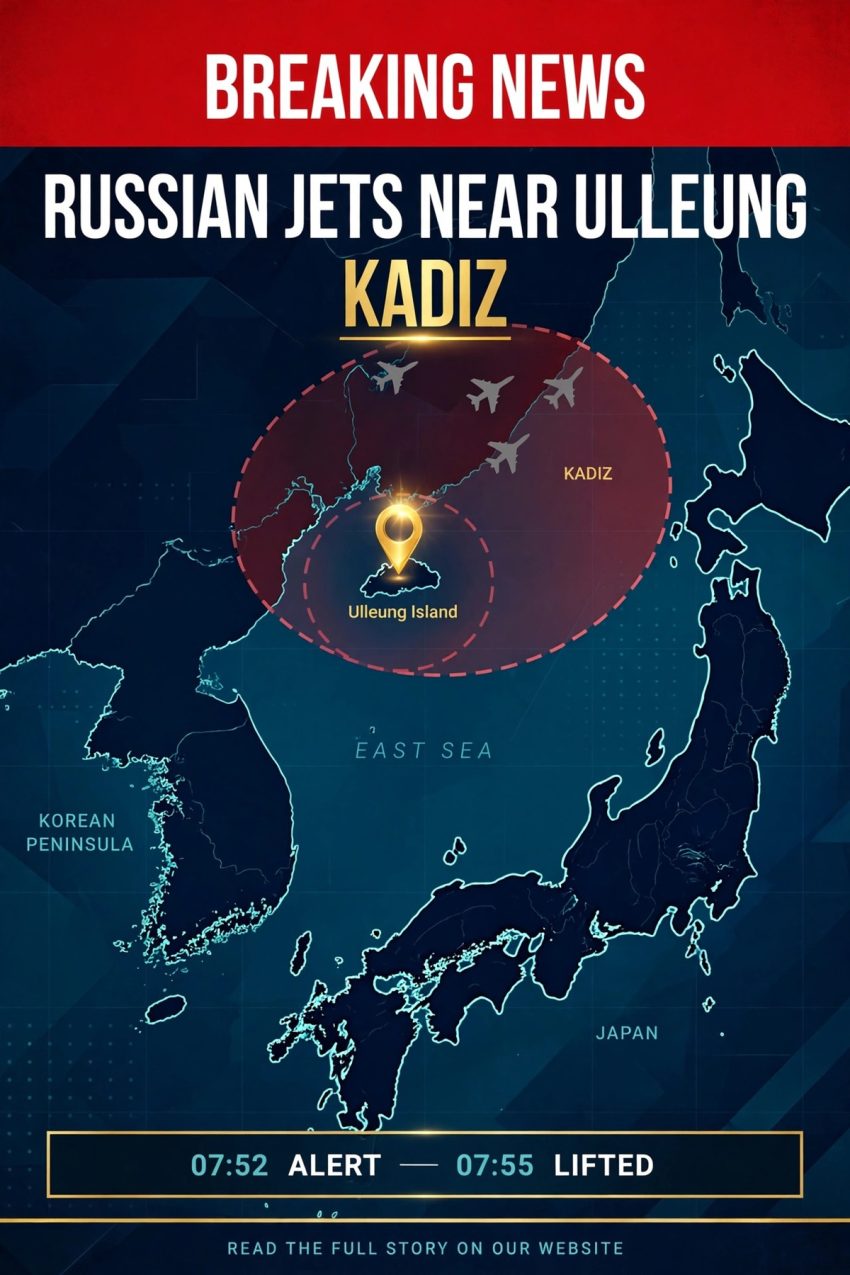
Russian aircraft South Korea tensions flared on Tuesday morning, 24 November 2026, when several Russian military planes flew into South Korea’s air defence identification zone near Ulleung Island — and the island’s residents were briefly told to take shelter. Within minutes, the warning was lifted. But the morning left behind a tangle of conflicting official messages, and the question now is what happens the next time Russian jets come this close.
The confusion matters. South Korea’s own military later corrected the first official accounts. What was first described as a violation of South Korean airspace was, according to the Joint Chiefs of Staff, an entry into the air defence identification zone — a buffer area, not sovereign airspace. And a warning naming a North Korean aircraft, sent out by a local government, was issued in error. This article sets out what is confirmed, what was corrected, and what is still not known.
Russian aircraft South Korea: What Happened at 7:52 a.m. on Ulleung Island
At 7:52 a.m. local time on Tuesday 24 November, South Korea’s Ministry of the Interior and Safety sent an emergency disaster message to residents of Ulleung County, an island of around 9,000 people off the country’s east coast. The message told residents to take shelter in underground facilities or inside buildings, and said a Russian aircraft had violated South Korean airspace, according to Reuters and the Associated Press.
The warning did not last long. The safety ministry lifted it three minutes later, at about 7:55 a.m., saying the aircraft had left the danger area. A separate message from the provincial government of Gyeongsangbuk-do, which had warned of an object presumed to be a North Korean aircraft, was also lifted shortly afterwards, with officials confirming a return to normalcy by 7:58 a.m., according to Aju Press.
There were no immediate reports of accidents or major disruption on the island, the Associated Press reported. For Ulleung’s residents, though, the scare will have felt familiar: in 2022, North Korea fired more than 20 missiles into the sea during heightened inter-Korean tensions, and one missile headed toward the island, triggering air raid sirens and prompting residents to evacuate.
South Korea Scrambles Fighter Jets — What the Military Says Now
South Korea’s military scrambled Air Force fighter jets on Tuesday after “multiple” Russian military planes entered the Air Defense Identification Zone off the country’s east coast, the office of the Joint Chiefs of Staff said in a statement reported by Reuters. The military said it had been tracking the Russian aircraft as they approached the zone, and the jets conducted “tactical manoeuvres” to prevent any incident.
Crucially, the Joint Chiefs of Staff’s statement corrected the earlier announcements. It said there was no intrusion of South Korea’s airspace by the Russian aircraft. The Associated Press reported that the statement “revised earlier announcements by the Ministry of the Interior and Safety and the local provincial government that said foreign airplanes had violated South Korean airspace and that they were suspected to be Russian or North Korean.”
The military did not immediately say how many Russian planes it detected, or what types of aircraft they were. The aircraft entered the zone and then exited it, according to the Joint Chiefs.
KADIZ Air Defense Identification Zone — Why the Distinction Matters
The confusion on Tuesday morning turns on one distinction: the difference between sovereign airspace and an air defense identification zone. The Korea Air Defense Identification Zone, or KADIZ, is an area set by countries to help identify and respond to aircraft that may be approaching their airspace. It is a buffer zone where approaching aircraft are identified and monitored for national security purposes. Unlike sovereign airspace, an ADIZ does not confer territorial sovereignty — entering it is not the same, in law, as violating a country’s airspace.
That is why the correction matters. A Russian aircraft entering the KADIZ is a serious military signal, and South Korea scrambles jets in response — but it is not an airspace violation, and it does not carry the same legal or diplomatic consequences. Russia, for its part, does not recognise the air defense identification zones of South Korea and other countries, according to Aju Press.
This was the fourth entry of Russian military aircraft into the KADIZ this year, Aju Press reported. It came a week after a similar incident last Monday, when South Korea scrambled fighter jets to repel several Russian military aircraft that it said temporarily entered the country’s air-defense zone over waters between the Korean Peninsula and Japan. Japan protested to Moscow on that same day after saying two suspected Russian aircraft had entered its airspace off its southwestern coast, the Associated Press reported.
Why Two Different Warnings Went Out — the North Korea Error
One of the most confusing parts of Tuesday morning was the North Korea warning. Yonhap news agency reported that a warning of a possible North Korean aircraft near the Ulleung area was briefly issued by the local government in error. The provincial message described an object presumed to be a North Korean aircraft; the Joint Chiefs of Staff later clarified that the aircraft were Russian military aircraft that had entered the KADIZ, and that there had been no airspace violation.
Here is the timeline as reported:
- 07:52 — Safety ministry sends shelter warning to Ulleung residents, saying a Russian aircraft violated airspace.
- ~07:52 — Gyeongsangbuk-do sends a separate message about an object presumed to be a North Korean aircraft.
- ~07:55 — Safety ministry lifts its warning, saying the aircraft had left the danger area. (Yonhap reported the lifting at around 07:57 — accounts differ by a couple of minutes.)
- 07:58 — Provincial government confirms the North Korean aircraft warning is lifted and normalcy returns.
- Later on Tuesday — Joint Chiefs of Staff confirm: multiple Russian military aircraft entered the KADIZ; fighter jets scrambled; no airspace intrusion.
What Happens Next — and What Is Still Not Confirmed
The immediate incident is over: the Russian aircraft left the zone, the warnings were lifted, and no damage or injuries were reported. But three questions remain open, and they will shape what happens next.
First, will Seoul protest? South Korea routinely scrambles jets for KADIZ entries, but a formal diplomatic protest — particularly after a false airspace-violation warning reached the public — would raise the stakes. No protest had been announced at the time of writing.
Second, will the pattern continue? Four KADIZ entries this year, including two in eight days, suggest Russian long-range aviation is testing South Korea’s responses on a regular schedule. Each entry forces a scramble, and each scramble carries a small risk of miscalculation.
Third, will the alert system be fixed? Two different official messages, naming two different countries, went out within minutes of each other — one of them wrong. For residents of an island of 9,000 people who have already lived through a missile scare, that is the part of Tuesday morning that most needs an answer.
What is confirmed — and what is not
- Confirmed: Multiple Russian military aircraft entered the KADIZ near Ulleung Island on 24 November 2026; South Korea scrambled fighter jets; a shelter warning was issued at 07:52 and lifted within minutes; this was the fourth Russian KADIZ entry this year.
- Corrected: The first official messages said South Korean airspace had been violated. The Joint Chiefs of Staff say it had not.
- Error: The local government’s warning about a presumed North Korean aircraft was issued in error, according to Yonhap.
- Not confirmed: How many aircraft were involved, what types they were, or their exact flight paths — the military has not disclosed these.
Why This Story Matters Beyond Ulleung
The Ulleung incident is the latest in a series of Russian military flights near NATO and allied territory. On the same day’s wider picture, NATO has just sent AWACS surveillance aircraft to Poland after Russian missiles landed on NATO soil — a story Nimda Pulse covered earlier today. Read that report here: NATO Sends AWACS to Poland After Russian Missiles Land on NATO Soil. The pattern is the same in both cases: Russian military activity near allied borders, a rapid allied military response, and a public message that has to be corrected in the hours that follow.
Related reading on Nimda Pulse: Ukraine Sinks Russian Warship Off Libya: Zelenskyy Confirms Benghazi Drone Strike Sank the Merkury and Hormuz Tanker Attacks: 4 Tankers Hit in 3 Days. More world news: World News on Nimda Pulse.
The poll below is for readers’ views only and is not a scientific survey.
1 thought on “Russian Aircraft Enter South Korea Zone — Jets Scrambled”