
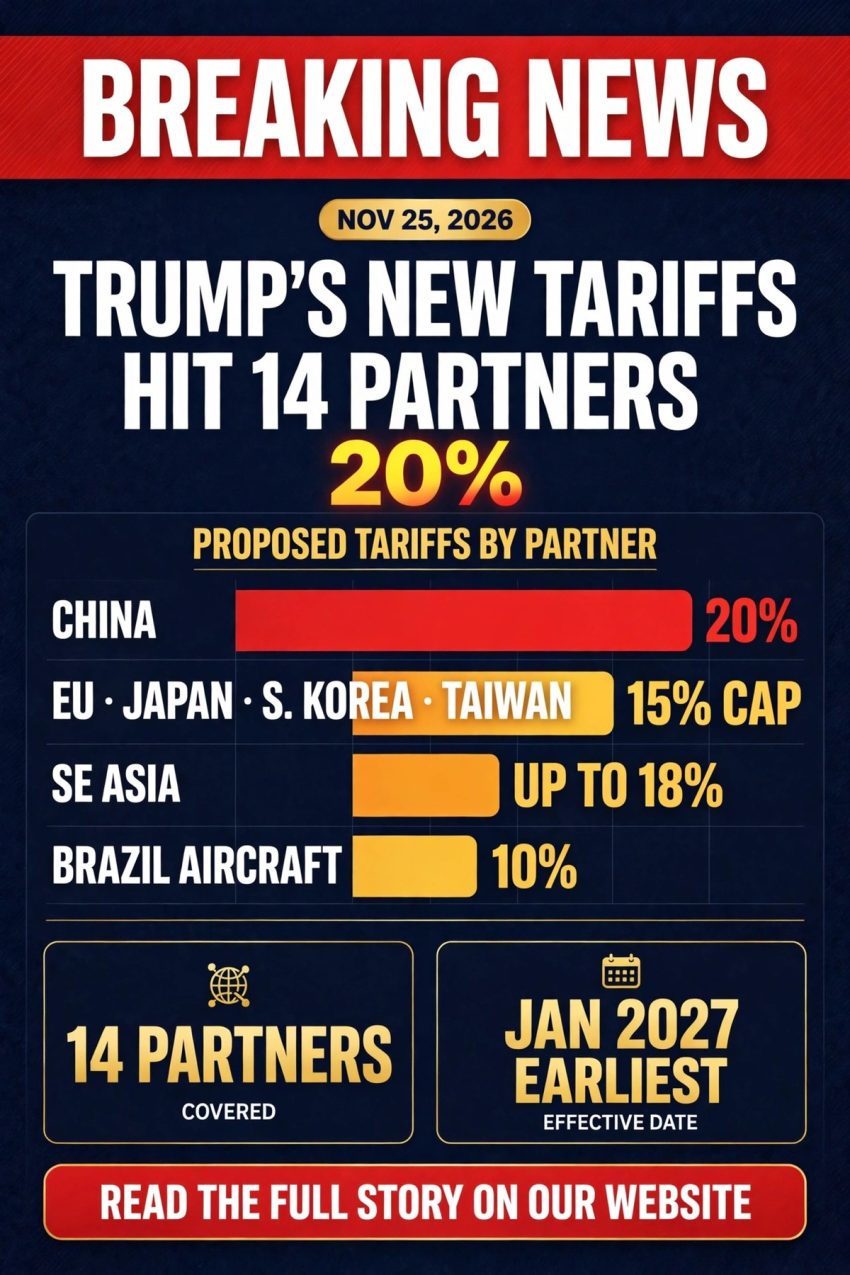
The USTR Section 301 tariffs proposal landed on Wednesday, with the Trump administration proposing new duties on 14 major trading partners after an eight-month investigation into what it calls structural excess industrial capacity — the biggest tariff move since the Supreme Court struck down the president’s global tariffs in February.
The US Trade Representative’s office announced the proposed duties after completing its Section 301 unfair trade practices probe into 16 trading partners, including close allies Japan, the European Union and South Korea. A senior administration official said tariffs were proposed for goods from China, Bangladesh, Cambodia, the European Union, India, Indonesia, Japan, South Korea, Malaysia, Singapore, Switzerland, Taiwan, Thailand and Vietnam. Mexico and Norway were spared for now, with their probes still under review.
China faces the highest rates. The proposed 20% excess-capacity tariff on Chinese goods would sit on top of roughly 25% in tariffs imposed during President Trump’s first term, taking the total to about 45% for some goods. But the duties will not exceed limits in trade deals the administration has negotiated — including a 20% cap for China under the year-old trade truce with Beijing that is due to expire on January 10.
USTR Section 301 Tariffs: The Rates and the Caps
The USTR Section 301 tariffs are tailored by country, and the caps are the detail that matters most for how much prices actually move. The European Union, Japan, South Korea, Taiwan and Switzerland are capped at 15%, while Cambodia, Indonesia, Malaysia, Thailand and Bangladesh are capped at 18%. China is capped at 20%. The specific rates are to be published in a US Federal Register notice on Wednesday.
The proposed duties will not stack on top of the 10% or 12.5% tariffs the administration imposed in July on a wider group of 60 trading partners over allegations of lax enforcement of anti-forced-labour laws. That is the key difference from the worst-case scenario markets feared after the Wall Street Journal first reported the plan on Tuesday — and the reason the details landed as better than expected on Wall Street.
Brazil was singled out under a separate Section 301 action. The US is proposing a new 10% tariff on finished aircraft, a move that would hit Embraer, Brazil’s largest aircraft maker, plus higher import taxes on raw and refined sugar. That proposal carries its own timetable: requests to appear are due December 7, written comments by December 30, and a hearing is set for January 14, 2027.
Why the Administration Says It Is Acting
The official case for the USTR Section 301 tariffs is excess capacity: countries “creating, sustaining, or contributing to structural excess capacity and production in manufacturing sectors through various acts, policies, and practices that we find to be unreasonable and burden or restrict US commerce.” USTR defines structural excess capacity as production “divorced from the realities of demand and market principles” — driven by industrial policies, subsidies and components imported from non-market economies. US tech leadership is also in focus after Nvidia reinstated Jensen Huang as CEO.
Following Huawei’s guilty verdict in the Brooklyn trial, China is singled out as the biggest source, accused of flooding world markets with cheap steel, aluminium, electric vehicles, appliances and solar products. The probe was also partly aimed at Chinese investment in Southeast Asia — in Vietnam, Indonesia and Cambodia — which Washington says is used to manufacture goods for the US market and route around earlier tariffs. China has rejected the accusations, saying its exports reflect competitive advantages.
The timing is political as well as economic. The duties come the day before Thanksgiving, weeks after Republicans lost ground in the midterm elections — and a Reuters/Ipsos poll after those losses showed 62% of respondents would support efforts to repeal the tariffs. Alongside Trump’s data center tax plan, the administration has long served notice of a plan to rebuild the duties the Supreme Court struck down in February, and the USTR probe, launched in March, is the vehicle.
What Happens Next — and What It Means for Prices
Nothing takes effect yet. The proposed duties will go through a public notice and comment period, with a hearing scheduled before they go into effect — a process the senior official said could push implementation into January at the earliest. The administration says it expects the process to produce more trade agreements, possibly finalised at a G20 leaders’ summit in Miami in December.
The USTR Section 301 tariffs also arrive on the same day as a reminder of why tariffs are a live political issue: the Bureau of Economic Analysis reported on Wednesday that October inflation rose to 3.8% year-on-year, up from 3.6% in September, while core PCE — the Federal Reserve’s preferred measure, excluding food and energy — accelerated to 3.3%, its highest since November 2023 and above the 3.2% economists expected. The administration’s own reporting acknowledges its tariffs have in part contributed to higher prices on consumer goods in the United States.
Washington is also signalling it wants the fight contained. The official said about $30 billion worth of Chinese imports are under consideration for tariff reductions under a bilateral “Board of Trade” process, and that the US does not expect Beijing to retaliate. The official pointed to last week’s Trump–Xi meeting as “really great” and said there had been progress on supplies of Chinese rare earth minerals in recent days. Whether that stability holds once the Federal Register notice lands — and once Beijing responds — is the first test of the new duties.
This poll is not a scientific survey — it reflects the views of our readers only.
1 thought on “Trump’s USTR Proposes Section 301 Tariffs on 14 Trading Partners — China Faces 20%”