
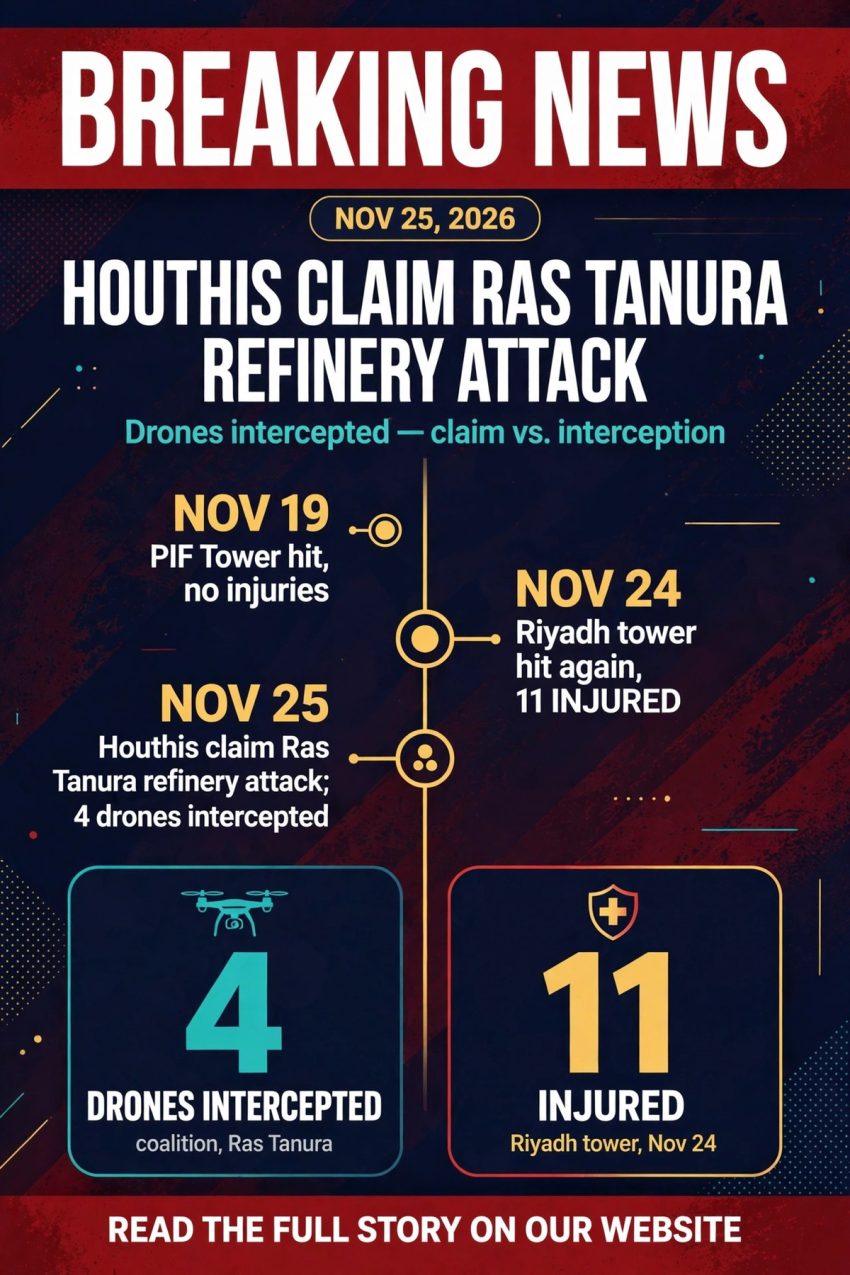
The Houthi attack Ras Tanura refinery claim landed on Wednesday, with Yemen’s Houthis saying they had struck Saudi Arabia’s largest oil refinery and Riyadh’s financial district — a sharp widening of a confrontation that, a day earlier, was still centred on one tower in the Saudi capital.
Houthi military spokesman Yahya Saree said the refinery attack caused fires and that the group had attacked Riyadh’s financial district in three phases, Reuters reported. The Saudi-led coalition said earlier on Wednesday that air defences had intercepted and destroyed four drones in Ras Tanura in Saudi Arabia’s Eastern Province.
Ras Tanura, Saudi Arabia’s largest refinery, is part of a complex on the kingdom’s Gulf coast that also serves as a major export terminal for Saudi crude. No damage to the refinery has been independently confirmed: the coalition says the drones were destroyed in the air, while Saree claims fires were caused. That gap — claim versus interception — is the central unresolved fact of the story.
Houthi Attack Ras Tanura Refinery: What Is Verified
What is verified so far is narrow, and the post must keep it that way. The Houthis claimed the attacks on Wednesday through their military spokesman. The coalition confirmed that drones were intercepted over Ras Tanura, putting the number at four. Al Jazeera’s live blog also recorded four drones at Ras Tanura, while other reports put the figure at two — so the exact count is not settled. No injuries were reported from the Ras Tanura interception, with debris falling after the drones were destroyed.
The Houthi attack Ras Tanura refinery claim is the first time in this escalation cycle that the group has said it targeted Saudi oil infrastructure directly. Until now, the week’s targets were a tower in Riyadh and, in the Houthis’ threats, Saudi Red Sea ports. A refinery and export terminal is a different category of target — the core of Saudi Arabia’s oil economy.
The second new fact in Saree’s statement matters just as much: the Houthis have now claimed the Riyadh financial district attack. Until Wednesday, they had not publicly claimed Tuesday’s strike on the tower in Riyadh’s King Abdullah Financial District, even though Saudi authorities attributed it to them. The claim closes the attribution gap in our earlier reporting — while still leaving the details (which phases, which weapons) unverified.
The Riyadh Tower Strike, One Day On
Saudi Civil Defence said 11 people were wounded on Tuesday in the strike on a tower in Riyadh’s financial district. It was the second strike on the same tower in less than a week: the first, on November 19, damaged the building but caused no injuries. Three witnesses told AFP the November 24 strike hit the 385-metre Public Investment Fund tower, Riyadh’s tallest skyscraper and the headquarters of the Saudi sovereign wealth fund.
Houthi drone struck Riyadh’s tallest tower on Tuesday, injuring 11.
The Houthi attack Ras Tanura refinery claim now sits alongside that Riyadh strike as part of a single Houthi claim of a multi-phase operation — Saree’s “three phases” language suggests the group presents the November 19 tower hit, the November 24 tower hit and the Ras Tanura attempt as one campaign, not three separate incidents. That framing is the Houthis’ own; it is not independently verified.
The Retaliation Cycle So Far
The coalition answered Tuesday’s Riyadh strike by hitting Yemen overnight. The Saudi coalition strikes Hodeidah port after ordering civilians to evacuate, and said it destroyed targets in the Yemeni governorates of Saada and Amran. The Houthis answered that with a threat to strike Jeddah and every other Saudi port on the Red Sea coast — and then, on Wednesday, with the Ras Tanura claim.
The escalation comes amid disputed Hormuz mine claims across the region.
The pattern of the past week is now unmistakable: a strike on Riyadh, a coalition answer in Yemen, a Houthi threat against Saudi ports, and now a claimed attack on Saudi oil infrastructure. Each round has hit a more strategic target than the last.
Whether the Ras Tanura claim is a real escalation or a propaganda claim built on intercepted drones is the question that decides what happens next. If the refinery was actually hit and damaged, oil markets and the coalition’s response will both move fast. If the drones were all destroyed, as the coalition says, the claim still matters — it shows the Houthis are now willing to threaten the kingdom’s oil lifeline in public.
What Happens Next
Three things to watch. First, any independent evidence of damage from the Houthi attack Ras Tanura refinery claim — satellite imagery, Aramco statements, or shipping data from the export terminal. Second, whether the Houthis follow through on the Jeddah threat, which remains a threat, not an action: no strike on Jeddah or any other Saudi port had been confirmed as of Wednesday afternoon. And third, the coalition’s next move — whether it answers the Ras Tanura claim with another round of strikes in Yemen, as it did after Riyadh.
This poll is not a scientific survey — it reflects the views of our readers only.