
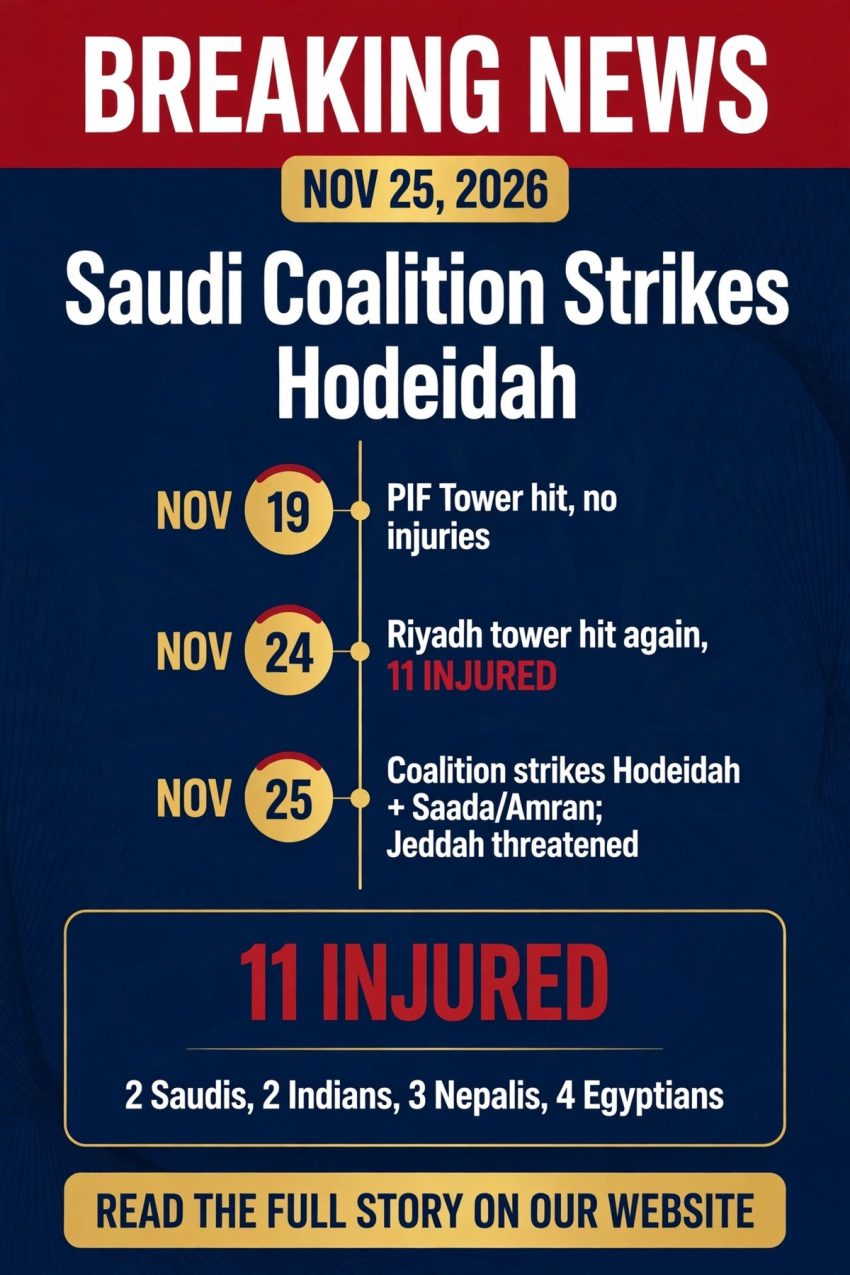
The Saudi coalition strikes Hodeidah overnight, hitting Yemen’s main Red Sea port hours after ordering civilians to evacuate — the “firm response” Riyadh promised after a Houthi drone struck Riyadh’s tallest tower on Tuesday, injuring 11.
The coalition said on Wednesday that its forces targeted operational capabilities at Hodeidah and destroyed a number of targets in the Yemeni governorates of Saada and Amran, Reuters reported. The strikes came after the Houthis threatened to hit Jeddah and every other Saudi port on the Red Sea coast if the coalition attacked Hodeidah.
No casualty or damage figures for the overnight strikes had been released as of Wednesday morning.
Saudi Coalition Strikes Hodeidah: What Happened Overnight
The sequence unfolded fast. On Tuesday, coalition spokesman Maj. Gen. Turki al-Maliki posted an evacuation order on X, asking civilians to leave the port of Hodeidah “for their safety” and sharing a map marking the zone in red. A Saudi Press Agency dispatch dated 1:36 a.m. Saudi time on Wednesday confirmed the renewed evacuation warning.
The Houthis’ Saba news agency reported a coalition attack on Hodeidah port shortly after the order. The coalition then confirmed the operation in a statement on Wednesday, saying it had targeted operational capabilities at the port and destroyed targets in Saada and Amran. The Saudi coalition strikes Hodeidah for the second time in five days, after a similar operation on November 20.
The coalition also reported intercepting and destroying two drones in Saudi Arabia’s Eastern Province on Tuesday.
Hodeidah is the main port through which food and other essential supplies enter Houthi-controlled northern Yemen, and the United Nations has said it carries about 70 percent of Yemen’s commercial imports. That makes any strike on the port a high-stakes move — and a direct answer to the attack on Riyadh.
Why the Coalition Struck Now: The Riyadh Tower Attack
The trigger was Tuesday’s drone strike on a tower in Riyadh’s King Abdullah Financial District. Saudi Civil Defence said 11 people were injured: two Saudis, two Indians, three Nepalis and four Egyptians. Three witnesses told AFP the strike hit the 385-metre Public Investment Fund tower, Riyadh’s tallest skyscraper and the headquarters of the Saudi sovereign wealth fund. Saudi authorities attributed the attack to the Houthis.
It was the second strike on the same tower in under a week. On November 19, an attack damaged at least five floors of the PIF Tower, with no casualties. The Houthis claimed that November 19 strike; their claim status for Tuesday’s strike was not confirmed in early reporting.
Coalition spokesman al-Maliki called Tuesday’s attack a “cowardly terrorist attack” and said the deliberate targeting of civilians and civilian objects “will be met with a firm response.” The Saudi coalition strikes Hodeidah hours after that vow, turning the promise into action.
Jeddah Threatened as the War Widens
The Houthis answered the evacuation order with a threat of their own. Military spokesman Yahya Saree said Jeddah port and all Saudi ports along the Red Sea coast would become targets if the coalition attacked Hodeidah, and urged port workers, residents and shipping companies to evacuate Saudi Red Sea ports and move their vessels away.
The exchange marks a further escalation in a confrontation that has increasingly targeted strategic infrastructure on both sides. The Houthis have stepped up strikes on Saudi airports, ports and oil facilities, while Saudi Arabia has ramped up airstrikes on Houthi targets in Yemen, Reuters reported. The US State Department issued a security alert for citizens in the Middle East on Tuesday, citing Iranian threats to US assets in the Gulf and Houthi hostilities against Saudi Arabia.
This is not the first time Hodeidah has been hit. On November 20, the coalition struck the port after a similar evacuation order, in what an Al Jazeera correspondent called the heaviest strikes since the conflict began. The Houthis threatened Jeddah then, too. Yemen’s information minister said after that operation that the port remained fully operational and the flow of goods would continue. No such assessment has yet been given for the overnight strikes.
The fighting has spread across Yemen, including the Lahj airstrike that killed 26 people in southern Yemen.
The United Kingdom imposed sanctions on the Houthi group and four of its officials on Tuesday, citing attacks on Saudi Arabia and disruption of shipping through the Bab el-Mandeb Strait.
What Happens Next
Three questions now decide how far this escalation goes. First, whether the Houthis follow through on the Jeddah threat — no strike on Jeddah or any other Saudi port had been confirmed as of Wednesday morning. Second, whether the overnight strikes damaged Hodeidah’s ability to receive food and aid, which would deepen Yemen’s humanitarian crisis. And third, whether the Saudi coalition strikes Hodeidah again — or widens the campaign to Sanaa and other Houthi-held areas.
The pattern of the past week — a strike on Riyadh, a coalition answer in Yemen, a Houthi threat against Saudi ports — has repeated twice now. Each round has hit harder than the last.
The escalation comes amid tensions across the region, including the disputed Hormuz mine claims.
This poll is not a scientific survey — it reflects the views of our readers only.
3 thoughts on “Saudi Coalition Strikes Hodeidah After Riyadh Tower Attack Injures 11”