
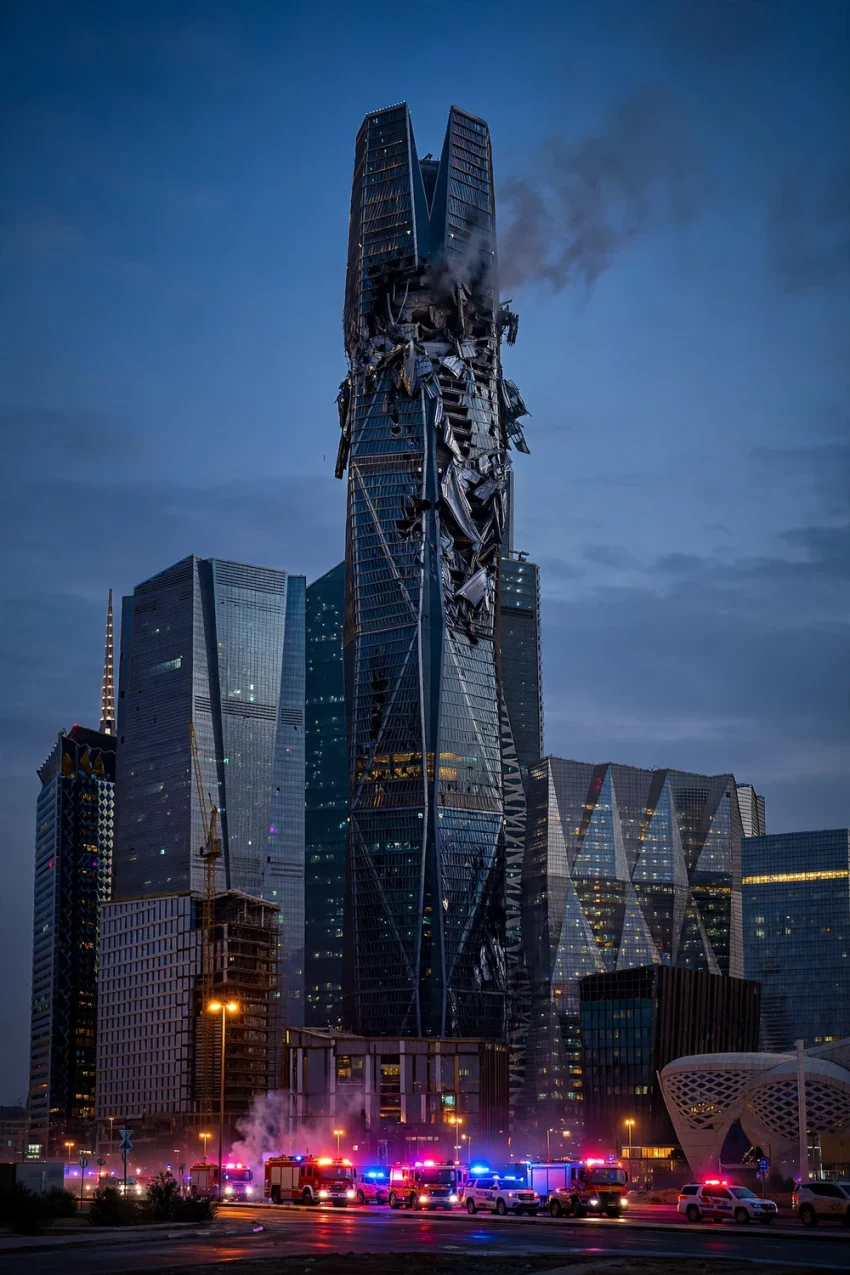
A Houthi missile strike Riyadh faced in the early hours of Thursday, 19 November 2026, damaged the PIF Tower — the tallest building in the Saudi capital’s King Abdullah Financial District — in the second strike on the district in 11 days. No casualties have been reported.
Saudi Civil Defence sent a mobile alert to residents at around 04:42 Riyadh time, warning of a missile threat. A loud explosion was heard minutes later, followed by an all-clear message. By dawn, the scale of the damage was visible: windows blown out across seven to eight floors of the 80-storey tower, with parts of its metal facade bent out of shape. Entrances to the financial district were closed, people were evacuated from the area, and ambulances and fire trucks were at the scene.
Houthi Missile Strike Riyadh: What We Know So Far
The Saudi-led coalition said its forces “dealt with a missile threat launched by the terrorist Houthi militia towards Riyadh”, according to a statement from coalition spokesman Major General Turki al-Malki posted on X. The coalition’s initial assessment was that falling debris caused material damage to the tower, with the full extent still being determined.
The coalition also said it had intercepted and destroyed four ballistic missiles heading towards the southern region of the kingdom, destroyed launch platforms in the Houthi-held provinces of Dhamar and Saada, and intercepted two Houthi drones over Riyadh and the south.
The Houthis claimed responsibility for the attack. Their military spokesman, Yahya Saree, said on X that the group had targeted Riyadh’s international airport and the financial district with cruise missiles, as well as the southern cities of Khamis Mushait and Abha.
The two accounts differ in an important respect. The Houthi claim that they struck the tower itself has not been independently verified, and the coalition attributes the damage to the PIF Tower to falling debris rather than a direct hit. Reuters reported the damage to the tower and the coalition’s account of the incident
The PIF Tower: What Was Damaged
The PIF Tower stands 385 metres tall, with 80 storeys, making it the tallest building in the King Abdullah Financial District (KAFD). It is the headquarters of Saudi Arabia’s Public Investment Fund — the kingdom’s sovereign wealth fund, with more than $900 billion in assets, chaired by Crown Prince Mohammed bin Salman.
Witnesses described the scale of the damage to the tower’s upper floors. KAFD entrances were closed as emergency services responded, and people were evacuated from the area. No casualties have been reported.
The tower is one of the most recognisable symbols of the Crown Prince’s economic transformation programme, and the financial district houses the offices of major Saudi and international companies. An attack that reaches the heart of the district carries weight far beyond the physical damage.
Second Strike on Riyadh’s Financial District in 11 Days
This is the second strike on Riyadh’s financial district in 11 days. On 8 November, a building belonging to state oil giant Aramco was hit in the same district. The repeated targeting of the capital’s financial centre marks a clear escalation in the Houthis’ campaign against Saudi Arabia.
The Houthis have been intensifying attacks on Saudi airports and oil infrastructure since Yemen’s war resumed, and Reuters has reported that Saudi officials expect the campaign to continue for up to six months. Saudi airstrikes on Houthi-controlled Sanaa were also reported early on Thursday by the Houthi-run Saba news agency, although no details were given.
The escalation comes against a backdrop of rising regional tension. The Houthi missile strike Riyadh endured on Thursday follows weeks of renewed fighting in Yemen, and it underlines how quickly the conflict is spilling beyond Yemen’s borders. For a fuller picture of the region’s shifting conflicts, read our coverage of Israel’s ground operation crossing the ceasefire line in central Gaza — and the third strike on the Crimea Bridge — another attack on a symbol of national power.
Timeline: Thursday Morning in Riyadh
- Around 04:42 Riyadh time: Saudi Civil Defence sends a mobile alert warning residents of a missile threat.
- Minutes later: A loud explosion is heard over the capital.
- Shortly afterwards: An all-clear message is issued to residents.
- Early morning: Damage to the PIF Tower becomes visible — windows blown out across seven to eight floors, parts of the metal facade bent.
- Morning: KAFD entrances closed, evacuations under way, ambulances and fire trucks at the scene.
- Thursday: Crown Prince Mohammed bin Salman meets US CENTCOM chief Admiral Brad Cooper in Riyadh to discuss military ties and regional developments.
What Happens Next
The key question now is whether the Houthis can sustain this tempo of attacks on the Saudi capital — and how Riyadh responds. The coalition has already answered with strikes on launch platforms in Dhamar and Saada and airstrikes on Sanaa, and Saudi officials expect the campaign to continue for up to six months.
The timing is significant. The Crown Prince’s meeting with Admiral Cooper on Thursday to discuss military ties and regional developments puts the attack at the centre of US-Saudi security talks. Whether the response is military, diplomatic or both will shape the next phase of a war that has already spilled well beyond Yemen.
Diplomacy elsewhere in the region continues in parallel — the leaders of the United States, China and Russia signed a historic peace declaration in Shenzhen — but the renewed fighting in Yemen shows how fragile that wider picture remains.
For now, the immediate facts are clear: Riyadh’s tallest tower is damaged, no one was reported hurt, and the financial district has been hit for the second time in 11 days. What happens next depends on whether the Houthis press on with their campaign — and on what Riyadh and its allies decide to do about it.
Do you think the Houthi attacks on Saudi Arabia will escalate further in the coming weeks?
- YES
- NO
- NOT SURE
This is not a scientific survey.
Sources:
- Reuters (via SRN): Houthi missile threat towards Riyadh causes damage, Saudi-led coalition says
- TBS / Reuters: Riyadh’s tallest skyscraper hit in Houthi strike, Saudi wealth fund HQ
- The National (syndicated): Saudi PIF Tower damaged in Riyadh strike
- Saudi-led coalition statement (Maj Gen Turki al-Malki, X); Houthi military spokesman Yahya Saree (X); Houthi-run Saba news agency
2 thoughts on “Houthi Missile Strike Riyadh: PIF Tower Damaged in Second Attack on Financial District”