
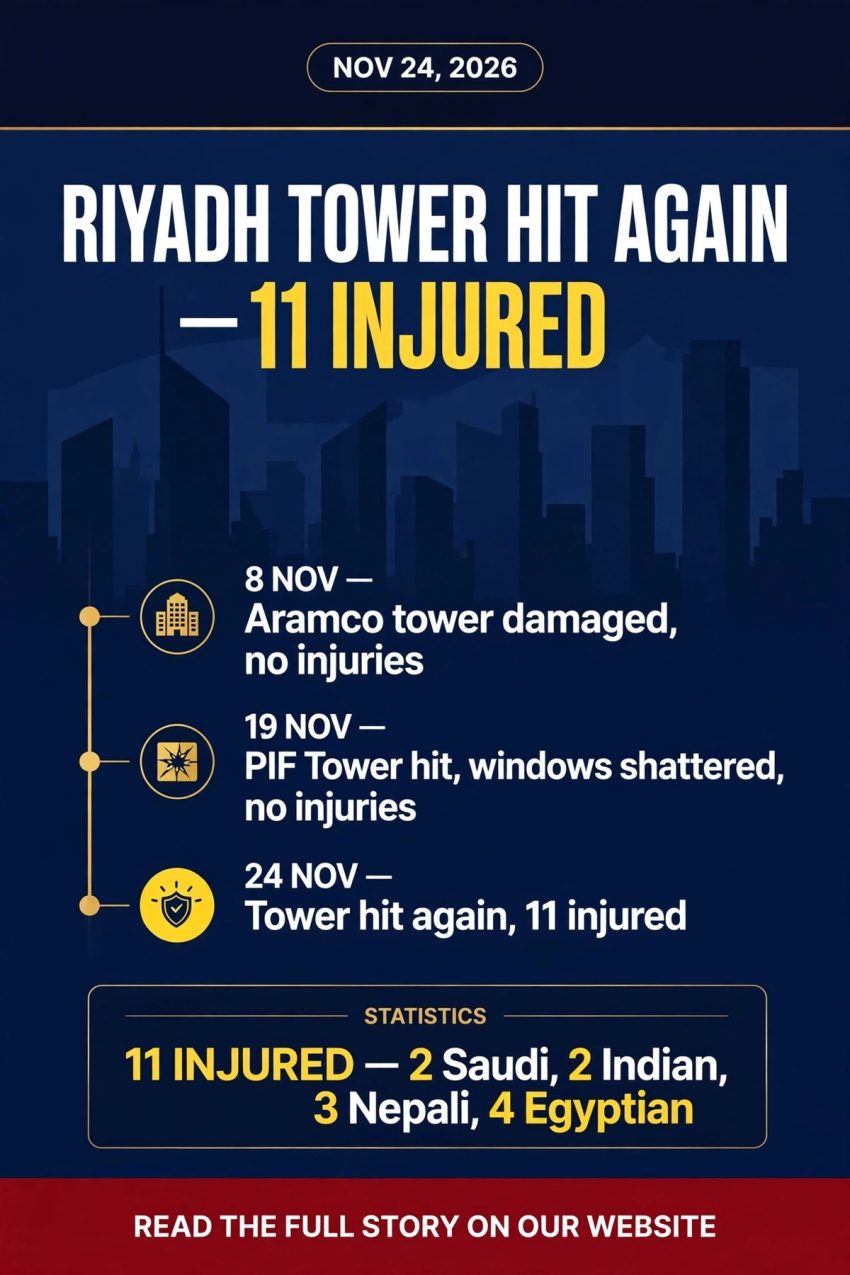
The Houthi drone attack Riyadh suffered on Tuesday, 24 November 2026, injured at least 11 people when a drone struck a tower in the Saudi capital’s King Abdullah Financial District, according to Saudi authorities and the Saudi-led coalition in Yemen. It was the second attack on the district in less than a week — and the first to cause injuries.
Saudi Civil Defence said the 11 injured included two Saudi citizens, two Indian nationals, three Nepali nationals and four Egyptian nationals. The Indian Embassy confirmed that two Indian nationals were among the injured and said it would extend all possible assistance to them and their families.
The Saudi-led coalition said the attack was carried out by a drone and vowed a firm response. “The deliberate targeting of civilians and civilian objects by the [Houthis] will be met with a firm response,” coalition spokesman Major General Turki al-Maliki said, calling the strike a “cowardly terrorist attack”.
What we know about the Houthi drone attack Riyadh
The Houthi drone attack Riyadh suffered on Tuesday struck one of the towers in the King Abdullah Financial District (KAFD), the capital’s showcase financial quarter and home to banks, investment firms and the Saudi stock exchange. The coalition said authorities were conducting an on-site investigation, and emergency services responded immediately to protect civilian lives and property.
Saudi Civil Defence posted a photograph of the tower that houses the headquarters of the Public Investment Fund, the kingdom’s sovereign wealth fund and the country’s tallest skyscraper. The image showed damage about halfway up the facade — similar to the damage from the strike on the same tower five days earlier.
Three witnesses told the AFP news agency that the projectile struck the 385-metre PIF Tower, Riyadh’s tallest building. A fourth witness told AFP that a vehicle fitted with a speaker had warned pedestrians to take cover. Notably, no phone warning was sent about threats to the capital, as had happened during recent strikes.
The injured were a mix of Saudi citizens and foreign residents — a reminder that the district’s workforce is heavily international. The authorities have not disclosed the severity of the injuries.
What is still unclear
Two important questions remain unanswered, and the distinction matters.
First, Saudi authorities have not officially confirmed which building was hit. The coalition’s statement referred only to “one of the towers” in the financial district. The identification of the PIF Tower as the building struck rests on witness accounts reported by AFP and Reuters, and on the Civil Defence photograph — not on an official Saudi statement naming the building.
Second, attribution. Saudi authorities and the Saudi-led coalition attribute the attack to Yemen’s Houthi group, and the coalition says a drone was used. But the Houthis had not publicly claimed the 24 November attack by Tuesday evening — a sharp contrast with the previous strike on the same tower, which they claimed openly. Until the group claims it or evidence is published, the Houthi link for 24 November rests on the Saudi account, and this report presents it that way.
The exact time of the strike has not been confirmed in public reporting, and the weapon type is described differently in different accounts: the coalition says a drone, while some witness-based reporting describes only an unspecified projectile.
A pattern, not an isolated strike
The 24 November attack was the second strike on Riyadh’s financial district in less than a week, and the third on the district this month.
On Thursday 19 November, a Houthi attack damaged the PIF Tower, blowing out windows across seven to eight floors and bending parts of its metal facade, according to Reuters. No one was injured, and the district was closed to visitors while people inside were evacuated. The Houthis claimed that attack: military spokesman Yahya Saree said the group had targeted the financial centre with cruise missiles and declared it a military target, urging employees and residents to stay away.
Eleven days earlier, on Sunday 8 November, Houthi missiles were fired at Riyadh and an administrative building belonging to Saudi Aramco in the financial district was damaged. Saudi Arabia’s Energy Ministry said falling shrapnel caused minor damage and no one was hurt — though witnesses told AFP and Reuters they had seen a projectile strike the building directly, and BBC Verify said footage showed more extensive damage than the ministry described.
The wider campaign has been running since Yemen’s frozen civil war reignited in July 2026, a knock-on from the US-Iran war. The Houthis, who control much of western Yemen including the capital Sanaa, have been firing at Saudi airports, oil infrastructure and office buildings. The escalation is spreading: the coalition ordered civilians to evacuate Hodeidah port on 24 November, and Nimda reported on 23 November that a Lahj airstrike left 26 people dead, with blame for the strike disputed. Tensions are also running high in the Strait of Hormuz, where mine claims involving five vessels remain unconfirmed, and in Washington, where President Trump has discussed resuming strikes on Iran.
What happens next
The coalition’s vow of a “firm response” points to retaliation, and the pattern of the past week suggests it could come quickly: after the 19 November strike, the coalition struck Houthi targets in Yemen within days. The 24 November evacuation order for Hodeidah port — a key Houthi-controlled Red Sea gateway — may be part of that response.
But the repeated strikes also raise harder questions for Riyadh. Three attacks have now reached the heart of the capital’s financial district in 17 days, despite Saudi air defences that the coalition says intercepted missiles on 8 November. Each strike tests confidence in the district at the centre of Crown Prince Mohammed bin Salman’s Vision 2030 plans.
The diplomatic fallout was immediate. The Gulf Cooperation Council’s Secretary-General, Jasem Mohamed AlBudaiwi, called the attack “treacherous” and a “heinous crime”. Qatar called it “a flagrant violation of Saudi sovereignty”, Kuwait warned of a “dangerous escalation”, and the US, the UAE, Lebanon and Pakistan also condemned the strike. US Secretary of State Marco Rubio spoke to Saudi Foreign Minister Prince Faisal bin Farhan Al Saud, condemning what he called “Iran-backed Houthi terrorist attacks on Saudi civilian and energy infrastructure”.
The practical cost is already visible: most international flights to Riyadh have been cancelled and Saudi Arabia has postponed or cancelled major events, including football’s AFC Asian Cup. If the Houthi drone attack Riyadh suffered becomes a weekly event rather than a one-off, the question for investors, airlines and the thousands of foreign workers in the district will be whether the financial capital can be kept safe — and what a “firm response” actually deters.
For now, the confirmed facts of the Houthi drone attack Riyadh are these: 11 people injured, a tower damaged, a coalition promising retaliation, and a group that has not claimed the attack. What happens next depends on whether that retaliation stops the strikes — or invites the next one.
This poll is not a scientific survey.
Sources: Al Jazeera, 24 Nov 2026 · Reuters, 24 Nov 2026 · QNA via Fana News, 24 Nov 2026
4 thoughts on “Houthi Drone Attack Riyadh: 11 Injured in Tower Strike”