
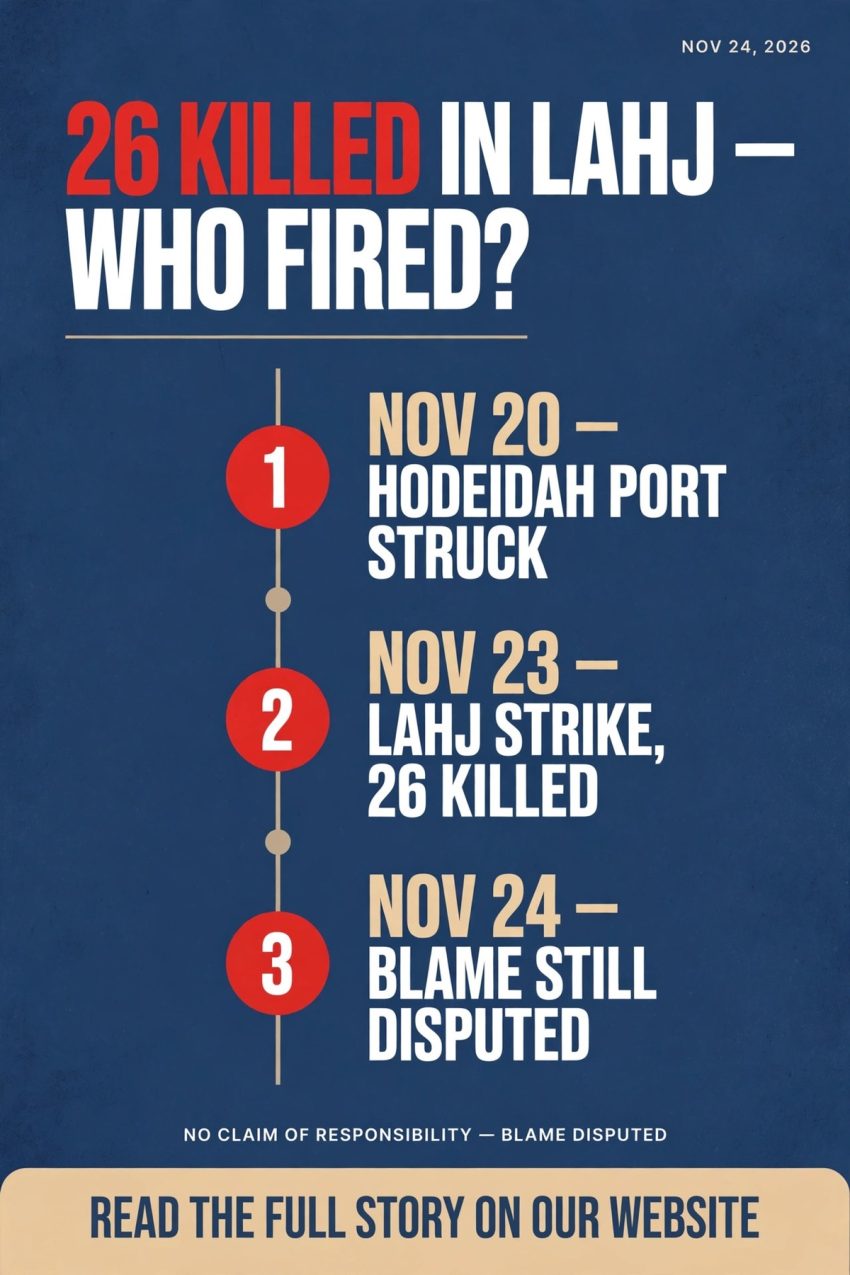
An airstrike on buses and trucks in south-western Yemen killed 26 people on Monday 23 November, local officials told the AFP news agency — but nobody agrees on who fired it. The Yemen Lahj airstrike hit vehicles in Wadi Maabaq, in Lahj province, where Houthi forces have advanced in recent weeks towards Aden, the government’s interim capital. Twelve of the dead were Houthi fighters and 14 were civilians, according to the officials. The Houthis say Saudi warplanes did it. The Yemeni government says Houthi shelling did it. Saudi Arabia has said nothing at all.
That unresolved blame is the story. In a war where the facts of a single strike cannot be established, the claims around it — and what each side threatens to do next — matter more than the strike itself.
Yemen Lahj airstrike: two accounts, no independent verification
The strike hit at a moment when a truck and a bus were passing two Houthi vehicles on a frontline road, one official told AFP. The Houthis’ military spokesman, Yahya Saree, said Saudi F-15SA jets carried out the attack, giving precise details: he said the aircraft left King Khalid Air Base near Khamis Mushait at 11:36 a.m. local time and left Yemeni airspace at 12:55 p.m., striking passenger buses and cargo trucks with what he identified as US-made GBU-49 and GBU-12 laser-guided bombs. The Houthi-run Saba news agency put the toll at 25 dead or missing and six wounded, and said circling aircraft were blocking rescue efforts. Residents told Saba that remains in one bus were badly burned.
Local authorities in Lahj, aligned with Yemen’s internationally recognised government, gave a different account: they blamed Houthi forces for the shelling. A Xinhua report citing a local government-aligned official initially put the toll far lower, at six travellers killed. AFP, the first international wire to carry the story, said it could not independently verify either account and noted the Saudi-led coalition had not commented.
The casualty figures are therefore contested as well as the attribution. The most complete figure available is the one from local officials speaking to AFP: 26 killed, 12 fighters and 14 civilians. Saba’s figure of 25 dead or missing and six wounded is close, but it does not separate the confirmed dead from the missing. Neither figure has been independently verified, and no outside organisation has been able to reach the site. This post reports both figures with their sources rather than choosing between them.
“Will not go unanswered”: the Houthi vow
Saree vowed the attack “will not go unanswered”. The threat is not new — it is the Houthis’ standard response to strikes they attribute to the coalition — but it lands in a week when the group has already widened its threats considerably. Since the July 2026 collapse of the truce between the Houthis and the Saudi-backed government, the Houthis have adopted what Saree calls a “blockade for blockade” strategy, and their warnings have already moved insurers and airlines away from Jeddah without a single confirmed strike on the port city.
Hodeidah: the port at the centre of the threats
The Lahj strike came on the same day as separate strikes that killed 17 people and destroyed several buildings in the coastal province of Hodeida, according to the Houthis’ telecommunications ministry. The day before, coalition aircraft struck multiple targets across Hodeidah that the Houthis said served civilian purposes. Hodeidah is the main port bringing food and other supplies into Houthi-controlled northern Yemen, which makes it both a military target and a humanitarian lifeline.
The port was already the focus of the week’s sharpest exchange. On Friday 20 November, the Saudi-led coalition struck Hodeidah port to destroy what it said were operational capabilities used for smuggling and transporting weapons and ballistic missiles. Before the strike, the coalition had warned civilians to evacuate the area and published a map defining the zone to be cleared. Yemen’s information minister said afterwards that the port remained fully operational and the flow of goods would continue.
The Houthis answered within hours. Saree declared that Jeddah port and all Saudi ports on the Red Sea coast would be targets if the coalition carried out its threat against Hodeidah, told employees and workers at the ports to evacuate immediately, and urged shipping companies to remove their vessels. He also warned airlines to avoid Saudi airspace, exempting only the airspace over the holy cities of Mecca and Medina, and named the Shuqaiq power station in southern Saudi Arabia as a target. As of 24 November, no confirmed strike had hit Jeddah or any other Saudi commercial port, and civil aviation regulators had announced no formal airspace closures. The threats, for now, are threats.
A war that has already widened
The Lahj strike is one incident in a conflict that has escalated sharply since July, when the truce unravelled and Yemen was drawn into the wider US–Iran confrontation. The United Nations toll since July stands at more than 1,600 people killed and over 300,000 displaced, and October 2026 was the worst month for civilian deaths since 2017. Houthi forces are now positioned about 60 kilometres from Aden, with renewed fighting reported around Tur al-Baha as Saudi-backed forces reinforce defensive positions around the city.
The exchange with Saudi Arabia has run in both directions for days. On 20 November, the day after the Houthis struck the PIF Tower in Riyadh’s financial district, the coalition hit Hodeidah. On 21 November the coalition intercepted three ballistic missiles targeting Riyadh, and on 22 November another missile targeting western Saudi Arabia was intercepted, prompting an early-warning alert in Mecca Province. On 24 November the coalition said one of the towers in Riyadh’s financial district had been targeted in what it called a “cowardly terrorist attack”, the third attack on the district in less than three weeks.
Britain added a diplomatic step on 24 November, announcing sanctions on the Houthi movement and four of its officials, including the Sanaa interior minister and the intelligence chief. The group is already heavily sanctioned by the United States and others, so the practical effect is limited — but the timing, in the middle of the escalation, is the point. Separately, the news agency Semafor reported, citing unnamed sources, that Saudi Arabia has asked allies including the United States, Britain and France to help restock interceptor missiles. That report is unverified, and it is presented here as a report, not a fact.
What to watch next
Three things would change this story. A Saudi acknowledgement — or a denial — of the Lahj strike would settle the attribution question that neither side’s claim can settle alone. A Houthi retaliatory strike on Saudi territory, of the kind Saree has promised, would turn the threat into an event. And any confirmed strike on Jeddah port or another Saudi Red Sea port would mark a major escalation, since the Houthis have so far threatened those ports without hitting them. Until one of those happens, the Lahj strike stands as it is: 26 people dead on a frontline road, and two sides blaming each other while Saudi Arabia stays silent.
This poll is not scientific — it reflects the views of readers who choose to vote.
Related coverage
- Houthi missile strike on Riyadh PIF Tower
- Trump resumes Iran strikes
- Israel Gaza ground operation in central Gaza
2 thoughts on “Yemen Lahj Airstrike Kills 26 as Blame Game Grows”